Quick Facts
Quick Facts
The Communist Manifesto was published in 1848, a year of revolutions across Europe.
Marx and Engels were commissioned to write the manifesto by the Communist League, a secret society.
Marx later developed a more detailed theory in 'Das Kapital,' which he worked on for decades.
He distinguished between socialism (transitional) and communism (final goal).
He did not live to see a communist revolution. He died in 1883, 34 years before the Russian Revolution.
Visual answer
Marx's Vision of Communism
From capitalism to classless society.
Capitalism
Bourgeoisie (owners) vs. Proletariat (workers). Exploitation is built in.
Revolution
Inevitable. The workers will rise up and overthrow the bourgeoisie.
Dictatorship of the Proletariat
Temporary phase. Workers control the state. Use it to crush counterrevolutionaries.
Socialism
Transitional phase. Private property is abolished. The state still exists.
Communism
Final goal. Classless. Stateless. Moneyless. 'From each according to his ability, to each according to his needs.'
Story in brief
Story in Brief
1840s
Marx becomes involved with socialist and communist groups in Paris and Brussels.
He is developing his political identity.
1847
Marx and Engels join the Communist League, a secret society of German revolutionaries.
The league commissions them to write a manifesto.
1848
The Communist Manifesto is published. It ends with: 'Workers of the world, unite!'
Marxism is born. The manifesto is short, angry, and brilliant.
1867
The first volume of 'Das Kapital' is published. Marx spends the rest of his life trying to finish the remaining volumes.
This is his masterpiece. It provides the economic theory behind the manifesto.
1883
Marx dies. He never sees a communist revolution.
His ideas will be implemented by Lenin, Stalin, and Mao. He is not responsible for their excesses. But his ideas made them possible.
The Story
How a German Philosopher Became the World's Most Famous Communist
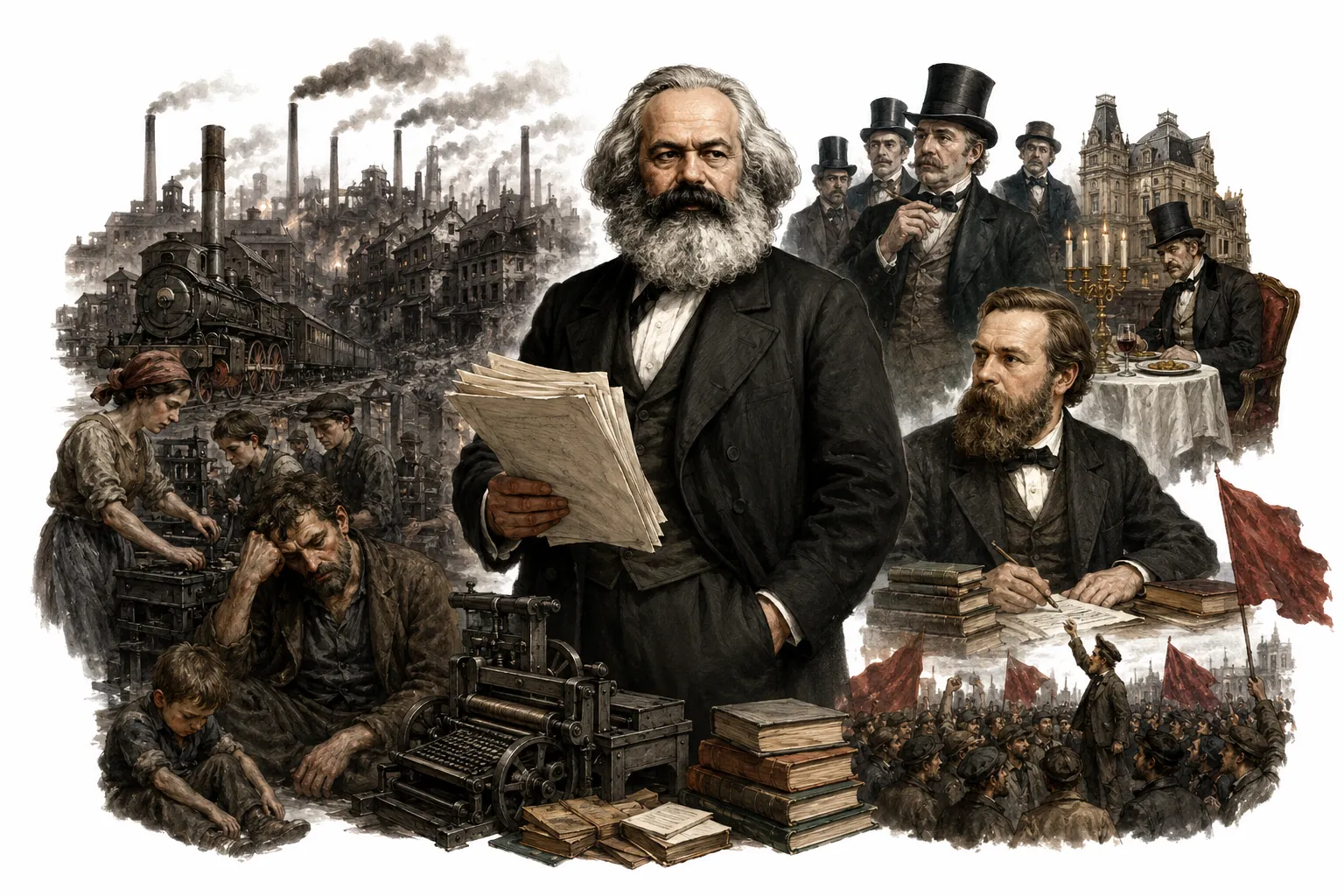
Karl Marx was a communist. He co-wrote 'The Communist Manifesto.' He developed the theory of communism in 'Das Kapital.' He spent his life arguing that capitalism would be overthrown and replaced by a classless society. He died believing that revolution was inevitable.
But Marx was not a communist in the way that Lenin or Stalin were communists. He was not a dictator. He did not run a country. He did not send people to gulags. He was a theorist. He wrote books. He gave speeches. He organized political groups. He was a revolutionary intellectual, not a revolutionary leader.
The distinction matters. Marx's communism was a vision. It was a critique of capitalism. It was a call to action. It was not a blueprint for a totalitarian state. That blueprint came later, from Lenin. Marx is not responsible for Stalin. But his ideas were the foundation on which Stalin built. The father is not guilty of the son's crimes. But the son would not exist without the father.
From the Communist Manifesto
"Workers of the world, unite! You have nothing to lose but your chains. You have a world to win."
, Karl Marx and Friedrich Engels, The Communist Manifesto
These are the last lines of the manifesto. They are a call to action. They are also a promise. The chains are capitalism. The world is communism.
Evidence
Was Marx a Communist?
He co-wrote the Communist Manifesto, which calls for communist revolution.
StrongHe described himself as a communist in his writings.
StrongHe was a member of the Communist League, a revolutionary organization.
StrongHe distinguished between socialism (transitional) and communism (final goal).
StrongHe never saw communism implemented. He died before the Russian Revolution.
ModerateKey Points
Key Points So Far
Marx co-wrote the Communist Manifesto and called himself a communist.
He developed the theory of communism in 'Das Kapital.'
He was a theorist, not a dictator. He never ran a country.
He distinguished between socialism (transitional) and communism (final goal).
He died before communism was implemented anywhere.
Analogy
Like a Father Who Invented a Recipe
The familiar part
Imagine a father who invents a recipe for a cake. The cake is delicious in theory. His son bakes it. The son burns the cake. The son adds poison. The cake kills people.
How it applies
Marx invented the recipe for communism. Stalin baked the cake. The cake was poison. The father is not guilty of the son's crimes. But the son would not have committed them without the father.
Where the analogy breaks
Recipes are not ideologies. Marx's ideas were not just a recipe. They were a call to action. He bears some responsibility for the actions of his followers.
Curiosity Notes
Details Most People Miss
Why this still matters
Why This Still Matters
Karl Marx was a communist. The label fits. But the label is also misleading. He was not a communist in the way that Stalin was. He was a theorist. He wrote books. He did not send people to labor camps. He is responsible for his ideas. He is not responsible for how they were used. The distinction is subtle. It is also crucial. Marx is not Stalin. Stalin is not Marx. But Stalin could not have existed without Marx.
Key Findings
- ✓Core findingMarx co-wrote the Communist Manifesto and called himself a communist.
- ✓Strong evidenceHe developed the theory of communism in 'Das Kapital.'
- ⚠Main consequenceHe distinguished between socialism (transitional) and communism (final goal).
- ✓Wider legacyHe was a theorist, not a dictator. He never ran a country.
- ★Bottom lineHe died before communism was implemented anywhere.
Final insight
A Last Thought
Was Karl Marx a communist? Yes. He invented the ideology. He gave it its name. He spent his life advocating for it. But he never saw it implemented. He died before Lenin, before Stalin, before Mao. He is not responsible for what they did. But his ideas made them possible. That is the burden of being a theorist. You do not control how your ideas are used. But you are judged by their consequences. Marx is judged by Stalin. It is not fair. But it is history.
Quick answers
Common questions
Is Marxism the same as communism? +
Marxism is the theory. Communism is the goal. Marxism is the name for Marx's ideas. Communism is the society he wanted to create.
Was Lenin a Marxist? +
Lenin claimed to be a Marxist. He adapted Marx's ideas to Russian conditions. Many Marxists (including some of Marx's followers) thought Lenin distorted the theory.