Quick Facts
Quick Facts
Marx was born into a Jewish family. His father converted to Lutheranism to avoid anti Semitic laws.
Marx was baptized as a child. He rejected religion as a young man.
His doctoral thesis was on ancient Greek philosophy, not religion.
He wrote 'On the Jewish Question' which criticized both Judaism and Christianity.
He thought that religion would disappear after communism solved material suffering.
Visual answer
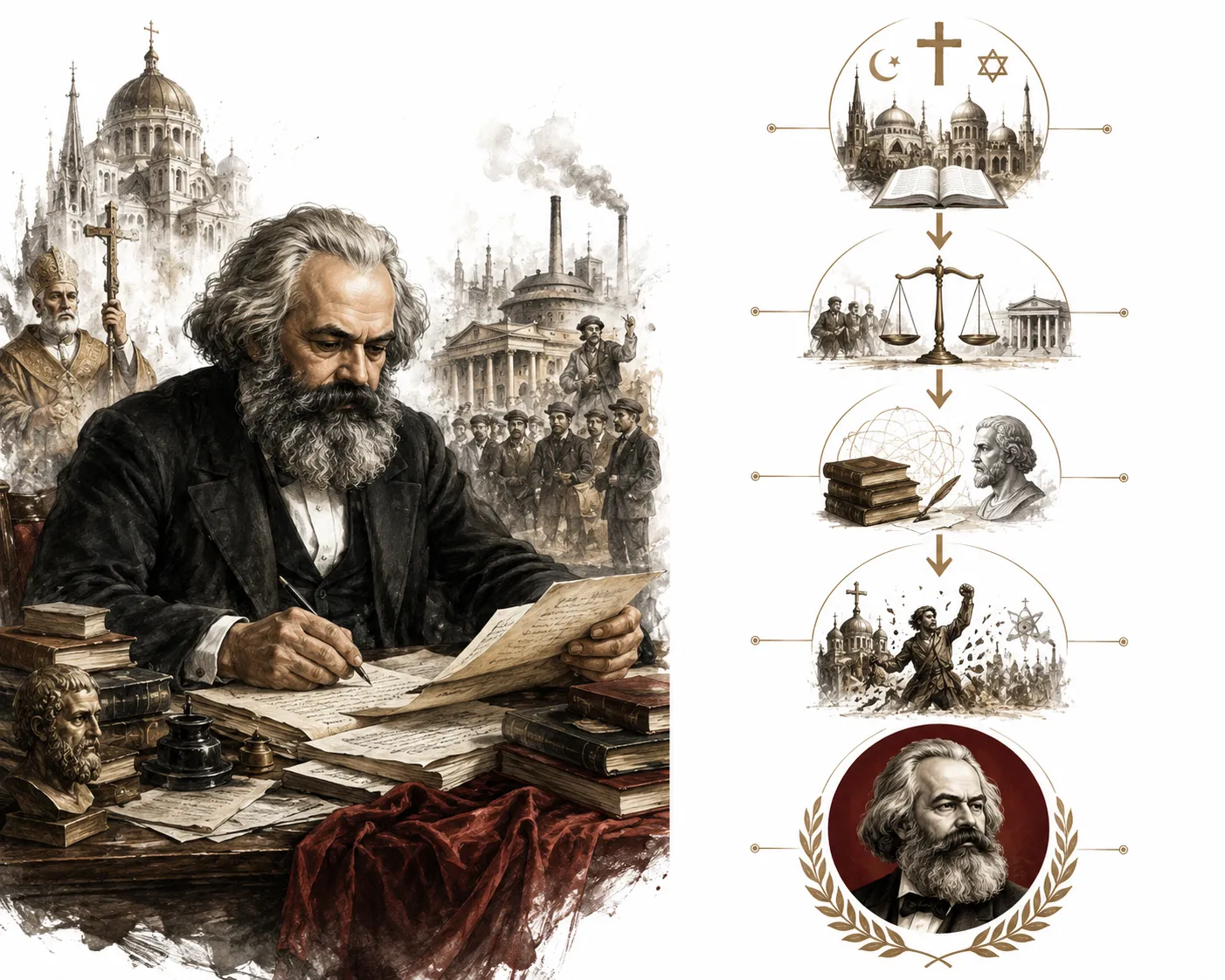
Marx's View of Religion
Why he called it the opium of the people.
The Problem
Workers are exploited. They suffer. They are miserable.
The Illusion
Religion promises a better life after death. It tells the poor to accept their suffering on Earth.
The Function
Religion dulls the pain. It prevents revolution. It is 'the sigh of the oppressed creature.'
The Solution
Abolish religion. Abolish capitalism. Create a just society on Earth. Then religion will die naturally.
Story in brief
Story in Brief
1818
Marx is born in Trier, Prussia. His family is Jewish. His father converts to Lutheranism the year before he is born.
Marx is baptized as a child. He grows up in a nominally Christian household.
1830s
Marx studies philosophy at university. He is influenced by the atheist philosopher Ludwig Feuerbach.
Feuerbach argued that God is a human projection. Marx agrees.
1844
Marx writes 'Introduction to a Critique of Hegel's Philosophy of Right.' He calls religion 'the opium of the people.'
The quote becomes famous. It captures his view perfectly.
1848
The Communist Manifesto is published. It dismisses religion as a 'bourgeois' institution.
Communism is explicitly atheist. There is no room for faith.
1883
Marx dies. He remains an atheist to the end. There is no deathbed conversion.
Unlike many intellectuals, he did not return to faith in old age. He stayed consistent.
The Story
Why Marx Rejected Religion
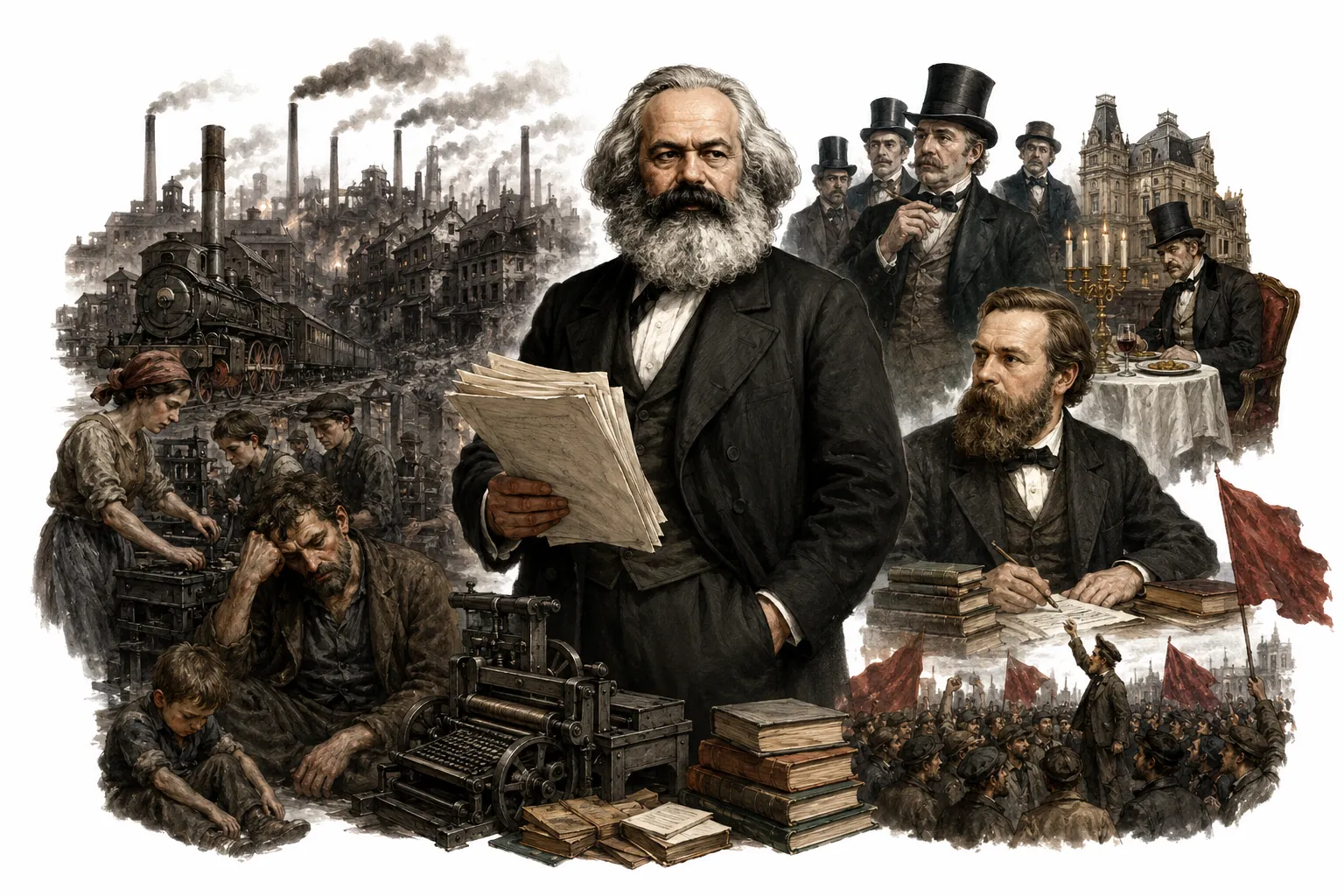
Karl Marx was not just an atheist. He was an anti-theist. He thought religion was harmful. He thought it was a lie. He thought it was a tool of the ruling class. He wanted it gone.
His most famous statement on religion is: 'It is the opium of the people.' The context is important. He meant that religion, like opium, dulls pain without curing the disease. The poor are suffering. Religion tells them that their suffering is virtuous. It promises a reward in heaven. It encourages submission. It discourages revolution.
Marx thought that communism would make religion unnecessary. When the material conditions of poverty and exploitation were eliminated, people would no longer need the illusion of a better world after death. They would have a better world on Earth. Religion would fade away.
He was wrong about that. The Soviet Union was officially atheist. It persecuted religious believers. But religion did not disappear. It went underground. It survived. It returned after the collapse of communism. Marx underestimated the human need for faith.
Famous Quote
"Religion is the sigh of the oppressed creature, the heart of a heartless world, and the soul of soulless conditions. It is the opium of the people."
, Karl Marx, Critique of Hegel's Philosophy of Right
The full quote is more nuanced than the famous snippet. Marx acknowledges that religion expresses genuine suffering. But he says it is a false solution.
Evidence
Why Marx Was an Atheist
He explicitly called religion an illusion and a form of false consciousness.
StrongHe argued that God is a human projection (influenced by Feuerbach).
StrongHe thought religion would disappear under communism.
StrongHe never practiced any religion as an adult.
StrongThere is no evidence of a deathbed conversion.
StrongKey Points
Key Points So Far
Marx was a lifelong atheist. He rejected all forms of religious belief.
He called religion 'the opium of the people,' meaning it dulls the pain of exploitation.
He thought religion was a human projection, not a divine reality.
He believed communism would make religion unnecessary.
He was wrong about that. Religion survived communism.
Analogy
Like a Painkiller That Prevents Healing
The familiar part
Imagine a painkiller that dulls the pain of a broken bone. The bone does not heal. The patient keeps taking painkillers. The bone gets worse.
How it applies
That is Marx's view of religion. It dulls the pain of exploitation. It prevents the patient (the working class) from seeking a real cure (revolution). The painkiller is not helping. It is making the problem worse.
Where the analogy breaks
Painkillers do not create the disease. Religion did not create capitalism. Marx thought it did. He was wrong.
Curiosity Notes
Details Most People Miss
Why this still matters
Why This Still Matters
Marx's atheism is still relevant because it is part of his larger critique of capitalism. He thought religion was a symptom of a sick society. Cure the society, and the religion would disappear. He was wrong about the disappearance. But he was right about the connection. Poverty and inequality drive people to faith. So does wealth and comfort. Religion is not going away. But Marx's question remains: what does it do? Does it comfort? Does it control? Does it liberate? The answer depends on who is using it.
Key Findings
- ✓Core findingMarx was a lifelong atheist. He rejected all forms of religious belief.
- ✓Strong evidenceHe called religion 'the opium of the people,' meaning it dulls the pain of exploitation.
- ⚠Main consequenceHe thought religion was a human projection, not a divine reality.
- ✓Wider legacyHe believed communism would make religion unnecessary.
- ★Bottom lineHe was wrong about that. Religion survived communism.
Final insight
A Last Thought
Karl Marx was an atheist. He was also an anti-theist. He thought religion was harmful. He wanted it gone. He was wrong about that. Religion did not disappear under communism. It survived. It thrived. It adapted. But his critique of religion as a tool of oppression is still relevant. Churches have blessed wars. They have blessed slavery. They have blessed exploitation. Marx was not wrong about that. He was just too confident that the cure would work. The cure killed millions. The disease is still here.
Quick answers
Common questions
Did Marx believe in God? +
No. He was an atheist. He thought God was a human invention.
What did Marx say about Judaism? +
He wrote a controversial essay, 'On the Jewish Question.' He argued that Jewish identity was tied to capitalism. The essay has been accused of anti Semitism. Scholars debate the charge.