Quick Facts
Quick Facts
Marx was a university student. He studied philosophy and law.
He became a journalist. His newspaper was shut down by the government.
He was exiled from Prussia, France, and Belgium before settling in London.
He spent most of his adult life in the British Library, writing 'Das Kapital.'
He never saw communism implemented. He died 34 years before the Russian Revolution.
Visual answer
The Path to Communism
How Marx thought history would unfold.
Feudalism
Lords and serfs. The old system.
Capitalism
Bosses and workers. Marx's present. Exploitation is built in.
Revolution
Inevitable, according to Marx. The workers will rise up.
Dictatorship of the Proletariat
Temporary phase. Workers control the state.
Communism
Classless, stateless, moneyless society. The end goal.
Story in brief
Story in Brief
1842
Marx becomes editor of a liberal newspaper in Cologne. He writes articles criticizing the government. The newspaper is shut down.
Marx realizes that writing is not enough. He needs a revolution.
1848
Marx and Friedrich Engels publish 'The Communist Manifesto.' The pamphlet ends with a famous call: 'Workers of the world, unite!'
Marxism is born. The manifesto is short, angry, and brilliant.
1849
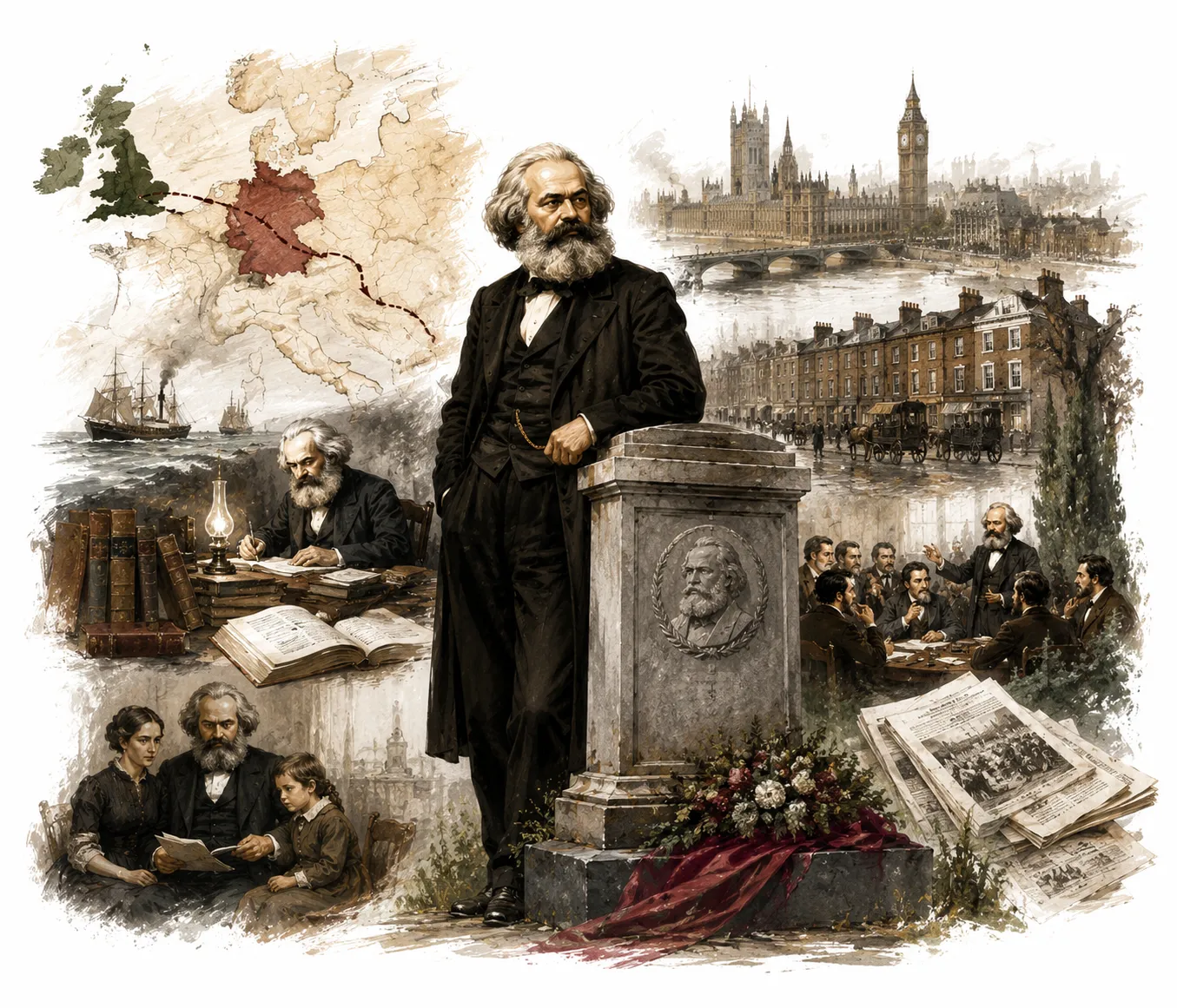
Marx is exiled from Prussia. He moves to London. He will live there for the rest of his life.
London gives him access to the British Library and a platform for his writing.
1867
Marx publishes the first volume of 'Das Kapital.' He spends the next 16 years trying to finish the remaining volumes.
This is his masterpiece. It is dense, difficult, and unfinished.
1883
Marx dies in London. He is 64 years old. He is buried in Highgate Cemetery.
He does not live to see the Russian Revolution. He does not see his ideas twisted into Stalinism.
The Story
Why a Broke Intellectual Wanted to Overthrow Capitalism
Karl Marx grew up in a comfortable middle class family. His father was a lawyer. He went to university. He could have become a professor. Instead, he became a revolutionary.
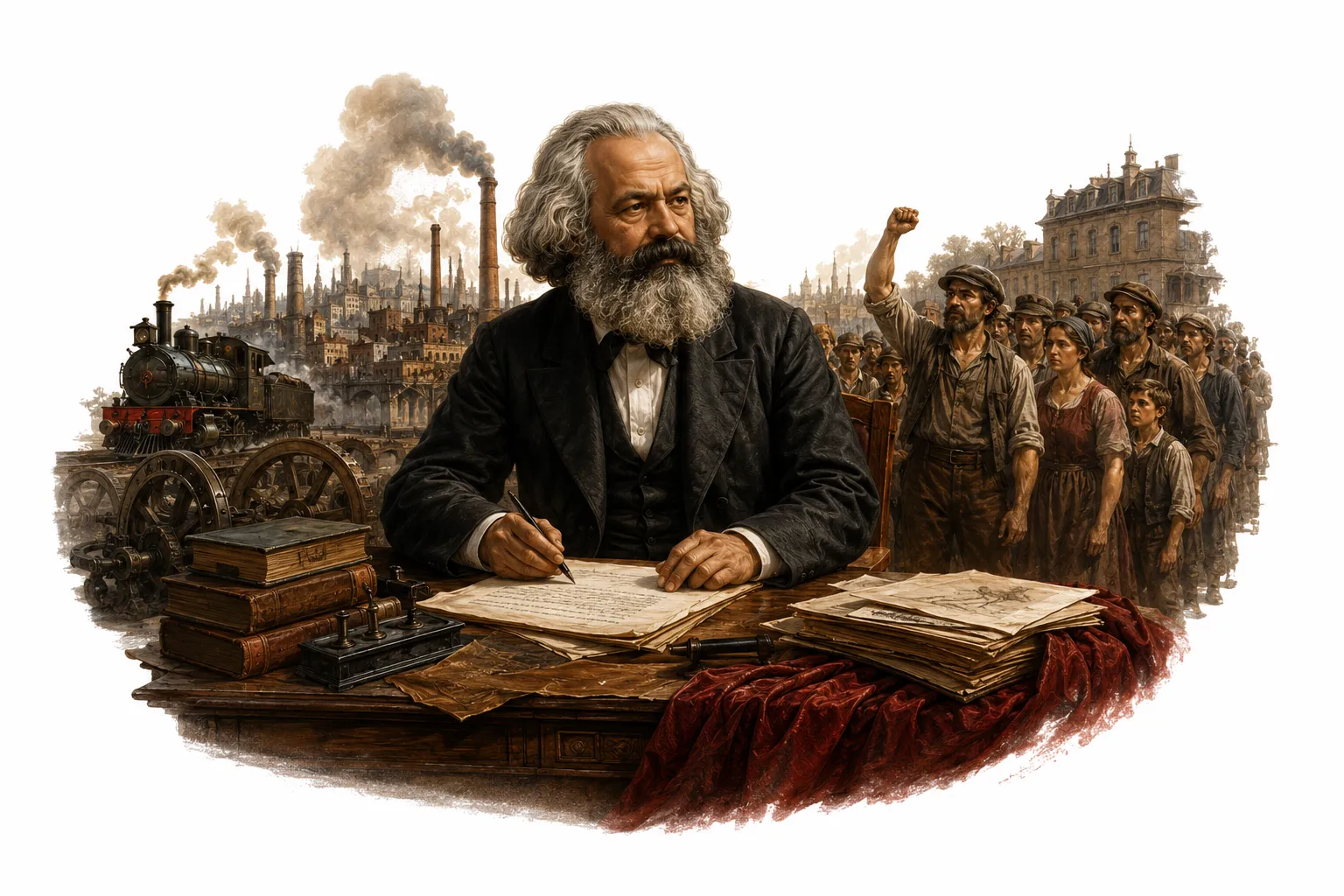
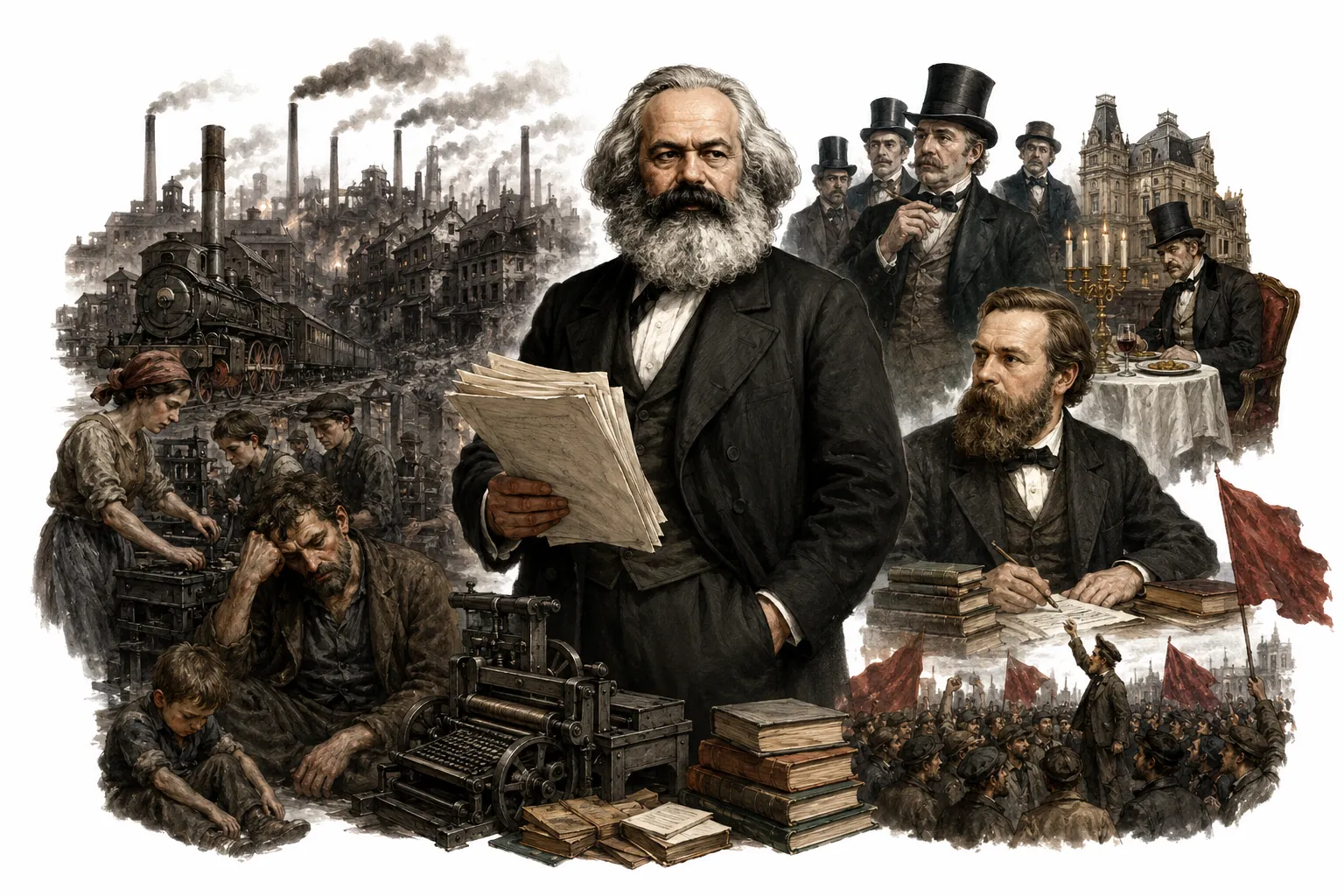
The reason was the Industrial Revolution. Marx saw factories where children worked 16 hours a day. He saw families evicted from their homes when landlords raised rents. He saw the rich getting richer and the poor getting poorer. He thought this was wrong. He thought it was inevitable under capitalism.
His solution was communism. In a communist society, there would be no private property. The workers would own the factories. There would be no bosses, no landlords, no exploitation. Everyone would work according to their ability and receive according to their needs.
It was a beautiful vision. It also ignored human nature. Marx thought that people would cooperate willingly. He did not anticipate that someone would need to force them. The people who tried to implement his ideas, from Lenin to Stalin to Mao, turned his vision into a nightmare. Marx is not responsible for Stalin. But he is also not blameless.
Famous Quote
"The philosophers have only interpreted the world, in various ways. The point, however, is to change it."
, Karl Marx, Theses on Feuerbach
This is the most famous line from Marx's early writings. It captures his activism. He did not want to think about the world. He wanted to remake it.
Evidence
Why Marx Created Communism
He witnessed extreme poverty and inequality during the Industrial Revolution.
StrongHe believed that capitalism was inherently unstable and would collapse.
StrongHe wanted a classless society without exploitation.
StrongHe was influenced by earlier socialist thinkers, including Fourier and Owen.
ModerateKey Points
Key Points So Far
Marx created communism as a response to the poverty and inequality of the Industrial Revolution.
He argued that capitalism exploits workers and is inherently unstable.
His solution was a classless, stateless society where workers own the means of production.
He published 'The Communist Manifesto' in 1848 and 'Das Kapital' in 1867.
He died before his ideas were implemented. He did not see the disasters of Stalinism.
Analogy
Like a Doctor Who Prescribes a Poison
The familiar part
Imagine a doctor who correctly diagnoses a disease: capitalism causes inequality and suffering. But the cure he prescribes, communism, is worse than the disease.
How it applies
That is Marx. He saw the problems of capitalism clearly. His solution was elegant on paper. In practice, it killed millions. The doctor was brilliant. The medicine was poison.
Where the analogy breaks
Doctors are supposed to heal. Marx was a theorist. He never had to implement his ideas.
Curiosity Notes
Details Most People Miss
Why this still matters
Why This Still Matters
Karl Marx is still relevant because capitalism is still here. The problems he identified, inequality, exploitation, instability, are still with us. His solutions have been discredited. But his questions remain. Why are some people so rich while others are so poor? Why do workers get so little of the value they create? Marx did not have the answers. But he asked the right questions. That is why we still read him.
Key Findings
- ✓Core findingMarx created communism as a response to the poverty and inequality of the Industrial Revolution.
- ✓Strong evidenceHe argued that capitalism exploits workers and is inherently unstable.
- ⚠Main consequenceHis solution was a classless, stateless society where workers own the means of production.
- ✓Wider legacyHe published 'The Communist Manifesto' in 1848 and 'Das Kapital' in 1867.
- ★Bottom lineHe did not live to see his ideas implemented. Stalinism was not his vision.
Final insight
A Last Thought
Karl Marx created communism because he was angry. He was right to be angry. The Industrial Revolution was brutal. Children worked in mines. Families starved. The rich lived in palaces. Marx diagnosed the disease perfectly. His cure was poison. But the disease is still here. That is the tragedy of Marx. He was right about the problem. He was wrong about the solution. And the world is still suffering from both.
Quick answers
Common questions
Did Marx invent communism? +
He was the most famous communist thinker. But socialist ideas existed before him. He synthesized them into a coherent theory.
What is the difference between socialism and communism? +
For Marx, socialism was the transitional phase after revolution. Communism was the final, stateless, classless society. In practice, the terms are used interchangeably.