Quick Facts
Quick Facts
Mozart's father, Leopold, was a composer and violinist. He wrote a famous violin textbook.
Mozart and his sister, Nannerl, also a prodigy, toured Europe as child performers.
He could play the piano and violin by age 4.
He had perfect pitch, the ability to identify any note without a reference.
He could write down music after hearing it once.
Visual answer
The Prodigy's Timeline
Mozart's astonishing early achievements.
Age 3
Mozart picks out chords on the piano. His father begins teaching him.
Age 4
He can play short pieces on piano and violin. He learns them in 30 minutes.
Age 5
He composes his first piece, a minuet. It is simple but coherent.
Age 6
He performs for the Bavarian elector and the Austrian empress.
Age 7
He tours Europe, performing in Paris, London, and other cities.
Age 8
He writes his first symphony. It is performed in London.
Story in brief
Story in Brief
1761
Mozart, age 5, composes his first piece, a minuet.
1762
He performs for the Austrian empress. He slips and falls on the polished floor. The empress's daughter, Marie Antoinette, helps him up.
He supposedly says, 'You are kind. I will marry you.' He was 6. She was 7. They did not marry.
1763-1766
The Mozart family tours Europe. Wolfgang performs for royalty in Paris, London, and other capitals.
He becomes famous as a child prodigy. He is exposed to different musical styles.
1764
In London, Mozart writes his first symphony. He is 8 years old.
1768
He writes his first opera, 'La finta semplice.' He is 12.
The opera is performed. Mozart is now a composer, not just a performer.
The Story
Natural Talent and Relentless Training
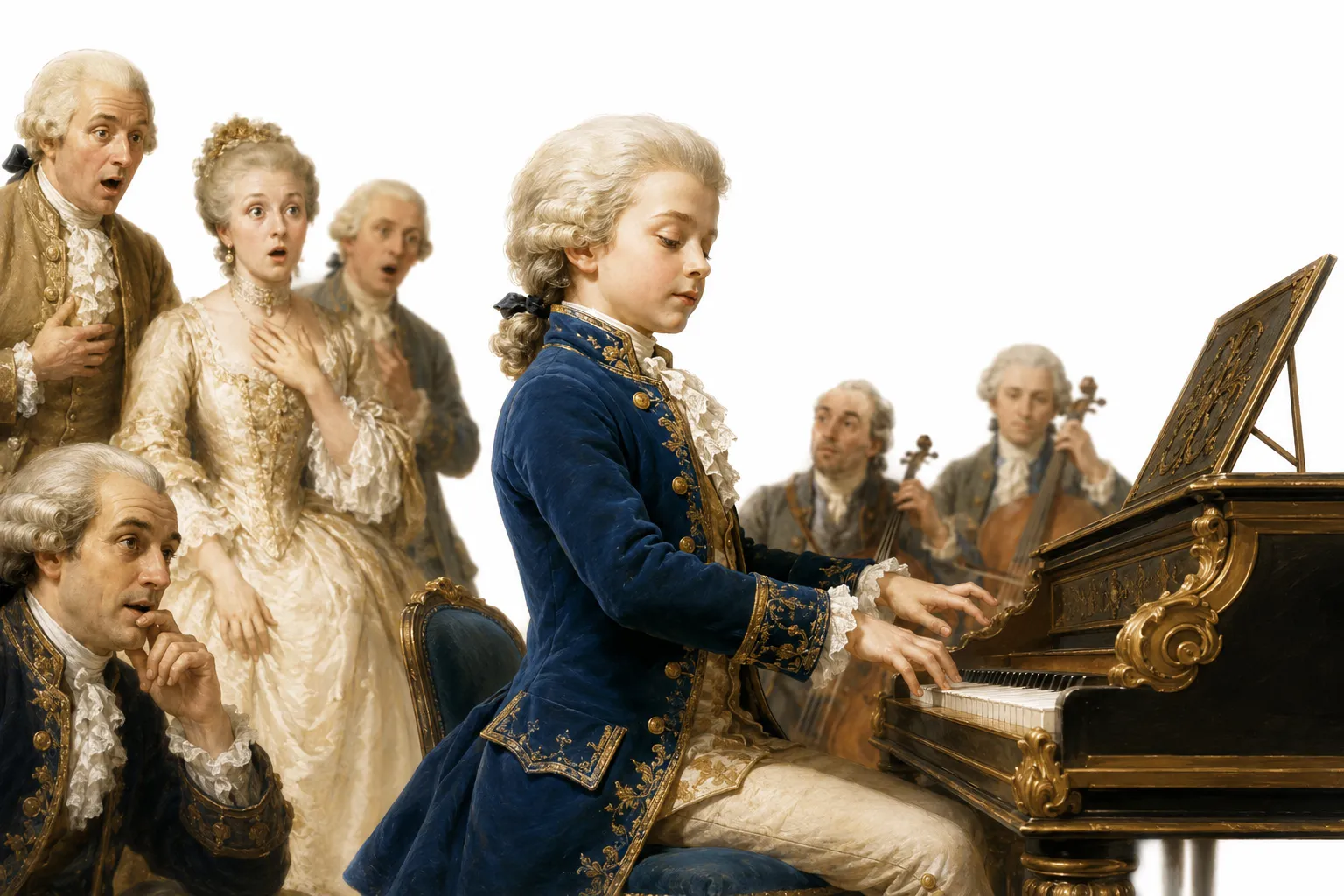
Wolfgang Mozart was born into a musical family. His father, Leopold, was a composer and violinist. He recognized his son's talent early. He began teaching Wolfgang at age 3. The boy learned quickly. He could play the piano and violin by age 4. He could read music before he could read words.
Leopold was ambitious. He took Wolfgang and his sister, Nannerl, on tours across Europe. They performed for royalty in Vienna, Paris, London, and other capitals. Wolfgang was a sensation. He could play blindfolded. He could improvise. He could write down a piece of music after hearing it once.
But the tours were grueling. Wolfgang was a child. He was treated like a performing monkey. He was exhausted. He was often sick. He missed his home. The genius came at a cost. Mozart's childhood was not normal. It was a constant round of practice and performance. He was a prodigy. He was also a prisoner of his talent.
Famous Quote
"I am not a genius. I have worked hard. Anyone who works as hard as I did will achieve the same results."
, Wolfgang Amadeus Mozart (attributed)
This quote is probably apocryphal. But it captures an important truth. Mozart worked extremely hard. The genius was not effortless.
Evidence
Was He Really a Genius?
He composed his first piece at age 5. That is extraordinary.
StrongHe wrote a symphony at age 8. Most composers cannot do that as adults.
StrongHis early works are not masterpieces. They are competent for a child.
ModerateHe practiced constantly. His father pushed him relentlessly.
StrongKey Points
Key Points So Far
Mozart composed his first piece at age 5.
He wrote his first symphony at age 8.
He toured Europe as a child performer.
His father pushed him relentlessly.
He was a prodigy, but he also worked extremely hard.
Analogy
Like an Olympic Gymnast
The familiar part
Imagine an Olympic gymnast. She started training at age 3. She has natural talent. She also practices 40 hours a week.
How it applies
That was Mozart. He had natural talent. He also practiced constantly. The talent was real. The discipline was learned.
Where the analogy breaks
Gymnasts compete. Mozart composed. Both require talent and practice.
Curiosity Notes
Details Most People Miss
Why this still matters
Why This Still Matters
Mozart's story is still told because it raises a question: what is genius? Is it natural talent? Is it hard work? Mozart had both. He had a gift. He also had a father who pushed him. The combination was explosive. But it was also destructive. Mozart's childhood was stolen. His health was ruined. He died young. The prodigy was a miracle. The man was a tragedy.
Key Findings
- ✓Core findingMozart composed his first piece at age 5 and his first symphony at age 8.
- ✓Strong evidenceHe toured Europe as a child performer, playing for royalty.
- ⚠Main consequenceHis father, Leopold, pushed him relentlessly.
- ✓Wider legacyMozart had natural talent and worked extremely hard.
- ★Bottom lineHis sister Nannerl was also a prodigy but was prevented from having a career.
Final insight
A Last Thought
Mozart was a child genius. But he was also a child who worked harder than most adults. His father pushed him. His talent was nurtured. He practiced until his fingers bled. The result was extraordinary. But the cost was high. He died at 35. He was exhausted. The prodigy burned out. That is the tragedy of genius. It is a gift. It is also a burden. Mozart carried it to the grave.
Quick answers
Common questions
Did Mozart write his first symphony at age 8? +
Yes. It is not a great symphony by adult standards, but it is a remarkable achievement for a child.
Was Mozart a genius or a hard worker? +
Both. He had natural talent. He also practiced constantly. The two are not opposites. They are partners.