Visual answer
Octopus Chromatophore and Iridophore Layers
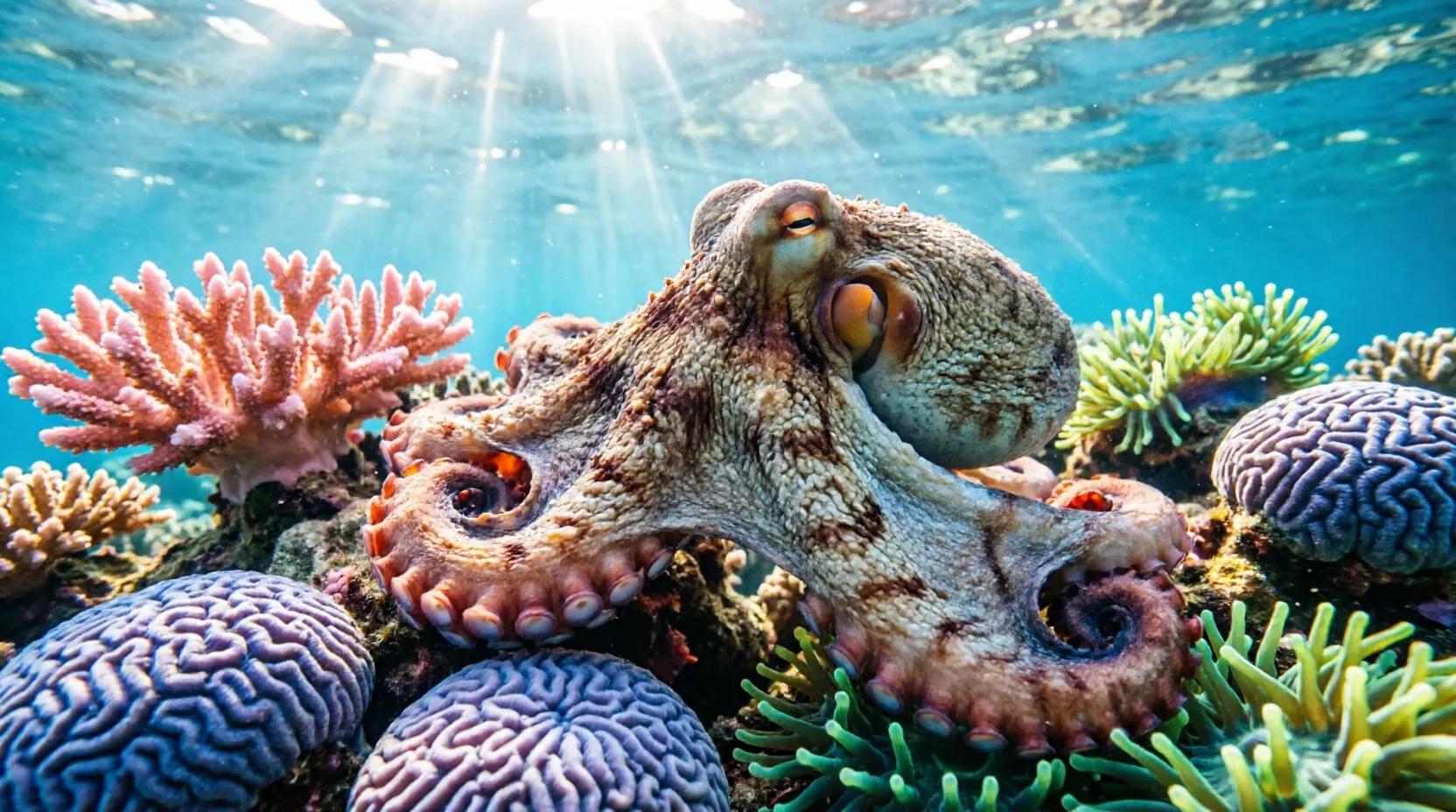
Three skin layers work together: chromatophores (pigment), iridophores (iridescence), leucophores (ambient light reflection).
Chromatophore (pigment sac)
Expands or contracts under neural control; contains yellow, red, or brown pigment.
Iridophore (structural color)
Stacked reflective plates produce iridescent blues, greens, golds.
Leucophore (ambient reflection)
Scatters ambient light to match background brightness.
Papillae (texture)
Muscular bumps raise or lower to match surface texture.
Colorblind camouflage
The Mystery: How Do Colorblind Animals Make Perfect Camouflage?
Octopuses and most cephalopods are colorblind - they have only a single type of photoreceptor, which cannot distinguish wavelengths. Yet they produce extraordinarily precise color matches. One hypothesis: their pupils are W-shaped, allowing different wavelengths to focus on different parts of the retina depending on ambient light, enabling a kind of chromatic aberration-based color detection. Another: the skin itself contains light-sensitive proteins (opsins), allowing direct, brain-bypassing color sensing in the skin.
Three layers
Three Layers of Color Change
The octopus skin is a layered optical system. Chromatophores control rapid pigment expression; iridophores add structural iridescence; leucophores mirror the background.
Key components: Chromatophores (primary pigment control - each has a central pigment sac surrounded by radial muscle fibers; when muscles contract, the sac expands; when relaxed, it retracts). Pigment types (yellow, red/orange, brown in different layers). Iridophores (structural iridescent colors - stack of reflective plates called reflectosomes). Leucophores (passive background mirroring - scatter ambient light). Papillae (texture matching - muscular skin bumps raised or lowered to match rocks, coral, sand).
Matching background
How an Octopus Matches Its Background
1. Visual assessment - The octopus eyes and, possibly, skin opsins assess the brightness, pattern, and texture of the surrounding background.
2. Neural motor pattern selection - The central brain selects one of a repertoire of camouflage motor patterns - uniform, mottled, or disruptive - matched to background type.
3. Chromatophore activation - Specific chromatophores across the skin expand simultaneously according to the pattern code, painting the primary color and light/dark distribution.
4. Iridophore tuning - Underlying iridophores adjust their structural reflectance to add shimmer and fine spectral detail.
5. Papillae deployment - Skin texture papillae raise or lower to replicate surface texture, eliminating the last visual cue of a smooth-skinned animal against a rough substrate.
Evolutionary purpose
Why Did Cephalopods Evolve Color Change?
Cephalopods are soft-bodied animals with no shell or external armor - they are extremely vulnerable to predation. Rapid, precise camouflage is their primary defense. The same system also enables communication: cephalopods flash patterns to signal aggression, submission, courtship, and alarm - a visual language expressed across the entire body surface.
Benefits include: Predator avoidance (matching background makes octopuses invisible to sharks and moray eels), Prey capture (some octopuses use camouflage to stalk prey), and Communication (males flash specific patterns during courtship; threat patterns deter predators).
Octopus vs chameleon
Octopus vs. Chameleon: Color Change Compared
Primary mechanism
Octopus: Chromatophore muscle expansion / Chameleon: Iridophore nanocrystal spacing
Speed
Octopus: Milliseconds / Chameleon: Seconds to minutes
Control
Octopus: Direct neural / Chameleon: Hormonal + neural
Primary purpose
Octopus: Camouflage + communication / Chameleon: Communication + thermoregulation
Color vision
Octopus: Colorblind (monochromat) / Chameleon: Tetrachromat (4 color receptors)
Examples
Master Color-Changers in Action
Mimic Octopus: Goes beyond camouflage - actively impersonates specific dangerous species (lionfish, flatfish, sea snakes) by combining color change with body shape and movement.
Cuttlefish (cephalopod relative): Males can simultaneously display a female-mimicking pattern to the left side (to fool rival males) while displaying a male courtship pattern to the right side (for a female).
Blue-Ringed Octopus: Normally well-camouflaged, this species flashes iridescent blue rings as a warning when threatened - the rings signal that the octopus carries enough venom to kill a human.
Day Octopus: Active in broad daylight, can change its skin pattern up to 177 times per hour while foraging - continuously updating camouflage as it moves across different substrates.
Myths vs reality
Myth vs Reality: Octopus Color Change
What people think
Octopuses change color only for camouflage
Their color change is purely for hiding from predators.
What actually happens
Color change serves camouflage, communication, and possibly thermoregulation
They flash patterns to signal aggression, submission, and courtship - a visual language across their entire body.
Surprising facts
Surprising Facts About Octopus Color Change
The skin of cephalopods may contain its own light-sensing proteins. Opsins - the same light-sensitive proteins found in eyes - have been detected in the skin of octopuses and cuttlefish, suggesting direct, brain-bypassing light detection that may help explain how colorblind animals match colors.
Color changes can occur in under 200 milliseconds. Because chromatophore expansion is a direct muscle contraction - not a hormonal process like in chameleons - the change is nearly instantaneous.
Octopuses have up to several million chromatophores, each one individually nerve-controlled, allowing a resolution of color pattern roughly comparable to modern display screens.
Quick answers
Common questions
How do octopuses change color so fast? +
Because chromatophore expansion is driven by direct nerve impulses to surrounding muscle fibers - the same mechanism as any other muscle contraction. The brain can address thousands of chromatophores simultaneously, updating the entire body pattern in under 200 milliseconds.
Are octopuses colorblind? +
Most octopuses have only one type of photoreceptor (monochromat), which technically makes them colorblind. However, they may detect color through chromatic aberration in their unusual pupils, or through light-sensitive proteins in the skin.
What are chromatophores? +
Chromatophores are specialized skin cells containing elastic sacs filled with pigment. In cephalopods, each sac is surrounded by radial muscle fibers controlled directly by nerves. Expanding the sac spreads the pigment; relaxing retracts it.
Can octopuses change texture as well as color? +
Yes. Octopuses can raise or flatten muscular skin projections called papillae, transforming their skin surface from smooth to spiky or bumpy in seconds - completing the camouflage by matching both color and texture.
Do all octopuses change color? +
All cephalopods (octopuses, squid, cuttlefish) have chromatophores and can change color. The degree of control and complexity varies greatly by species.