Visual answer
Dolphin Sound Production and Reception
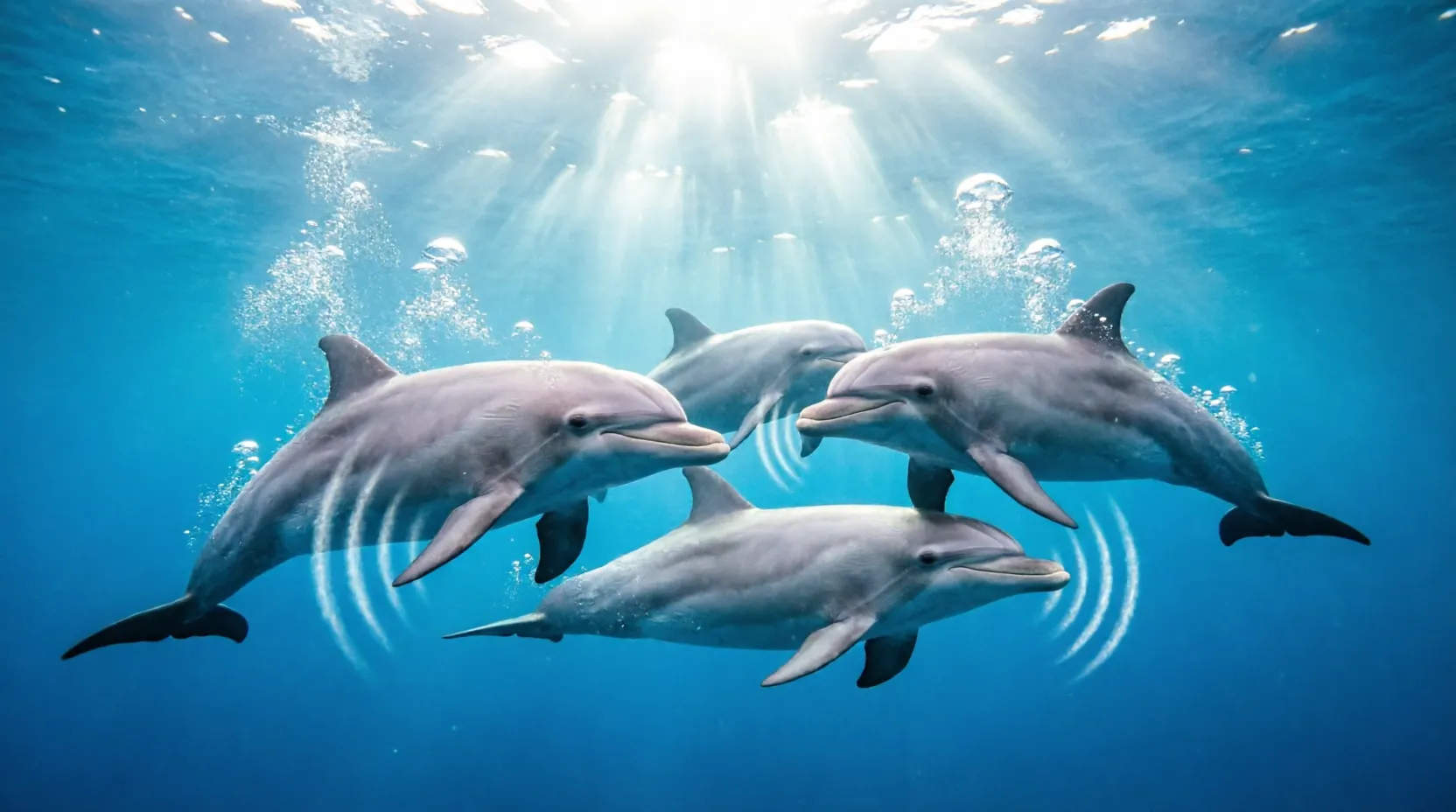
Dolphins produce sounds in nasal passages, focus them through the melon, and receive echoes via the lower jaw.
Nasal passages
Sound produced by forcing air through nasal tissue - no larynx involved.
Melon
Fat-filled organ that focuses sound into a directional beam.
Lower jaw (mandible)
Fat-filled channel conducts returning echoes to inner ear.
Brain
Integrates acoustic, tactile, and visual information.
Do they have language?
The Mystery: Do Dolphins Have Language?
Dolphins have large brains relative to body size, produce complex vocalizations, demonstrate self-awareness in mirror tests, understand gestural referential pointing, and have been shown to call each other by name. Yet despite decades of research, no 'dictionary' of dolphin communication has been decoded - partly because dolphin sounds encode far more simultaneous information than human sequential speech, and partly because the context-dependence of their communication makes mapping nearly impossible without fully understanding their social structure.
Multi-channel system
The Communication System
Dolphin communication is a multi-channel system - vocal, tactile, and visual - with the vocal component subdivided into several functionally distinct sound types.
Key components: Signature Whistle (individual identification and social bonding - each dolphin develops a unique frequency-modulated whistle used as a personal identifier). Echolocation Clicks (environmental sensing - high-frequency clicks produce a 3D acoustic image; potentially shared with pod members). Burst-Pulse Sounds (social and emotional communication - rapid click trains associated with excitement, aggression, alarm). Touch (social bonding - flipper rubbing and body contact analogous to primate grooming). Body Language and Aerial Behaviors (tail slaps, breaching, spy-hopping signal social status and group coordination).
Using sound
How Dolphins Use Sound to Communicate and Navigate
1. Sound produced in nasal sacs - Dolphins produce sound by forcing air through specialized nasal passages just below the blowhole. There is no dedicated larynx - sound is produced by pneumatically vibrating tissue folds.
2. Focused through the melon - The melon - a fat-filled organ in the forehead - acts as an acoustic lens, focusing sound waves into a directional beam projected forward into the water.
3. Echoes received in lower jaw - Returning echoes (from echolocation clicks) are received through a fat-filled channel in the lower jaw, which conducts sound vibrations to the inner ear and brain.
4. Social vocalizations broadcast - Whistles and burst-pulse sounds travel broadly through water (which carries sound about 4.3 times faster than air), reaching pod members at considerable distance.
5. Multi-modal integration - The dolphin's brain integrates acoustic signals, tactile input, visual information, and social context to produce and interpret communication.
Evolutionary purpose
Why Did Dolphins Evolve Complex Communication?
Bottlenose dolphins live in fission-fusion societies - groups that constantly split and reform, with individuals recognizing and maintaining social relationships with dozens of other individuals. Maintaining these relationships in an environment where visibility is often limited to a few meters demands sophisticated acoustic communication. Large social brains and complex communication co-evolved in dolphins much as they did in primates.
Benefits include: Cooperative hunting (vocalizations coordinate herding behavior), Alliance formation (male dolphins form long-term cooperative alliances maintained through social communication), and Cultural transmission (foraging techniques like using sea sponges as tools are passed through social learning).
Sound types
Types of Dolphin Sounds
Whistles
Frequency-modulated; used for social bonding, individual identification (signature whistles), and long-range contact.
Burst-pulse sounds
Rapid click trains (>200/sec); associated with excitement, aggression, alarm, and play.
Echolocation clicks
High-frequency pulses (20-150 kHz); primary function is environmental sensing and hunting; may also be social.
Examples
Dolphin Communication in Action
Signature Whistle Exchange: When pods encounter each other, individuals exchange signature whistles - effectively introducing themselves. Separated mother-calf pairs continuously emit their signature whistles until reunited.
Cooperative Fish Herding: Indo-Pacific bottlenose dolphins in Shark Bay, Australia, produce specific underwater vocalizations when coordinating the herding of fish into beachable schools, then strand themselves briefly to catch stranded fish - communicating throughout.
CHAT Project: Researchers built an underwater keyboard allowing dolphins to request objects by producing associated sounds. Dolphins quickly learned to 'ask' for specific toys by producing novel whistles - suggesting they can learn arbitrary acoustic labels.
Grieving Behavior: Dolphins have been documented carrying dead calves at the surface for days, vocalizing continuously - behavior interpreted as a social expression of distress.
Myths vs reality
Myth vs Reality: Dolphin Communication
What people think
Scientists have decoded dolphin language
Researchers can translate dolphin sounds into English sentences.
What actually happens
No dolphin 'dictionary' exists
While specific sounds have been associated with contexts, the full semantic content - whether it constitutes a language - remains unresolved.
Surprising facts
Surprising Facts About Dolphin Communication
Dolphins can share acoustic images via echolocation. Research suggests that the echolocation click train used to probe an object can be intelligible to other dolphins nearby - potentially transmitting an acoustic 'picture' of what one dolphin 'sees' to others in the pod.
Dolphin vocalizations can exceed 200 clicks per second. At these rates, burst pulses sound continuous to the human ear - but recording analysis reveals they are still discrete click trains.
Dolphins recognize themselves in mirrors. Bottlenose dolphins pass the mirror self-recognition test - one of the most stringent behavioral tests of self-awareness - placing them among great apes, elephants, and magpies in this cognitive category.
Quick answers
Common questions
What sounds do dolphins make? +
Dolphins produce three main sound types: whistles (frequency-modulated social signals), burst-pulse sounds (rapid click trains for social contexts), and echolocation clicks (high-frequency pulses for sensing the environment). Sounds are produced in nasal passages and focused through the melon.
Do dolphins have a language? +
Dolphin communication is complex and context-sensitive, with individual identity signals, emotional state encoding, and possibly referential communication. Whether it meets the technical definition of 'language' (combinatorial syntax, open-ended productivity) is an active research question.
What is a dolphin's signature whistle? +
A signature whistle is a unique frequency-modulated whistle that each dolphin develops in its first year and retains for life. It functions as a personal identifier - other dolphins recognize and use it to address that individual, much like a name.
How do dolphins use echolocation to communicate? +
While echolocation's primary function is environmental sensing, the sounds are audible to other dolphins. Evidence suggests dolphins can 'listen in' on each other's echolocation and potentially share the acoustic information it encodes.
How intelligent are dolphins? +
Dolphins have brain-to-body mass ratios second only to humans among mammals. They pass mirror self-recognition tests, use tools, learn referential communication, form long-term social alliances, and show evidence of cultural transmission.