Quick Facts
Quick Facts
Genghis Khan was born Temujin. He united the Mongol tribes after a childhood of poverty and violence.
Mongol soldiers carried multiple horses and could ride for days without stopping.
The Mongols used terror as a weapon. Cities that resisted were annihilated. Cities that surrendered were spared.
Genghis Khan promoted based on merit, not birth. His top generals were former enemies.
He created a legal code, the Yassa, which applied to everyone in the empire.
Visual answer
The Mongol Recipe for Conquest
How a few horsemen conquered the world.
Mobility
Every soldier was mounted. Each man had multiple horses. They could travel 100 miles per day, faster than any army in history.
Adaptability
The Mongols adopted technologies from conquered peoples: siege engines from China, artillery from Persia.
Psychological Warfare
Offer surrender. If refused, annihilate the city. The reputation for brutality made cities surrender without a fight.
Meritocracy
Genghis Khan promoted based on ability, not birth. His best generals were former enemies who had impressed him.
Organization
The army was organized in decimal units (10, 100, 1,000, 10,000). Communication was efficient. Orders were clear.
Story in brief
Story in Brief
1162
Temujin is born in Mongolia. His father is poisoned when he is 9. His family is abandoned.
1206
Temujin unites the Mongol tribes. He is proclaimed Genghis Khan (Universal Ruler).
The Mongols are now a unified nation, not a collection of warring clans.
1211
Genghis Khan invades China. Within 20 years, he conquers the Jin Empire.
1219
He invades the Khwarazmian Empire (Persia). The empire is destroyed in two years.
The Mongols demonstrate their ability to conquer sophisticated, urbanized empires.
1227
Genghis Khan dies. His empire is divided among his sons. It continues to expand under his successors.
1279
The Mongols complete the conquest of China, establishing the Yuan Dynasty.
The Story
How the Horsemen Conquered the World
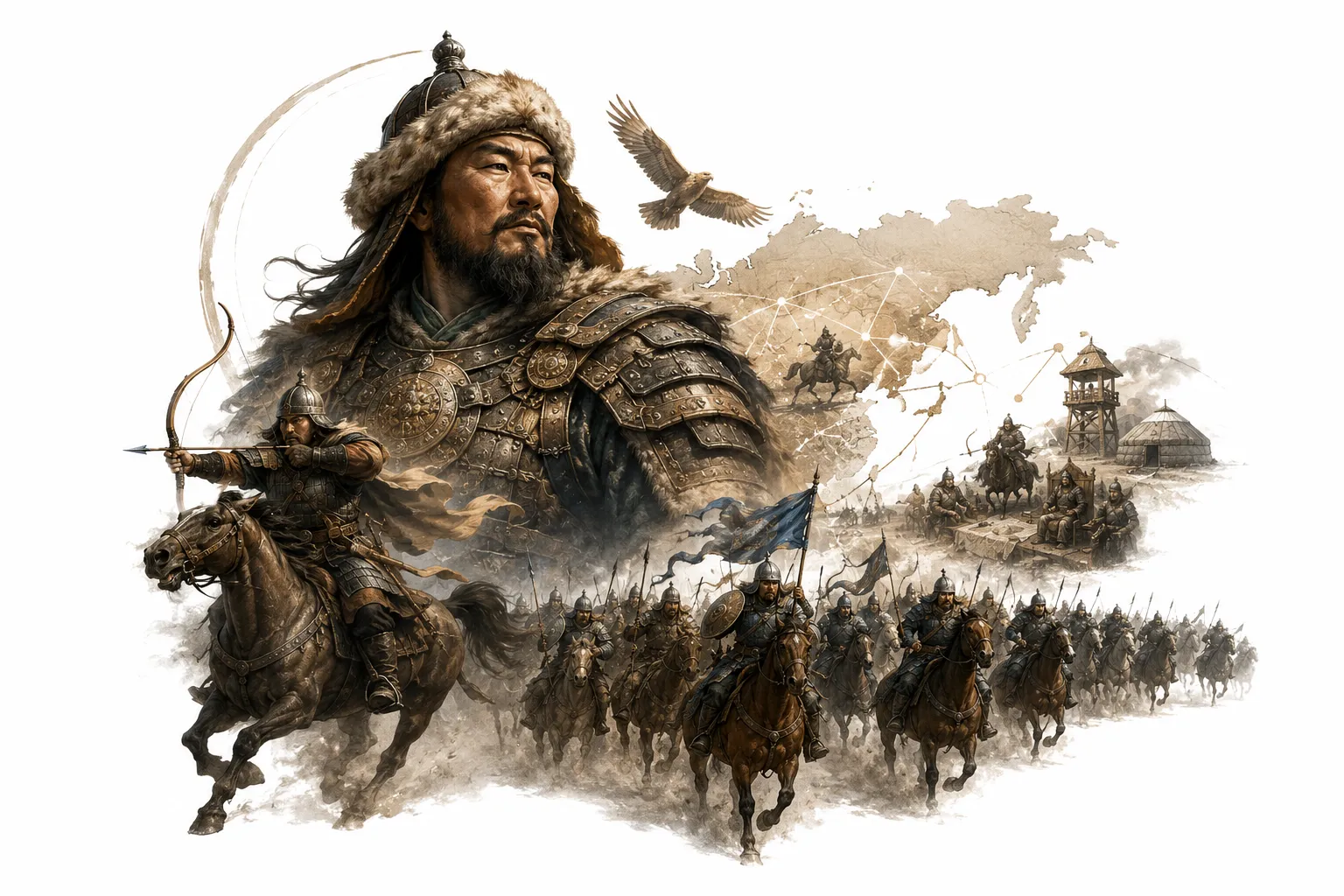
The Mongol army was not large by the standards of the empires they conquered. At its peak, it numbered perhaps 150,000 men. The armies of China were ten times that size. But the Mongols had speed.
Every Mongol soldier was mounted. Each man had three to five horses. They could ride for days without stopping, covering 100 miles per day. No army in history had ever moved that fast. They appeared out of nowhere, struck, and vanished before the enemy could respond.
The Mongols also mastered psychological warfare. They offered every city a choice: surrender and be spared, or resist and be annihilated. Cities that resisted were destroyed. The inhabitants were killed or enslaved. The reputation for brutality spread. Many cities surrendered without a fight. Why die for a king who could not protect you?
Famous Quote
"The greatest joy for a man is to defeat his enemies, to drive them before him, to take from them all they possess, to see those they love in tears, to ride their horses, and to hold their wives and daughters in his arms."
, Genghis Khan (attributed)
This quote captures his worldview. Conquest was not just strategy. It was joy.
Evidence
Why the Mongols Won
Superior mobility: mounted archers could outrun any infantry.
StrongAdaptability: Mongols adopted siege technology from conquered peoples.
StrongPsychological warfare: terror encouraged surrender.
StrongMeritocracy: Genghis Khan promoted based on ability, not birth.
StrongKey Points
Key Points So Far
The Mongol army was highly mobile, able to travel 100 miles per day.
They used psychological warfare to encourage surrender.
They adopted technologies from conquered peoples.
Genghis Khan promoted based on merit, not birth.
The empire became the largest contiguous land empire in history.
Analogy
Like a Medieval Blitzkrieg
The familiar part
Imagine an army that moves so fast that the enemy cannot react. It appears, strikes, and disappears before reinforcements arrive.
How it applies
That was the Mongols. They were the blitzkrieg of the 13th century. Speed was their weapon.
Where the analogy breaks
Blitzkrieg used tanks and planes. The Mongols used horses and bows. The concept is the same: speed kills.
Curiosity Notes
Details Most People Miss
Why this still matters
Why This Still Matters
Genghis Khan's conquests are still studied because they changed the world. He connected East and West. He destroyed old empires and created new trade networks. He was brutal. He was brilliant. He was a product of his time. And his time was brutal. The Mongol Empire did not last. But its impact did. The world after Genghis Khan was not the world before. That is his legacy.
Key Findings
- ✓Core findingGenghis Khan conquered more land than anyone in history.
- ✓Strong evidenceHis army was highly mobile, able to travel 100 miles per day.
- ⚠Main consequenceHe used psychological warfare to encourage surrender.
- ✓Wider legacyHe promoted based on merit, not birth.
- ★Bottom lineThe Mongol Empire became the largest contiguous land empire in history.
Final insight
A Last Thought
Genghis Khan conquered so much land because he understood that speed is power. His army was faster than any in history. He understood that terror is power. His reputation made cities surrender. He understood that adaptability is power. He adopted the best ideas from every people he conquered. He was not a genius. He was a learner. He learned from his enemies. He learned from his allies. And he applied those lessons ruthlessly. That is how a few horsemen conquered the world.
Quick answers
Common questions
How many people died in the Mongol conquests? +
Estimates range from 20 to 60 million. The population of Europe at the time was about 80 million. The Mongol conquests were devastating.
What happened to the Mongol Empire after Genghis Khan died? +
It was divided among his sons. The empire continued to expand but eventually fractured into separate khanates. It declined in the 14th century.