Quick Facts
Quick Facts
Air has weight even though it's invisible.
Pressure changes often happen hours before weather changes.
A rapidly falling barometer can indicate an approaching storm.
Modern weather stations still measure atmospheric pressure.
Visual answer
How a barometer predicts weather
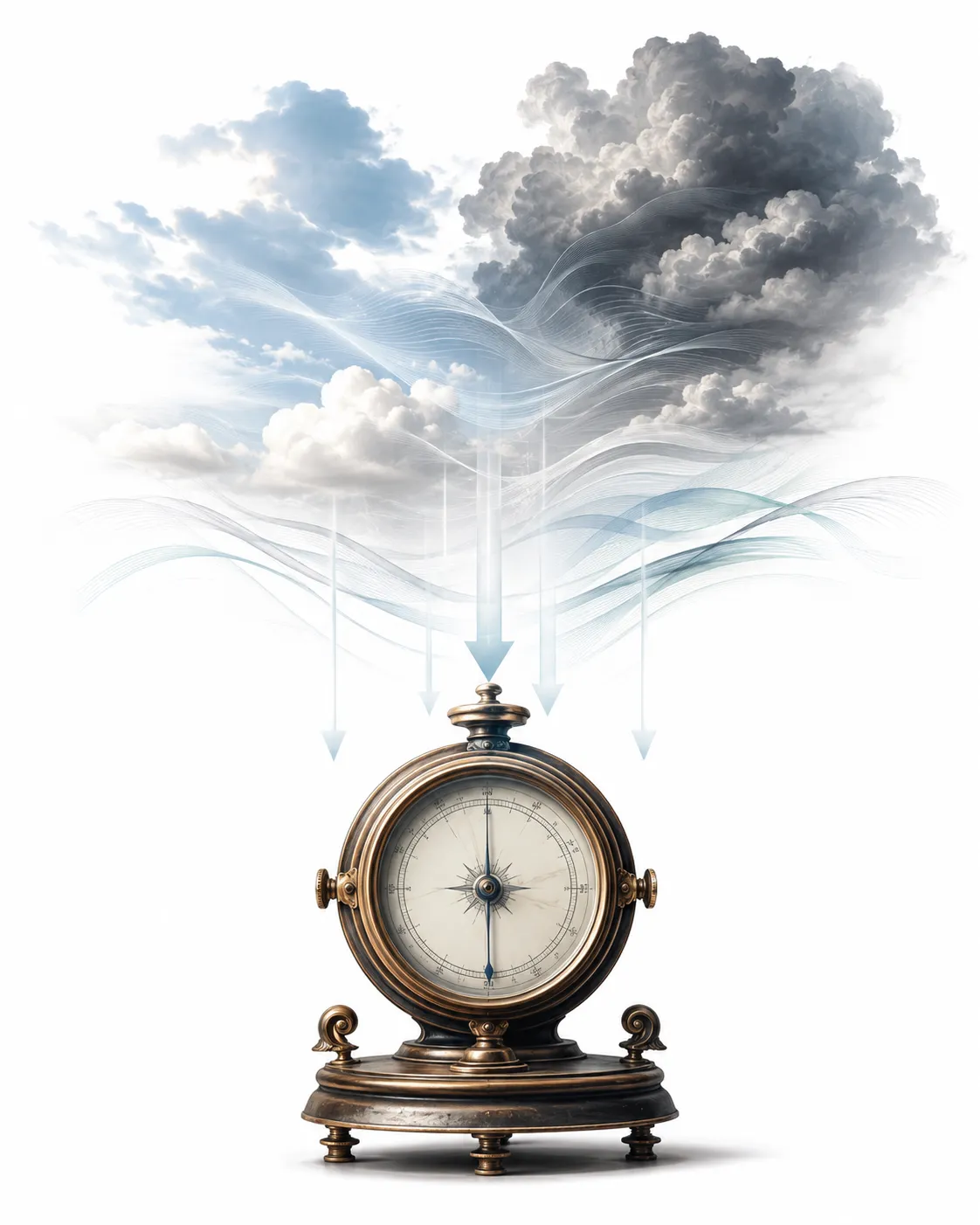
The diagram connects air pressure changes to rising, sinking, and shifting weather patterns.
Pressure rises
Sinking air usually points to calmer, clearer weather.
Pressure falls
Rising air often means clouds, wind, or storms are approaching.
Trend matters
The direction and speed of pressure change tell more than one reading alone.
Air Has Weight
You're Standing At The Bottom Of An Ocean Of Air
Earth is wrapped in a blanket of air hundreds of kilometers thick. Gravity keeps this enormous mass from drifting into space.
That means the air above you is constantly pressing downward. We call this atmospheric pressure.
When weather systems move, the amount of pressure above you changes. A barometer notices these tiny differences long before your eyes do.
Why It Works
Pressure Changes Before The Rain Arrives
Storm systems usually bring lower air pressure. Clear, calm weather usually arrives with higher pressure.
As these large weather systems travel across the landscape, the barometer needle begins moving before the clouds arrive.
That's why sailors relied on barometers for centuries. They weren't magicthey were simply early warning systems.
Analogy
A Scale For The Sky
The familiar part
If someone slowly piled books onto a table, a scale underneath would notice long before the table collapsed.
How it applies
A barometer is doing something similar. It constantly measures how much weight the atmosphere is placing above it.
Where the analogy breaks
Unlike a stack of books, the atmosphere is constantly moving, swirling, and changing shape.
Curiosity Notes
Details Most People Miss
Why this still matters
Why This Still Matters
Every airport, weather station, ship, and meteorological satellite still relies on atmospheric pressure. Your smartphone's weather app uses the same principle discovered nearly four centuries ago.
Key Findings
- ✓Core findingA barometer measures atmospheric pressure.
- ✓Strong evidenceFalling pressure usually means unsettled weather.
- ⚠Main consequenceRising pressure often signals clearer conditions.
- ✓Wider legacyIt detects changes before they're visible.
Final insight
A Last Thought
A barometer isn't really forecasting tomorrow. It's simply noticing that the enormous ocean of air above your head has begun to rearrange itself. The weather is already changingyou just haven't seen it yet.
Quick answers
Common questions
Can a barometer predict rain? +
Not directly. It detects falling air pressure, which often accompanies weather systems that bring rain.
Why does air pressure change? +
As warm and cold air masses move around Earth, they create regions of high and low pressure that constantly shift.