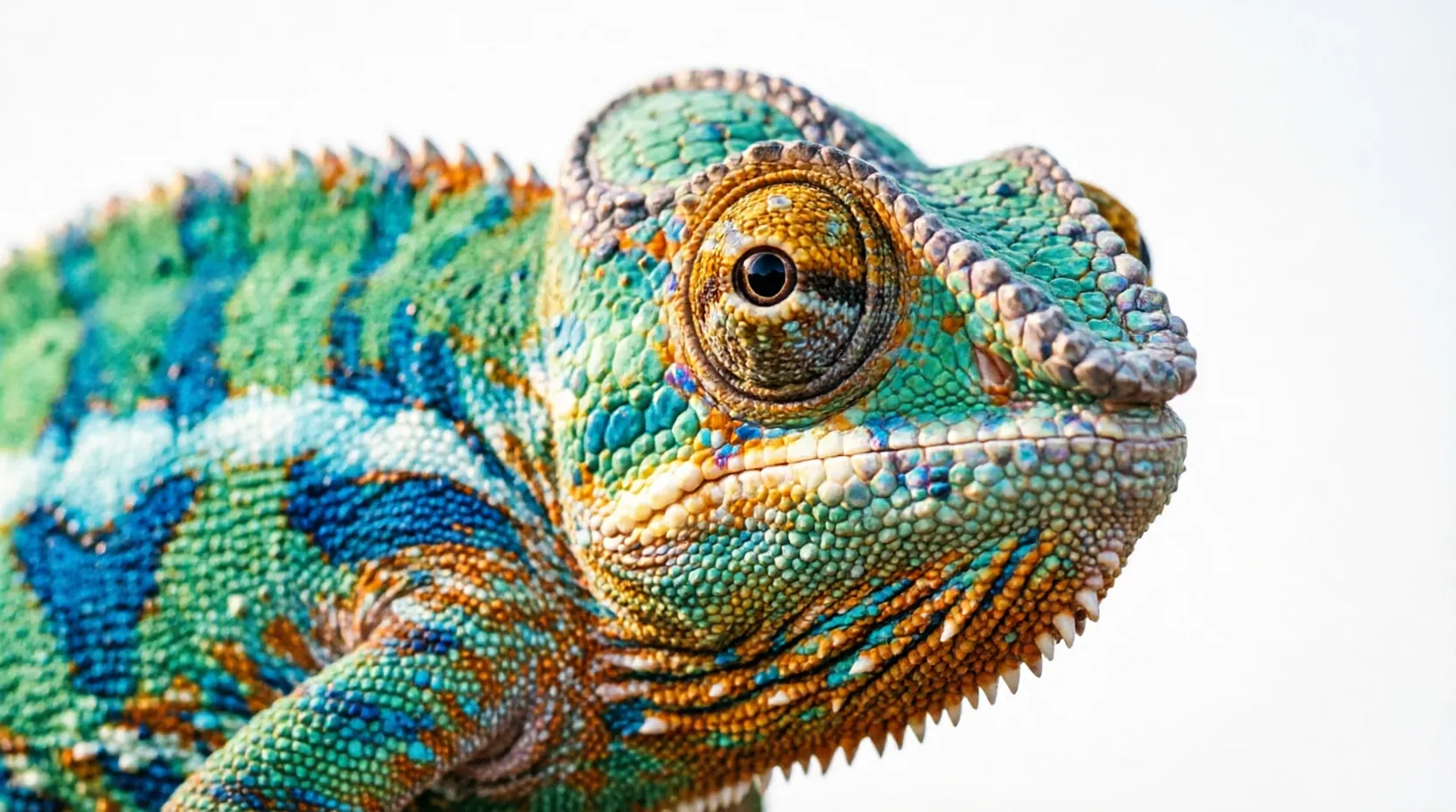
Visual answer
Chameleon Iridophore Nanocrystals
Changes in crystal lattice spacing alter reflected wavelengths - closer spacing = shorter wavelengths (blue/green); wider spacing = longer wavelengths (red/yellow).
Resting state (calm)
Nanocrystals closely packed (~130 nm spacing) - reflects blue/green.
Excited state
Cells stretch; crystal spacing increases (~180+ nm) - reflects yellow/red.
Upper iridophore layer
Active color display layer.
Lower iridophore layer
Reflects infrared; helps thermoregulation.
Camouflage myth
The Mystery: Why the Camouflage Myth Is Wrong
The idea that chameleons constantly shift color to match their background is a pervasive myth. In reality, chameleons in their resting state are already naturally colored to blend into their arboreal (tree-dwelling) environment - green and brown. They change away from this natural camouflage during emotional arousal (excitement, aggression, courtship). A chameleon trying to 'match the background' would actually make itself more conspicuous, not less. The color change serves communication and thermoregulation - not dynamic camouflage.
Nanocrystals
Nanocrystals: The Physics of Structural Color
Chameleon color change is driven by physics - changes in crystal lattice spacing that alter which wavelengths of light are reflected - not by chemistry (pigment movement) as in octopuses.
Key components: Upper Iridophore Layer (contains nanocrystals in a tunable lattice; resting lattice spacing reflects blue-green; stretched spacing reflects red-yellow). Lower Iridophore Layer (infrared reflection and thermoregulation - contains larger, less organized crystals). Xanthophore and Erythrophore Layers (pigment-based color contribution - yellow and red pigments modulate final color). Melanophores (black/brown pigment cells that darken the overall appearance - used in thermoregulation and threat displays). Autonomic Nervous System and Hormones (control color change - neural for rapid changes, hormonal for slower sustained states).
Male contest display
How a Male Chameleon Changes Color During a Territorial Contest
1. Resting state - natural camouflage - The iridophore crystal lattice is tightly packed, reflecting short wavelengths. Combined with yellow pigment, the chameleon appears green-brown - blending into its arboreal habitat.
2. Rival detected - arousal begins - The sight of a rival male triggers autonomic nervous system activation. Stress hormones begin to be released.
3. Crystal lattice expands - Upper iridophore cells stretch, increasing nanocrystal spacing from about 130 nm to over 180 nm. The reflected peak wavelength shifts from blue-green to yellow-red.
4. Bright display pattern emerges - Yellows, oranges, and reds appear on the head and flanks - bright, high-contrast patterns that signal fighting condition and dominance.
5. Contest outcome determines subsequent color - The winner maintains bright colors; the loser rapidly returns to dull, darker tones - a physiological signal of submission.
Evolutionary purpose
Why Did Chameleons Evolve Color Change?
The primary evolved function of chameleon color change is communication - conveying information about reproductive status, fighting ability, social dominance, and stress to other chameleons. The iridophore system is especially prominent in males and most active during male-male competition and courtship. Color intensity and the speed of color change predict contest outcomes - brighter, faster-changing males win more fights.
Benefits include: Honest signaling in competition (color change predicts contest outcomes), Mate choice (females assess male color displays; receptive females display their own patterns), and Thermoregulation (darkening in cool morning conditions absorbs heat; lightening in midday reflects excess radiation).
Chameleon vs octopus
Chameleon vs. Octopus Color Change
Primary mechanism
Chameleon: Nanocrystal lattice spacing / Octopus: Pigment sac muscle expansion
Speed
Chameleon: Seconds to minutes / Octopus: Milliseconds
Color range
Chameleon: Blue-green to red-yellow / Octopus: Yellow, red, brown, black + iridescence
Primary purpose
Chameleon: Social communication + thermoregulation / Octopus: Camouflage + communication
Color vision
Chameleon: Tetrachromat (4 photoreceptors) / Octopus: Colorblind (monochromat)
Examples
Color Change in Action
Panther Chameleon: The most studied species for iridophore color change. Males display extraordinarily vibrant reds, oranges, and turquoises during competition and courtship - some of the most vivid structural colors in vertebrates.
Veiled Chameleon: Females display distinctive dark stripes with orange and yellow spots when pregnant - a 'do not disturb' signal that deters male courtship while gravid.
Jackson's Chameleon: Males use complex multi-element color patterns during territorial displays, with head color changes predicting contest outcomes more accurately than body colors.
Namaqua Chameleon: Desert-dwelling species that dramatically splits its color - displaying dark (heat-absorbing) on one side and light (heat-reflecting) on the other when basking, maximizing temperature differential across the body.
Myths vs reality
Myth vs Reality: Chameleon Color Change
What people think
Chameleons change color for camouflage
They blend into any background by changing color.
What actually happens
Resting color provides camouflage; active color change is for communication
Active color change moves the chameleon away from camouflage toward conspicuous displays for signaling to other chameleons.
Surprising facts
Surprising Facts About Chameleon Color Change
The speed of head color change predicts who wins a fight. In panther chameleons, the male whose head color changes most rapidly at the start of a contest is significantly more likely to win - making color change rate an honest signal of fighting ability.
Some chameleons can see ultraviolet light. Several chameleon species have cone cells sensitive to UV wavelengths, allowing them to detect UV-reflective patterns in the skin of conspecifics that are invisible to most predators - a private communication channel.
Chameleon iridophores were only discovered to be the primary mechanism in 2015. Before that, scientists thought chromatophores (pigment cells) were the main color-change mechanism.
Quick answers
Common questions
How do chameleons change color? +
Primarily through iridophore cells that contain a tunable lattice of nanocrystals. In a relaxed state, the crystals are closely packed and reflect short (blue-green) wavelengths. When excited, the lattice expands and reflects longer (yellow-red) wavelengths. Pigment cells above and below modify the final perceived color.
Why do chameleons change color? +
Primarily to communicate with other chameleons - signaling reproductive state, dominance, submission, and emotional arousal. A secondary function is thermoregulation - darker colors absorb more heat. Camouflage is provided by the resting color, not by active color change.
Do chameleons change color to camouflage? +
This is a widespread myth. Chameleons' natural resting colors already provide camouflage in their tree-dwelling habitat. Active color change makes them more conspicuous, not less - it serves communication, not camouflage.
How fast can a chameleon change color? +
Color changes driven by neural signals can begin within seconds; full transitions between resting and fully aroused coloration typically take 20 seconds to a few minutes - much slower than octopus color change but faster than hormonal processes in other animals.
Can female chameleons change color? +
Yes, though female color-change ability is typically less dramatic than males'. Female color signals are primarily used to communicate reproductive state - receptive females signal with specific patterns, and pregnant females display rejection coloration.