Quick Facts
Quick Facts
Data centers often use evaporative cooling towers, the same basic principle as sweat cooling human skin.
Large AI training runs, involving thousands of chips running for weeks, can require especially significant cooling.
Electricity generation itself—particularly from power plants using steam turbines—also consumes water, adding an indirect layer of use.
Water use varies enormously depending on the data center's location, climate, and cooling technology.
Visual answer
Where the water actually goes
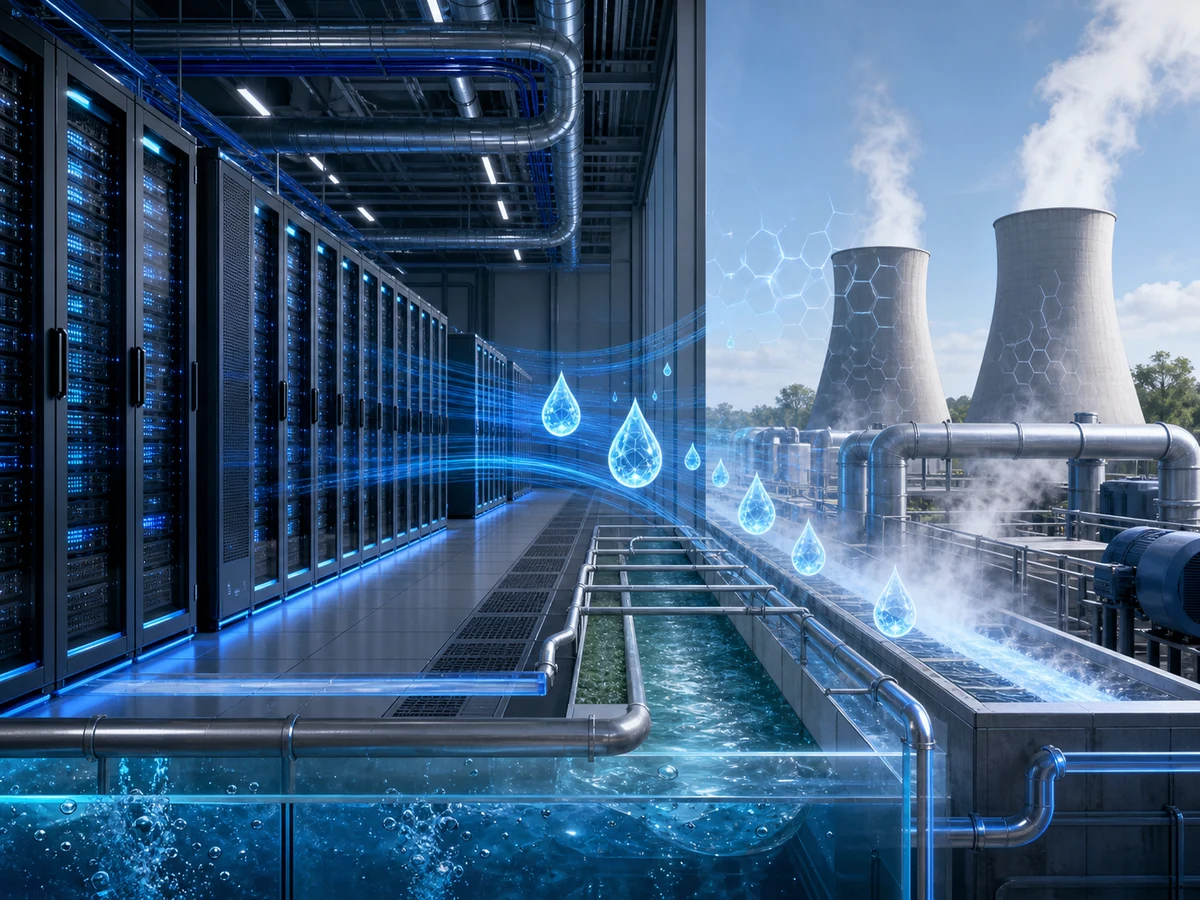
Cooling AI's massive server farms is where most of the water use happens.
Servers generate heat
Thousands of chips running AI models produce enormous amounts of waste heat.
Water absorbs it
Cooling systems circulate water past hot equipment, absorbing and carrying away the heat.
Water evaporates
Much of that heat is released by evaporating a portion of the water into the air, similar to sweat cooling skin.
The Mechanism
Chips Get Hot. Hot Chips Need Cooling.
Every time an AI model processes a request, it's really just an enormous number of calculations happening across specialized chips, and all that computation generates heat—a lot of it, concentrated in a relatively small physical space.
Left unchecked, that heat would quickly damage the equipment, so data centers rely on serious cooling infrastructure to keep everything within a safe operating temperature.
Many facilities use evaporative cooling towers, which work on the same basic principle as sweat cooling your skin: water absorbs heat and then evaporates, carrying that heat away into the air, at the cost of a genuine, measurable amount of water consumed in the process.
The Indirect Cost
Even the Electricity Has a Water Bill
There's a second, less obvious layer to this too. The electricity powering a data center often comes from power plants that themselves use water—particularly plants relying on steam turbines, where water is heated, turned to steam, and used to spin generators.
That means a data center's water footprint isn't just about the cooling towers on-site; it's tied to however the local power grid happens to generate its electricity in the first place.
Analogy
A Building That Sweats
The familiar part
When you run a marathon, your body cools itself by sweating—converting liquid water on your skin into vapor, carrying excess heat away with it.
How it applies
A data center full of AI hardware does something remarkably similar at an industrial scale, sweating out water through cooling towers to keep its own version of a fever under control.
Where the analogy breaks
The main difference is that a marathon runner rehydrates with a water bottle; a data center rehydrates with a municipal water supply, at a considerably larger scale.
Curiosity Notes
Details Most People Miss
Why this still matters
Why This Still Matters
Understanding AI's water use is a useful reminder that digital conveniences, however weightless they feel, are ultimately powered by very physical infrastructure—with very physical resource costs attached.
Key Findings
- ✓Core findingAI itself doesn't use water directly, but the data centers running it often do, mainly for cooling.
- ✓Strong evidenceEvaporative cooling towers work on the same principle as sweat cooling human skin.
- ⚠Main consequenceElectricity generation adds an indirect water cost, depending on the local power grid.
- ✓Wider legacyGrowing AI demand has increased scrutiny of, and investment in, more water-efficient data center design.
Final insight
A Last Thought
The next time an AI answers a question in a fraction of a second, somewhere far away, in a nondescript building full of humming servers, a little bit of water may well be quietly evaporating to make that instant reply possible.
Quick answers
Common questions
Does every single AI query use a measurable amount of water? +
Individually, the water used per query is extremely small, but multiplied across billions of daily requests worldwide, the cumulative water use becomes significant enough for companies and researchers to track closely.
Can data centers avoid using water for cooling? +
Some can, using air-cooling or closed-loop liquid cooling systems that recycle the same water repeatedly, though these approaches often trade off against energy efficiency or cost.