Visual answer
Ant Colony Caste System
Different castes perform different roles: queen (reproduction), workers (all tasks), males (mating).
Queen
Lays eggs; produces pheromones that regulate colony reproduction.
Workers (female)
Non-reproductive females that forage, build, nurse larvae, and defend.
Drones (male)
Exist solely to mate with queens during nuptial flights; die shortly after.
Brood
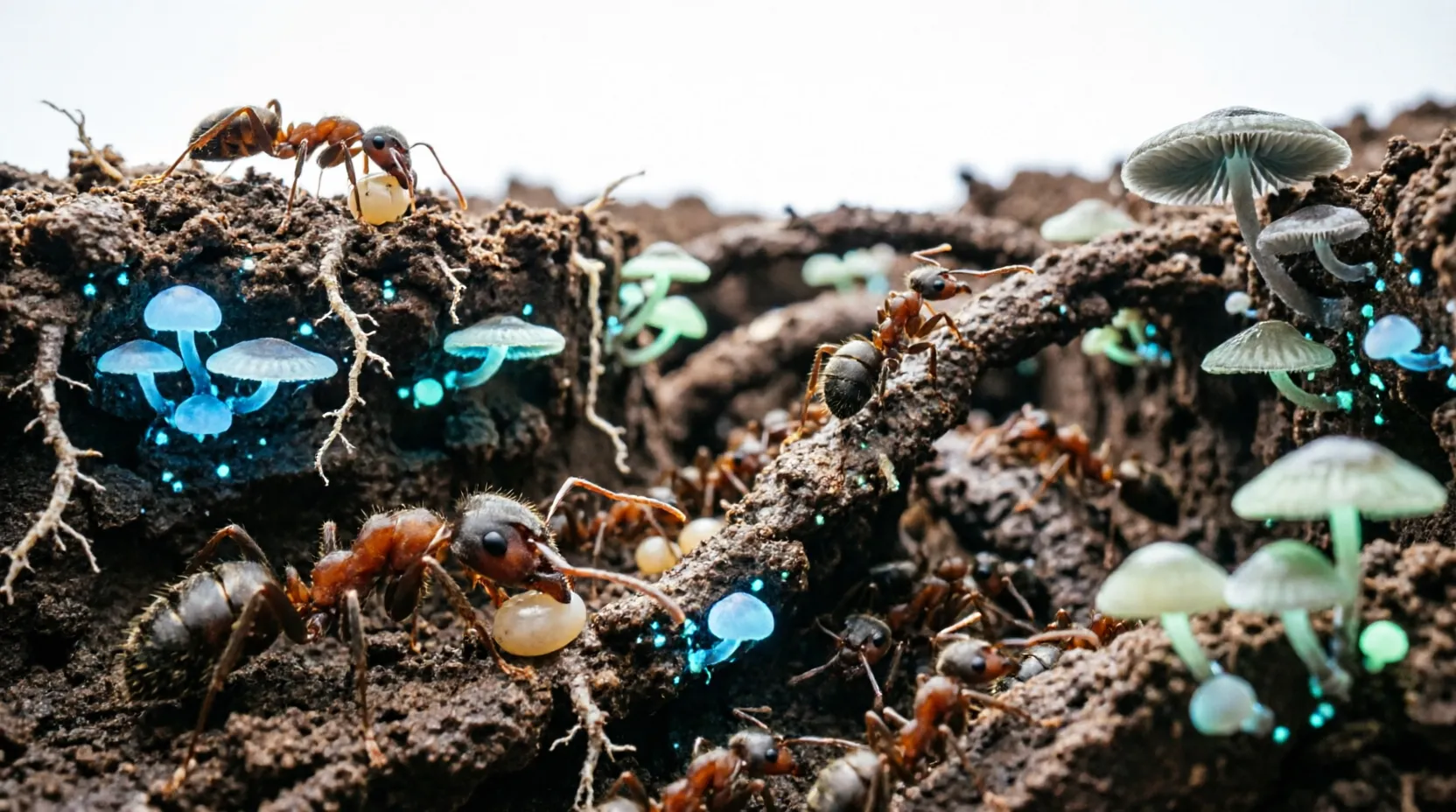
Eggs, larvae, and pupae cared for by nurse workers.
Emergent intelligence
The Mystery: How Does Complexity Emerge Without Central Control?
The queen ant lays eggs but does not direct workers. No ant has a global view of the colony's needs. Yet the colony collectively solves complex optimization problems - finding the shortest path to food, allocating workers to tasks dynamically, and even adjusting to seasonal changes. This emergent intelligence arises from simple local rules: each ant responds to its immediate chemical and tactile environment, and the aggregate of billions of such responses produces colony-level cognition.
Pheromones and castes
The Mechanism: Pheromones, Castes, and Collective Intelligence
Colonies are organized by three interlocking systems: a caste structure that divides labor, a pheromone communication network that coordinates tasks, and tactile signals that establish social identity.
Key components: Queen (reproduction), Worker ants (all colony maintenance tasks), Drones (mating only), Pheromone trails (foraging coordination), and Cuticular hydrocarbons (social identity and colony recognition - each colony has a unique chemical signature).
Worker decisions
How a Worker Ant Decides What to Do
1. Sensing the chemical environment - A worker constantly samples pheromones, nestmate odors, and food scents with its antennae, building a real-time picture of colony needs.
2. Task switching based on local cues - If a worker encounters larvae that haven't been fed recently, it switches to nursing. If it detects an alarm pheromone, it shifts to defense. No supervisor assigns these tasks.
3. Reinforcing successful strategies - When a forager finds food, it lays trail pheromones; successful trails attract more followers and accumulate more pheromone, producing a positive feedback loop.
4. Antennae contact establishes roles - When two ants meet, they touch antennae to exchange chemical information about their roles, identity, and nutritional status.
5. Collective decision-making - Decisions like choosing a new nest site emerge from the aggregate of hundreds of workers independently assessing options and recruiting nestmates - a democratic quorum sensing.
Why colonies?
Why Did Colonial Living Evolve?
Eusociality - the most extreme form of colonial living - evolved independently many times across insects because cooperating in large groups dramatically increases reproductive success for the queen (the colony's shared genome). Workers share roughly 75 percent of their genes with sisters, making helping sisters reproduce genetically advantageous.
Benefits include: Division of labor (specialists outperform generalists), Colony defense (large numbers allow ants to defend resources against much larger animals), and Environmental engineering (leafcutter ants cultivate fungal gardens; army ants build living bridges from their own bodies).
Ant strategies
Ant Colony Strategies Around the World
Leafcutter Ants
Cut leaves to cultivate fungal gardens - agriculture older than human farming by 50 million years.
Army Ants
Nomadic colonies of millions march in coordinated raids; workers build living bridges and bivouacs from their own bodies.
Fire Ants
During floods, they link bodies to form a floating raft, keeping the queen and brood in the center.
Carpenter Ants
When infected by pathogens, sick ants self-isolate and leave the nest to die - preventing disease spread.
Examples
Remarkable Ant Behaviors
Leafcutter Ants: Leafcutters cut fragments of leaves, carry them to underground gardens, and cultivate specific fungal species on them - a form of agriculture older than human farming by 50 million years.
Army Ants: Nomadic colonies of millions march in coordinated raids, consuming virtually all invertebrates in their path. Workers assemble living bridges and bivouacs from their own bodies.
Fire Ants: During floods, fire ants link their bodies together to form a floating raft, keeping the queen and brood in the center - a remarkable collective survival behavior.
Carpenter Ants: When infected by a pathogen, sick carpenter ants self-isolate from the colony and leave the nest to die - preventing disease spread before pheromone signals alert others.
Myths vs reality
Myth vs Reality: Ant Colonies
What people think
The queen ant is the boss of the colony
The queen tells workers what to do, like a human monarch.
What actually happens
Workers self-organize; the queen only reproduces
Workers decide their own tasks based on pheromone cues and local interactions. The queen does not direct any work.
Surprising facts
Surprising Facts About Ant Colonies
Worker ants take roughly 250 power naps per day. Research found that workers sleep in short 1-minute bursts throughout the day, while queens sleep in longer roughly 6-minute cycles. The queen averages about 9 hours of sleep per day.
Some ant colonies have no queen at all. In certain clonal raider ant species, all workers can reproduce asexually, producing genetically identical daughters.
Ants can carry 10-50 times their own body weight. The jaw muscles of leafcutter ants can generate forces equivalent to a human lifting a car.
The total biomass of all ants roughly equals that of all wild birds and mammals combined - roughly 20 quadrillion ants live on Earth.
Quick answers
Common questions
How do ants communicate? +
Ants communicate primarily through pheromones - chemical signals detected by antennae. They also use tactile communication (antennal contact), vibrations (stridulation), and body language. Different pheromones convey different messages: alarm, food trail, colony identity, and reproductive status.
What is the role of the queen ant? +
The queen's primary role is reproduction - laying hundreds to millions of eggs per year. She also produces pheromones that regulate worker behavior and suppress worker reproduction. Despite her title, she does not direct worker activities.
How do worker ants know what to do? +
Workers self-assign tasks based on the chemical and social cues they encounter locally. Younger workers tend to work inside near the brood; older workers forage. Task allocation shifts dynamically as colony needs change.
How long do ants live? +
Worker lifespan varies by species: a few weeks to a few months for most workers. Queens live dramatically longer - some species' queens live 10-30 years. Males die within weeks of mating.
What do ants eat? +
Most ants are omnivores, eating sugars, proteins (insects, seeds), and plant materials. Leafcutter ants cultivate fungus for food. Some species herd aphids for honeydew, others hunt, and army ants eat almost any animal they encounter.