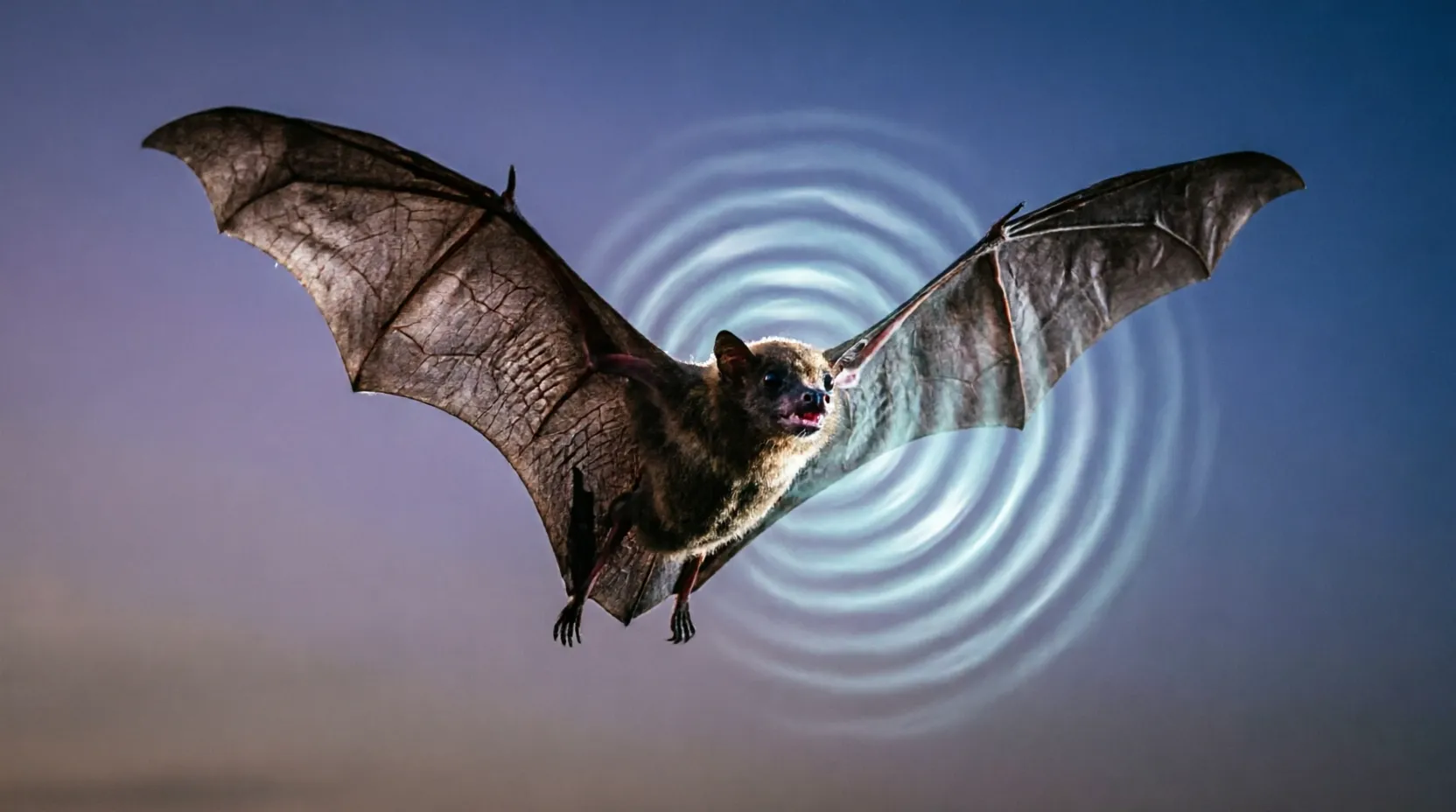
Visual answer
How Bat Echolocation Works
Bats emit ultrasonic pulses and analyze returning echoes to build a 3D acoustic map.
Ultrasonic call
Bat produces high-frequency sound from larynx or nose.
Sound waves travel
Calls travel outward at the speed of sound.
Echo returns
Sound bounces off objects (moth, tree, wire) and returns to bat's ears.
Brain processes
Time delay gives distance; ear difference gives direction; Doppler gives velocity.
Not deafening themselves
The Mystery: How Do Bats Not Deafen Themselves?
Some bat calls reach 120 decibels - equivalent to a loud rock concert inches from your ear. Yet bats hear returning echoes that may be 2,000 times quieter. The solution: a tiny muscle in the middle ear (the stapedius) contracts milliseconds before each call, decoupling the three ear bones and dramatically reducing sensitivity during the call. It relaxes just in time to receive the echo - a neural timing feat that must be executed tens of times per second during active hunting.
Biological sonar
The Mechanism: Biological Sonar
Bat echolocation is a full acoustic sensing system with specialized hardware for emission, reception, and neural processing.
Key components: Larynx / Noseleaf (sound production and directionality), Ultrasonic calls (20-200 kHz, providing fine spatial resolution), Large specialized ears (echo reception and focusing), Stapedius muscle (prevents self-deafening), and Doppler shift compensation (extracts precise velocity information).
Catching a moth
Echolocation in Action: Catching a Moth
1. Search phase - In open air, the bat emits relatively slow, low-frequency calls (10-30 per second) to survey its environment.
2. Target detection - When an echo returns suggesting an insect, the bat increases call rate and focuses attention on that target.
3. Approach phase - Call rate increases (30-50 per second) and frequency shifts to obtain finer spatial detail.
4. Terminal buzz - Just before capture, the bat fires up to 200 calls per second - a blur of acoustic probes giving centimeter-precise targeting.
5. Capture - The bat scoops the moth with its wing membrane or tail pouch, using echolocation data to intercept the predicted position.
Evolutionary purpose
Why Did Echolocation Evolve?
Bats are predominantly nocturnal insectivores. The night sky is rich in flying insects, but visual hunting in darkness is inefficient. Acoustic hunting using echolocation allowed bats to exploit a food resource inaccessible to most other animals, driving the extraordinary diversification of Chiroptera - over 1,400 species, roughly 20 percent of all mammal species.
Benefits include: Night hunting (no visual predator can compete), Precise 3D mapping (distance, direction, size, velocity, texture), and Social communication (mothers and pups identify each other by voice among millions in a cave roost).
Bat vs dolphin
Bat Echolocation vs. Dolphin Echolocation
Medium
Bat: Air / Dolphin: Water
Call frequency range
Bat: 20-200 kHz / Dolphin: 0.2-150 kHz
Sound production organ
Bat: Larynx or noseleaf / Dolphin: Nasal sacs and melon
Reception organ
Bat: External ears (pinnae) / Dolphin: Lower jaw (fat-filled channel)
Genetic origin
Both: Convergent evolution using same gene mutations (prestin)
Examples
Remarkable Bat Echolocation Abilities
Greater Bulldog Bat: This bat hunts fish by detecting ripples on the water surface with echolocation. It can distinguish a fish-caused ripple from wind chop, then pluck the fish with its large hind claws.
Spotted Bat: One of few bats whose calls are low enough (9 kHz) for humans to hear - described as loud metallic clicks. It hunts large moths by flying slowly above them.
Greater Horseshoe Bat: Uses constant-frequency calls and has an acoustic fovea in its cochlea specially tuned to the specific frequency at which its echo returns when tracking fluttering moth wings.
Western Barbastelle: Calls 100 times quieter than most bats to avoid detection by moths that have evolved ears specifically tuned to bat echolocation - an evolutionary arms race.
Myths vs reality
Myth vs Reality: Bat Echolocation
What people think
Bats are blind
Bats cannot see and rely entirely on echolocation.
What actually happens
All bats have functional eyes; many use vision extensively
Echolocation supplements vision, particularly in low light. Fruit bats rely mostly on vision and do not echolocate.
Surprising facts
Surprising Facts About Bat Echolocation
Bat calls can reach 120 decibels - louder than a rock concert - yet because the calls are ultrasonic, they are inaudible to humans. If they were in human hearing range, a bat calling next to your ear could damage your hearing.
Bats and dolphins evolved echolocation independently - using the same mutations. A 2010 study found nearly identical changes to the hearing gene prestin in both groups - one of the most striking known examples of convergent molecular evolution.
Bats can detect an object the width of a human hair in total darkness. Laboratory experiments show bats can perceive wires as thin as 0.1 millimeter.
Quick answers
Common questions
How does bat echolocation work? +
Bats emit pulses of ultrasonic sound (20-200 kHz) from their larynx or nose. The sound bounces off objects and returns as echoes, which the bat analyzes to determine distance (time delay), direction (ear differences), velocity (Doppler shift), and object properties (echo pattern).
Can humans hear bat echolocation? +
Most bat calls are ultrasonic - above the 20 kHz limit of human hearing. A few species, like the spotted bat, call as low as 9 kHz, which some humans can hear. Bat detectors convert ultrasonic calls to audible frequencies for researchers.
How accurate is bat echolocation? +
Extremely accurate. Bats can detect wires as thin as 0.1 millimeter, discriminate between objects differing by millimeters, and intercept erratically flying insects in total darkness.
Are bats blind? +
No - all bat species have functional eyes. Bats are not blind; they use echolocation to supplement vision in low light or darkness. In daylight, many bats rely primarily on vision.
Do other animals use echolocation? +
Yes. Dolphins, whales, porpoises, some shrews, a few cave-dwelling birds (oilbirds and swiftlets), and humans trained in a specific technique all use echolocation.