Visual answer
The Process of Natural Selection
Individuals with advantageous traits survive and reproduce more, passing those traits to the next generation.
Variation
Individuals in a population have different heritable traits.
Selection pressure
Environmental conditions make some traits more beneficial for survival.
Differential reproduction
Individuals with beneficial traits leave more offspring.
Inheritance
Offspring inherit the beneficial traits, which become more common over generations.
Random mutation puzzle
The Mystery: How Does Undirected Variation Produce Complexity?
Mutations are random - they do not arise because an organism 'needs' them. Yet life has produced eyes, sonar, photosynthesis, and the human brain. The resolution is that natural selection is not random: it systematically retains variants that improve survival and reproduction in a given environment. Over vast timescales, the cumulative filtering of countless small mutations can build staggeringly intricate adaptations.
Five forces
The Five Forces of Evolutionary Change
No single mechanism drives evolution. The modern evolutionary synthesis recognizes five interconnected forces that together explain the diversity and complexity of life.
Natural selection: non-random filtering of heritable variation. Individuals with traits that improve survival or reproduction leave more offspring. This is the only evolutionary mechanism that consistently produces adaptation.
Mutation: source of new genetic variation. Random errors in DNA copying, plus external damage from radiation and chemicals, create new alleles. Most mutations are neutral or slightly harmful; a small fraction are beneficial.
Genetic drift: random change in allele frequencies. Even in the absence of selection, allele frequencies fluctuate by chance. In small populations these random fluctuations can be dramatic - causing beneficial alleles to disappear and harmful ones to spread.
Gene flow: exchange of alleles between populations. When individuals migrate and reproduce, they carry alleles with them. Gene flow reduces genetic differences between populations.
Sexual selection: selection driven by mate choice. Traits that improve success in attracting or competing for mates spread even if they reduce survival - explaining peacock tails and elk antlers.
Selection steps
How Natural Selection Works Step by Step
1. Variation exists in a population - Individuals differ in heritable traits due to accumulated mutations and genetic recombination during reproduction.
2. Resources are limited - Not all individuals can survive and reproduce to their full potential; food, mates, and territory are finite.
3. Differential survival and reproduction - Individuals whose traits better match their environment tend to survive longer and leave more offspring than those with less suited traits.
4. Inheritance - Offspring inherit traits from parents via DNA, so better-suited traits become more common in each successive generation.
5. Accumulation over generations - Repeated across thousands or millions of generations, this filtering process can produce radically different organisms from a common ancestor - the process of speciation.
Why it matters
Why Does Evolution Matter?
Understanding evolution is foundational to medicine, conservation, agriculture, and biotechnology. Antibiotic resistance arises because bacteria evolve by natural selection in the presence of drugs. Vaccines must be reformulated because viruses evolve rapidly. Crop breeding and conservation of endangered species both rely on evolutionary principles.
Benefits include: explaining biodiversity (the unifying theory of why millions of species exist), predicting antibiotic resistance (essential to designing effective treatment strategies), and informing conservation (understanding genetic diversity guides breeding programs for endangered species).
Mechanisms compared
Comparing Evolutionary Mechanisms
Natural Selection
Non-random, produces adaptation, requires heritable variation and differential reproduction.
Mutation
Random, creates new alleles, usually neutral or harmful, provides raw material.
Genetic Drift
Random, most powerful in small populations, can fix harmful alleles by chance.
Gene Flow
Moves alleles between populations, reduces genetic differences, can introduce new variants.
Real examples
Evolution in Action
Peppered moths: Before industrialization, light-colored moths were camouflaged on pale tree bark; dark variants were rare. Industrial soot darkened tree bark, making light moths visible to predators. Within decades, dark moths dominated - a textbook example of selection shifting allele frequencies.
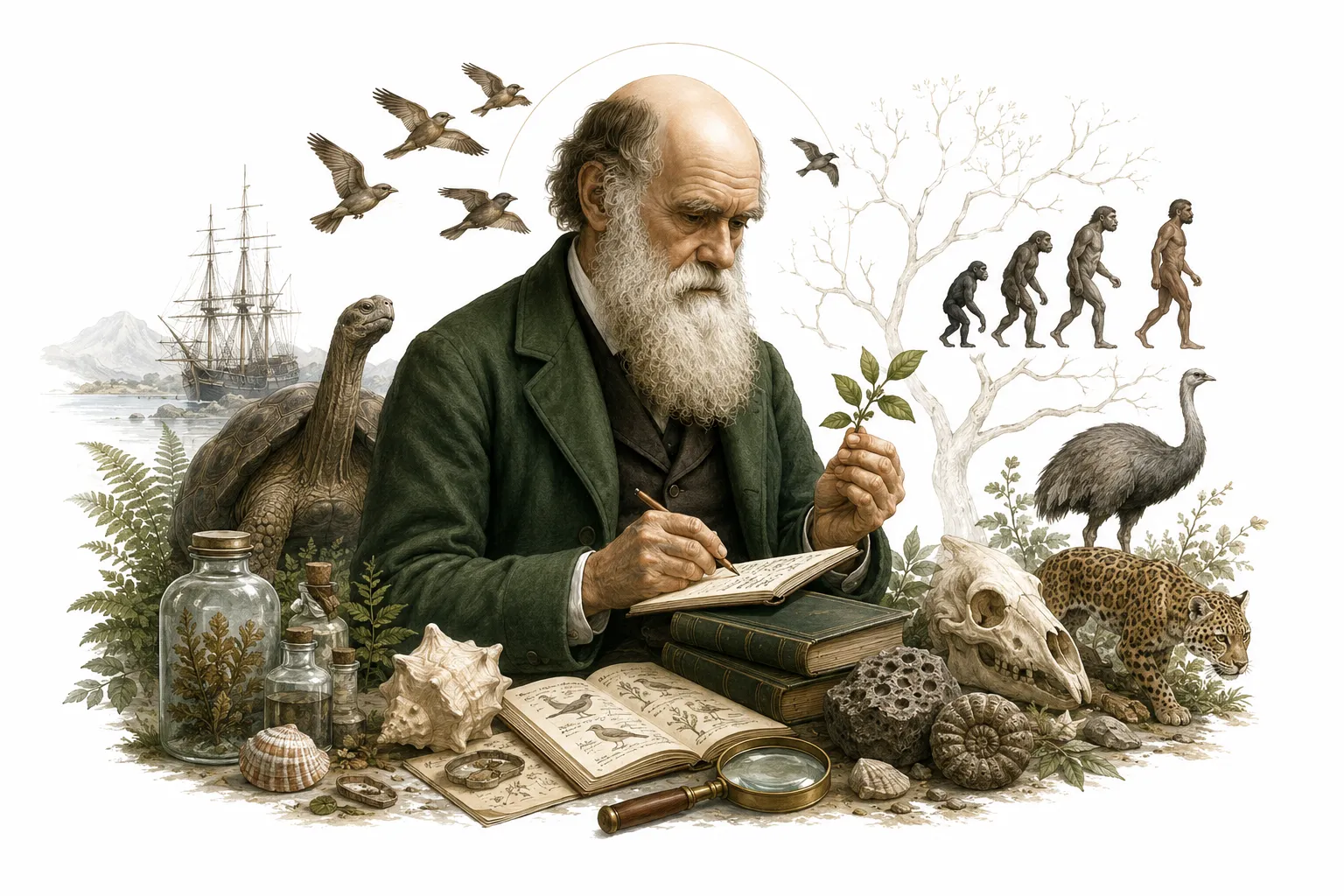
Darwin's finches: Fourteen finch species on the Galapagos Islands descended from a single ancestral species. Differences in beak shape evolved as finches adapted to different food sources - seeds, insects, cactus nectar - on different islands.
Antibiotic-resistant bacteria: A tiny fraction of bacteria in any population carry mutations that reduce antibiotic effectiveness. When antibiotics kill the susceptible majority, resistant individuals survive and reproduce, rapidly transforming the population.
Human lactase persistence: Most mammals lose the ability to digest lactose after weaning. In populations that domesticated cattle, mutations keeping the lactase gene active into adulthood spread strongly because milk provided a caloric advantage - a recent example of human evolution.
Myths vs reality
Myth vs Reality: Evolution
What people think
Evolution always leads to progress or increased complexity
Evolution produces 'better' organisms over time, moving from simple to complex.
What actually happens
Evolution produces adaptation, not progress toward a goal
Some lineages become structurally simpler over time - parasites often lose organs their free-living ancestors had. 'Better' means better adapted to current conditions, not universally more advanced.
Surprising facts
Surprising Facts About Evolution
Most of your genome is viral in origin. Roughly 8 percent of the human genome consists of remnants of ancient retroviruses that integrated into ancestral germ-line cells and have been carried forward ever since.
Some evolution is non-adaptive. Genetic drift means alleles can become fixed in a population purely by chance, regardless of whether they help or harm the organism.
Bats and dolphins independently evolved echolocation. Despite being separated by roughly 90 million years of evolution, both groups share nearly identical mutations in the hearing-related gene prestin - a remarkable case of convergent evolution.
Quick answers
Common questions
What is natural selection? +
Natural selection is the process by which heritable traits that improve survival or reproduction become more common in a population over successive generations. It was described by Charles Darwin in 'On the Origin of Species' (1859).
How do mutations drive evolution? +
Mutations introduce new alleles (gene variants) into a population. Most are neutral or slightly harmful, but a small proportion increase fitness in a given environment. Natural selection then acts on these variants, spreading beneficial ones and removing harmful ones.
What is the difference between natural selection and genetic drift? +
Natural selection is non-random: variants that aid survival and reproduction spread systematically. Genetic drift is random: allele frequencies change by chance, especially in small populations, regardless of whether a trait is helpful or harmful.
How long does evolution take? +
It depends on generation time, population size, and selection pressure. Bacteria can evolve antibiotic resistance in days. Observable evolution in vertebrates has been documented in decades. Major body-plan changes typically require millions of years.
Can humans still evolve? +
Yes. Genetic variation exists, reproduction is not perfectly equal across individuals, and some traits are heritable - all conditions for evolution by natural selection. Modern medicine and culture change selection pressures but do not stop evolution.