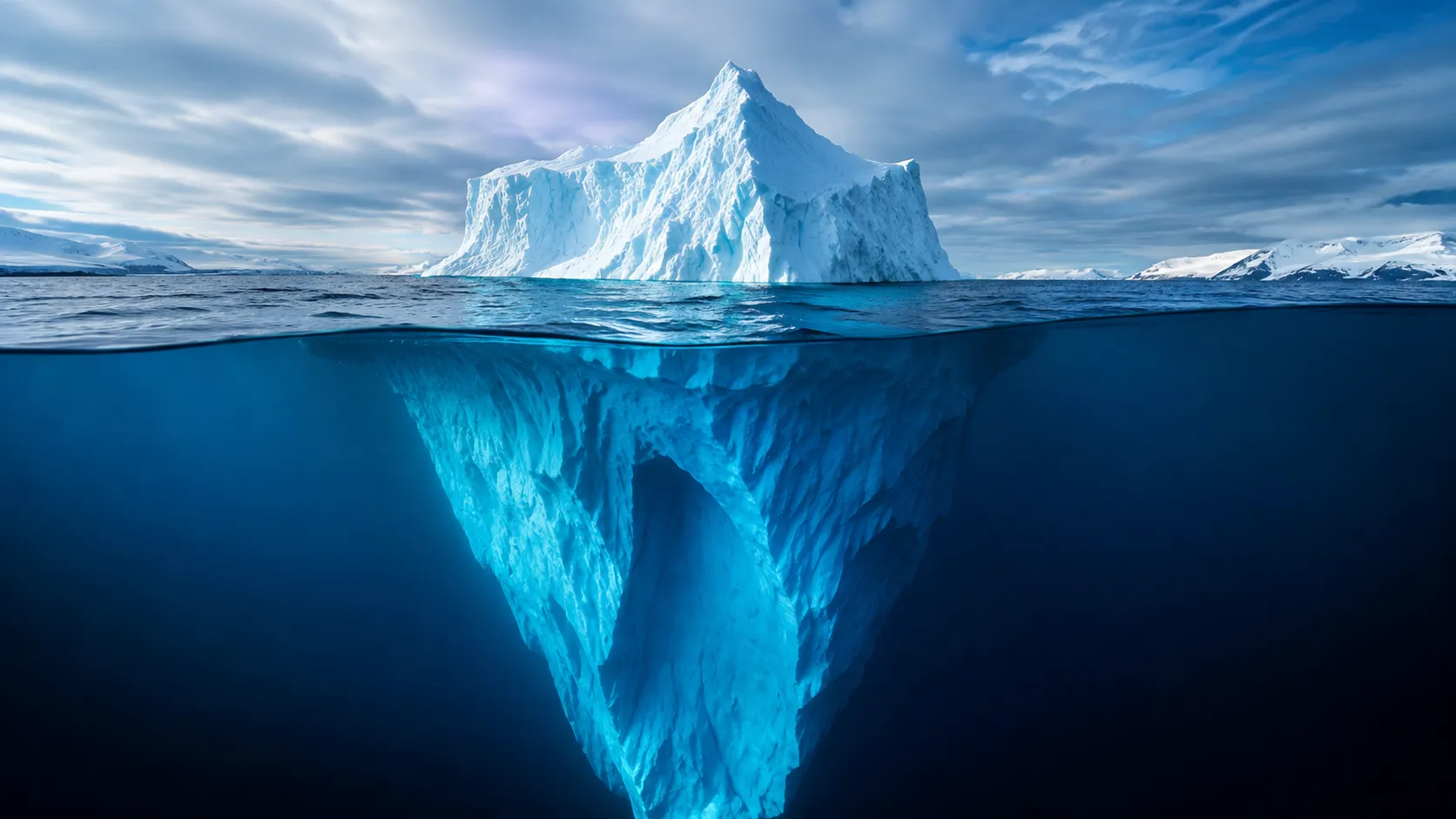
Visual answer
How Water Filters Light to Produce the Color of the Ocean
Why the same water that looks clear in a glass looks vivid blue across kilometers of depth.
Sunlight enters the ocean
White sunlight carries all visible wavelengths. All enter the water surface, though some reflects immediately at the air-water interface depending on sun angle.
Red and yellow light is absorbed by water molecules
Water molecules vibrate at frequencies that match red and infrared photon energy. Red light is absorbed within the first few meters. Orange and yellow penetrate further but are absorbed by 10 to 30 meters.
Blue light penetrates deeply and scatters
Blue light has shorter wavelengths that water absorbs poorly. It travels much deeper and is scattered by water molecules in all directions, similar to Rayleigh scattering in the atmosphere.
Blue light reaches the observer
The upward-scattered blue light is what emerges from the water surface and reaches the observer. The absence of red, orange, and yellow, and the abundance of scattered blue, makes the ocean appear blue.
Why the shade varies
Ocean Color Is a Map of What Is Living and Moving in the Water
The blue-to-green spectrum of ocean color tracks biological activity. Open ocean gyres with little nutrient upwelling are deep blue and nearly lifeless in terms of plankton density. Phytoplankton blooms in more productive waters add green and yellow-green chlorophyll pigments to the water, shifting its color visibly. Satellites can map global ocean productivity purely by analyzing the color of the water surface.
Sediment from rivers creates brown and yellow-brown coastal water. Glacial meltwater carries rock flour, extremely fine particles from glacial grinding, that produces distinctive milky turquoise in lakes and fjords. Red tides are caused by dense blooms of certain algae producing reddish-brown pigments. Bioluminescent bays glow blue-green at night from light-producing dinoflagellates.
Water temperature also influences color indirectly. Warmer water is less dense and stratifies, reducing nutrient mixing and producing clearer, deeper blue water. Cold, well-mixed water supports more life and tends to be more green-tinted. The deep indigo blue of tropical open ocean is partly a consequence of its biological desert status.
Why different oceans look different
Why Different Ocean Environments Have Different Colors
Deep open ocean
Color: deep indigo blue. Cause: very clear water, high depth, no sediment or significant biological material to add other wavelengths.
Shallow tropical reef
Color: bright turquoise or cyan. Cause: white sand bottom reflects light back, limited depth means less red absorption, clear water with minimal biological material.
Productive coastal water
Color: green to blue-green. Cause: phytoplankton bloom adds chlorophyll pigment. Higher nutrient levels support more biological activity and organic material.
River-influenced coastal water
Color: brown, yellow-brown, or murky green. Cause: river-carried sediment, tannins from land, and fresh water with high dissolved organic content.
Myth vs reality
Myth vs Reality
What people think
The ocean is blue because it reflects the sky
Sky reflection contributes to ocean color, especially at low sun angles where surface reflection is strong. But this is a secondary effect. An overcast grey sky above deep ocean still shows blue-green water because the intrinsic absorption and scattering properties of water dominate the color. The ocean's blue is real, not borrowed from the sky.
What actually happens
Water absorbs red light and the ocean color is an intrinsic optical property of water itself
Measurements of ocean color from below the surface, where sky reflection is not a factor, confirm that the blue color persists. The absorption spectrum of liquid water has a genuine trough in the blue region and an absorption peak in the red. This is physics, not reflection.
Quick answers
Common questions
Why does water in a glass not look blue? +
The path length through water in a glass is only a few centimeters. The red light absorption is proportional to path length. A few centimeters of water absorbs a negligible fraction of red light. You need meters to tens of meters before the cumulative effect becomes visible.
Why are some lakes and seas different colors? +
Mineral content, dissolved organic matter, algae, depth, and sediment all modify water color. Copper sulfate deposits create vivid turquoise lakes. Volcanic activity creates yellow-green sulfur-colored water. The Dead Sea appears blue-green due to its exceptional clarity despite extremely high salinity.
Why does water look different depending on the angle you look at it? +
At low angles close to horizontal, the water surface acts as a mirror and reflects the sky. At steeper angles or from above, you see through the surface into the water column and its intrinsic color dominates. This is why water looks different from a boat railing versus looking straight down into it.
Do underwater light conditions affect marine animals' color vision? +
Yes. Many deep sea animals have visual systems tuned specifically to blue wavelengths because that is the only light that penetrates to depth. Some have no color vision at all. Shallow reef fish typically have more complex color vision, and some can detect ultraviolet wavelengths invisible to humans.
Why does the ocean sometimes look silver or grey? +
Under overcast conditions with low contrast lighting, the surface reflection of a grey sky dominates over the water's intrinsic blue, giving the appearance of grey or silver water. Strong chop or whitecap conditions scatter all wavelengths equally from the surface foam, reducing the blue signal further.