Quick Facts
Quick Facts
The objective lens forms the first image.
That first image is already inverted.
The eyepiece enlarges the image but doesn't flip it back.
Modern digital microscopes can rotate the image electronically.
Visual answer
Why microscope images look inverted
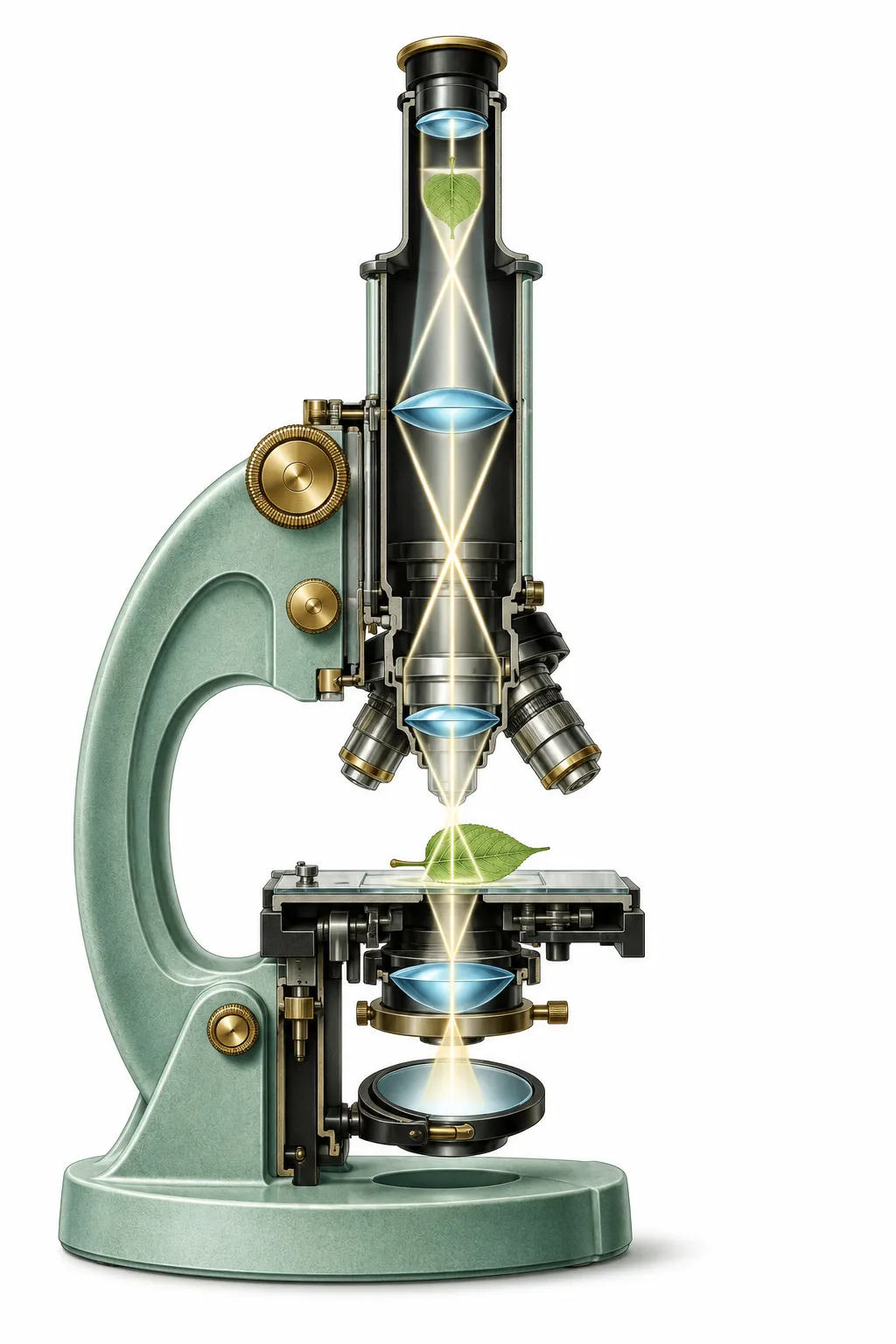
The diagram shows how lenses bend light rays so the final microscope image appears flipped compared with the specimen.
Light leaves specimen
Light from the sample enters the objective lens.
Rays cross
The lens bends rays through a focus, reversing their positions.
Image flips
The eyepiece magnifies the already inverted image.
Crossing Rays
Light Likes To Cross Over
Every point on an object sends light in many directions.
The microscope's objective lens bends those rays inward until they meet at a focal point.
During that journey, rays from the top cross below, while rays from the bottom cross above. The image naturally becomes inverted.
Eyepiece
The Eyepiece Doesn't Fix It
Once the objective has produced the upside-down image, the eyepiece simply acts like a magnifying glass.
Its job is to make the image appear larger, not to rotate it.
That's why moving a microscope slide left often makes the image appear to move right, which can feel surprisingly awkward at first.
Analogy
Two Crowds Crossing A Bridge
The familiar part
Imagine two groups of people starting on opposite sides of a bridge and walking toward each other. By the time they finish crossing, they've swapped sides.
How it applies
Light rays behave similarly when passing through a convex lens. They cross at the focus, causing the image to flip.
Where the analogy breaks
Fortunately, light never argues about who gets the better view.
Curiosity Notes
Details Most People Miss
Why this still matters
Why This Still Matters
Every biology student, medical researcher, and microbiologist works with this optical quirk. Understanding why images flip also explains how cameras, telescopes, binoculars, and even your own eyes form images.
Key Findings
- ✓Core findingThe objective lens flips the image naturally.
- ✓Strong evidenceLight rays cross at the focal point.
- ⚠Main consequenceThe eyepiece magnifies but doesn't rotate the image.
- ✓Wider legacyDigital microscopes often correct the orientation electronically.
Final insight
A Last Thought
The remarkable thing isn't that microscopes turn tiny creatures upside down. It's that a simple piece of curved glass can persuade light to cross paths so neatly that an invisible world suddenly becomes visibleeven if it does insist on entering the room headfirst.
Quick answers
Common questions
Why does the image move the opposite way? +
Because the image is inverted. Moving the slide left makes the viewed image appear to move right.
Do all microscopes invert images? +
Most compound optical microscopes do. Some modern digital systems rotate the image electronically before displaying it.