Visual answer
How Snow Turns Transparent Ice Crystals Into a White Surface
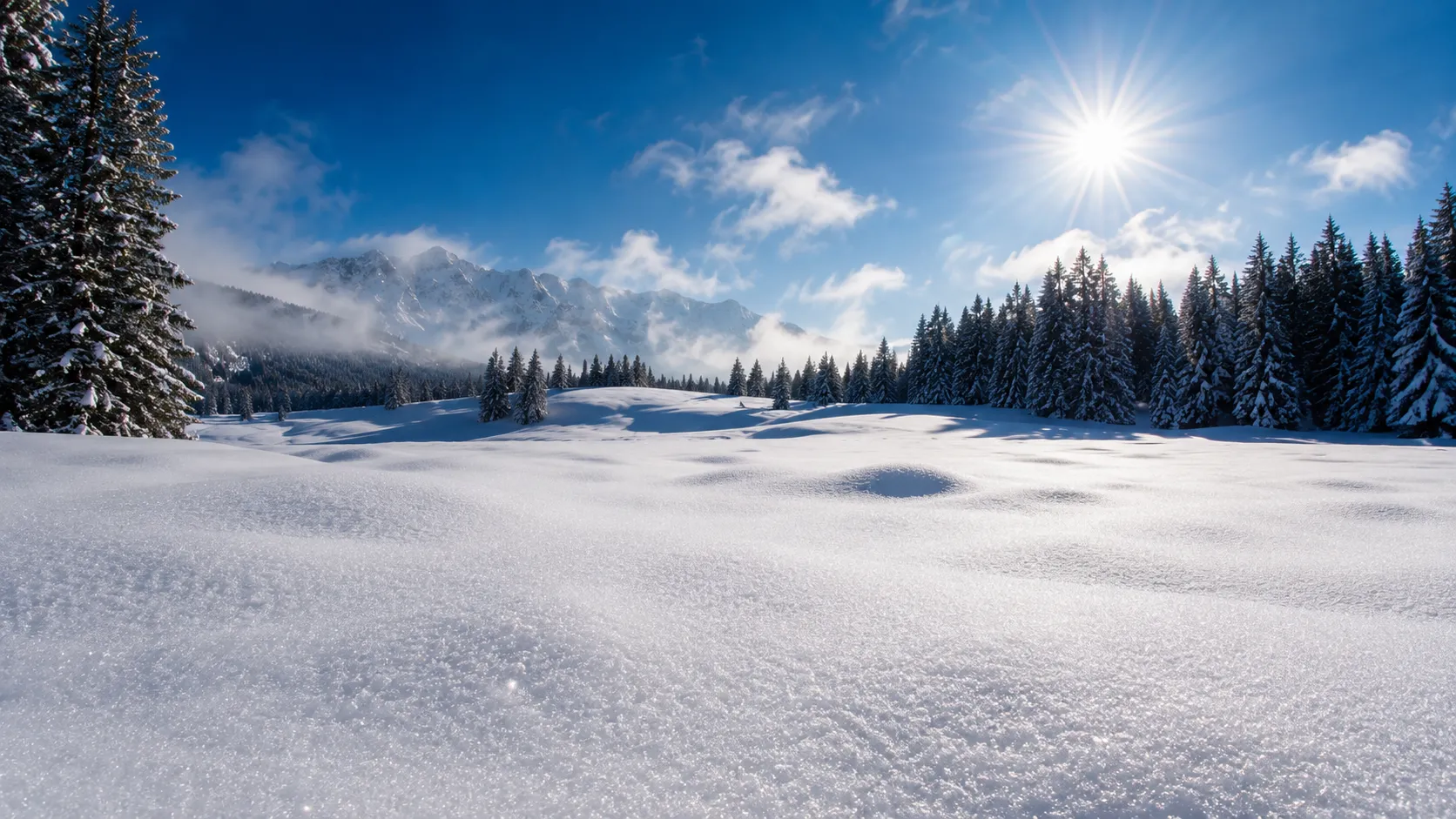
Light enters a snowpack and bounces between countless crystal surfaces before exiting in all directions.
Sunlight enters the snow surface
White sunlight carrying all visible wavelengths hits the top layer of snow crystals. Each crystal is individually transparent.
Light refracts at each crystal boundary
At every air-to-ice interface, light bends. With millions of crystals packed together, a single ray encounters many boundaries in milliseconds.
All wavelengths scatter equally
Unlike Rayleigh scattering in the atmosphere, scattering at ice-crystal boundaries affects all visible wavelengths roughly equally. No color is favored.
Full-spectrum light exits toward your eyes
Because all colors scatter back in equal proportions, your eyes receive the complete visible spectrum at once. The brain interprets this as white.
The physics
It Is All About Scattering at Crystal Boundaries
The technical term for what snow does is diffuse reflection. When light hits a smooth surface like a mirror or calm water, it reflects in one clean direction. When light hits a rough or complex surface with many tiny interfaces, it bounces in every direction.
A snowflake has a crystalline structure with flat facets, branches, and internal layers, all surrounded by air. When light enters a snowpack, it almost immediately hits an ice-air interface and refracts. Then it hits another. Each bounce scatters all colors roughly equally.
The result is that nearly all the light that enters snow exits again very quickly, carrying the full visible spectrum. That is white.
Myth vs reality
Myth vs Reality
What people think
Snow is white because ice is white
Ice is not white. A thick block of clear ice is nearly colorless and transparent. Snow's whiteness comes from its fragmented crystalline structure, not from any inherent color in ice or water.
What actually happens
Structure creates the color, not the material
Crush many transparent materials into tiny pieces and they turn white. The countless surfaces scatter all light equally. Melt snow and it returns to clear water.
Snow vs ice
Why Snow Looks Different From Ice
Structure
Snow: loosely packed crystals with air gaps between them. Ice: continuous solid with few internal boundaries.
Light behavior
Snow: scatters all wavelengths equally at thousands of interfaces. Ice: transmits light with minimal scattering.
Apparent color
Snow: white because full-spectrum light scatters back. Ice: clear to faintly blue depending on depth and purity.
Light absorption
Snow: absorbs very little, reflects most. Glacier ice: absorbs slightly more red, which is why deep ice looks blue.
Quick answers
Common questions
Why is snow white if water is clear? +
Water is clear because light passes straight through it. Snow is made of millions of tiny ice crystals that scatter light at every surface. All colors scatter equally, so the combined exit light is white.
Why does old or compacted snow sometimes look blue or grey? +
Older snow has fewer air pockets and more compressed ice. Light travels deeper before scattering, and ice absorbs slightly more red light over long paths, shifting the color toward blue. Grey snow often has surface dirt or pollution.
Can snow be other colors? +
Yes. Pink snow can be caused by algae, yellow snow is typically from pollen or urine, and black snow can come from pollution. The base structure still scatters white; the color comes from added pigments.
Why does crushed ice in a drink look white? +
Same reason as snow. A solid ice cube is clear, but crushing it creates countless tiny surfaces that scatter all wavelengths of light equally.