Quick Facts
Quick Facts
A magnifying glass uses a convex lens.
The lens bends parallel rays of sunlight toward one point.
The smallest, brightest spot is called the focal point.
Cloudy weather greatly reduces the effect because less sunlight reaches the lens.
Visual answer
How a magnifying glass burns things
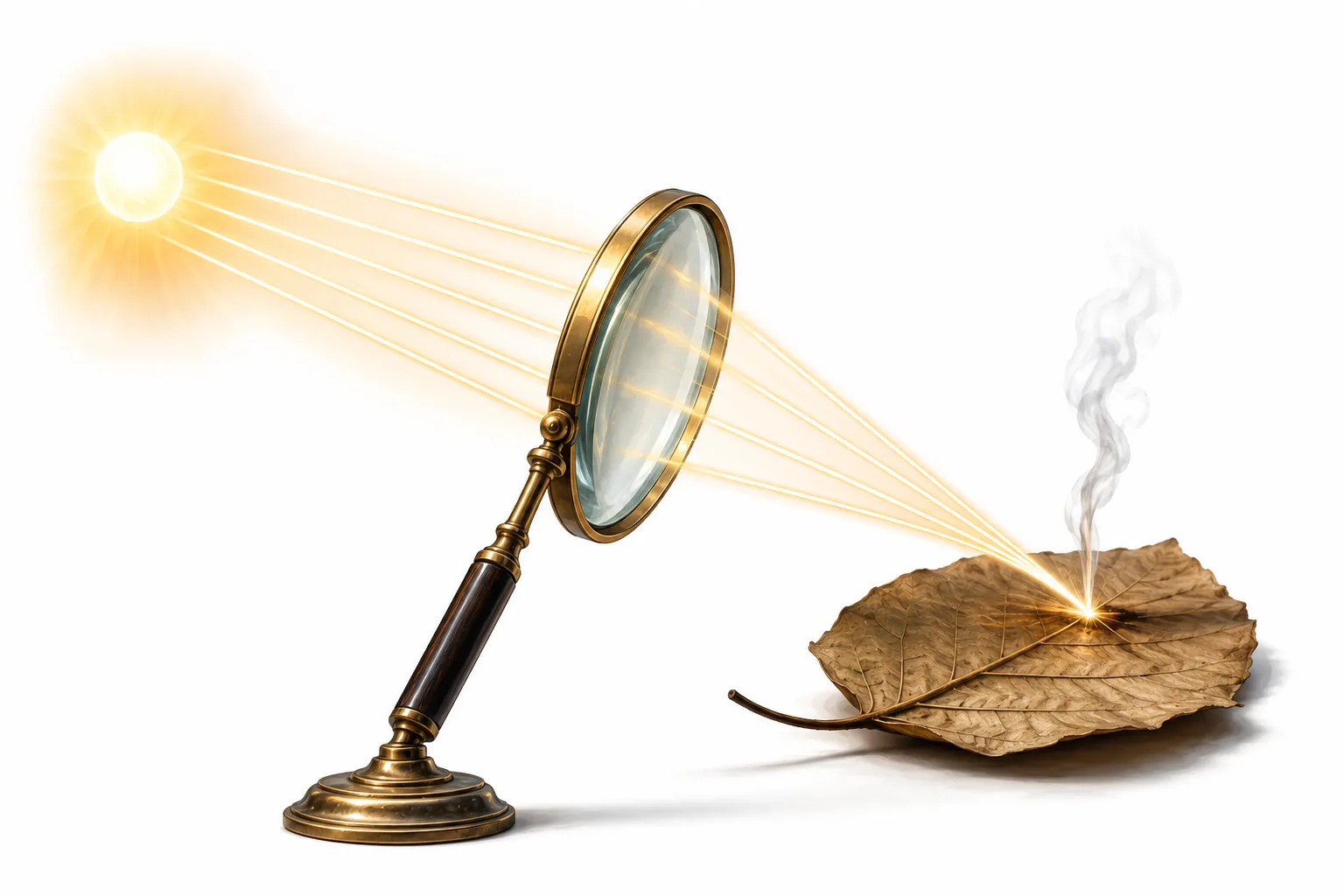
The diagram shows sunlight being concentrated by a convex lens into a small hot focal point.
Sunlight enters
Nearly parallel sunlight reaches the curved lens.
Lens bends rays
The convex glass refracts the rays toward one point.
Heat concentrates
Energy packed into a tiny spot can ignite dry material.
Focusing Light
The Lens Is A Light Collector
Sunlight arrives at Earth in nearly parallel rays because the Sun is so incredibly far away.
A convex lens bends those rays inward until they meet at a tiny point called the focus.
The energy hasn't increased. It has simply been concentrated into a much smaller area, causing the temperature to rise dramatically.
Why It Burns
Eventually The Material Gives Up
Paper, dry leaves, and wood all have ignition temperatures.
When enough sunlight is concentrated onto one tiny spot, that spot becomes hotter and hotter until the material begins to smoke or ignite.
Dark materials usually heat up faster because they absorb more sunlight than lighter ones.
Analogy
Packing A Concert Into A Closet
The familiar part
Imagine moving everyone from a football stadium into a small closet. The number of people hasn't changed, but the crowd becomes far more intense.
How it applies
A magnifying glass does something similar with sunlight. The amount of energy stays almost the same, but it's packed into a tiny space.
Where the analogy breaks
Unlike concertgoers, photons don't complain about personal space.
Curiosity Notes
Details Most People Miss
Why this still matters
Why This Still Matters
The same optical principle is used in cameras, telescopes, microscopes, solar cookers, and renewable-energy systems. Understanding how lenses focus light helps explain countless technologies around us.
Key Findings
- ✓Core findingA magnifying glass uses a convex lens.
- ✓Strong evidenceThe lens focuses sunlight into a tiny point.
- ⚠Main consequenceThe concentrated energy raises the temperature.
- ✓Wider legacyNothing new is createdthe sunlight is simply concentrated.
Final insight
A Last Thought
A magnifying glass feels almost magical because it lets you borrow a tiny fraction of the Sun's enormous power. It doesn't invent heat or summon fire. It simply convinces light that has traveled about 150 million kilometers across space to arrive together at one impossibly small pointand that's enough to start a flame.
Quick answers
Common questions
Can a magnifying glass burn things without sunlight? +
Not usually. It needs a strong source of parallel light, and the Sun provides that naturally.
Why does the bright spot have to be so small? +
The smaller the focused spot, the more energy is concentrated into each square millimeter, producing higher temperatures.