Quick Facts
Quick Facts
Pythagoras believed in reincarnation. He thought souls could be reborn in animals, plants, and even beans.
Beans resemble testicles. Some ancient Greeks believed beans were related to human reproduction.
Beans cause flatulence. Pythagoras believed that passing gas expelled the 'breath of life' from the body.
The ban on beans applied to all members of the Pythagorean Brotherhood.
The Roman writer Cicero reported that Pythagoras would not even allow beans to be placed on the same table as food.
Visual answer
The Many Reasons Pythagoras Hated Beans
A mathematician's bizarre legume phobia explained.
Souls of the Dead
Pythagoras believed that beans contained the souls of the deceased. Eating a bean was therefore a form of cannibalism.
Flatulence
Beans cause gas. Pythagoras believed that flatulence expelled the 'pneuma' (breath of life) from the body, harming the soul.
Reproduction
Beans resemble testicles. Some believed beans were related to human generation. Eating them was therefore impure.
The Death Legend
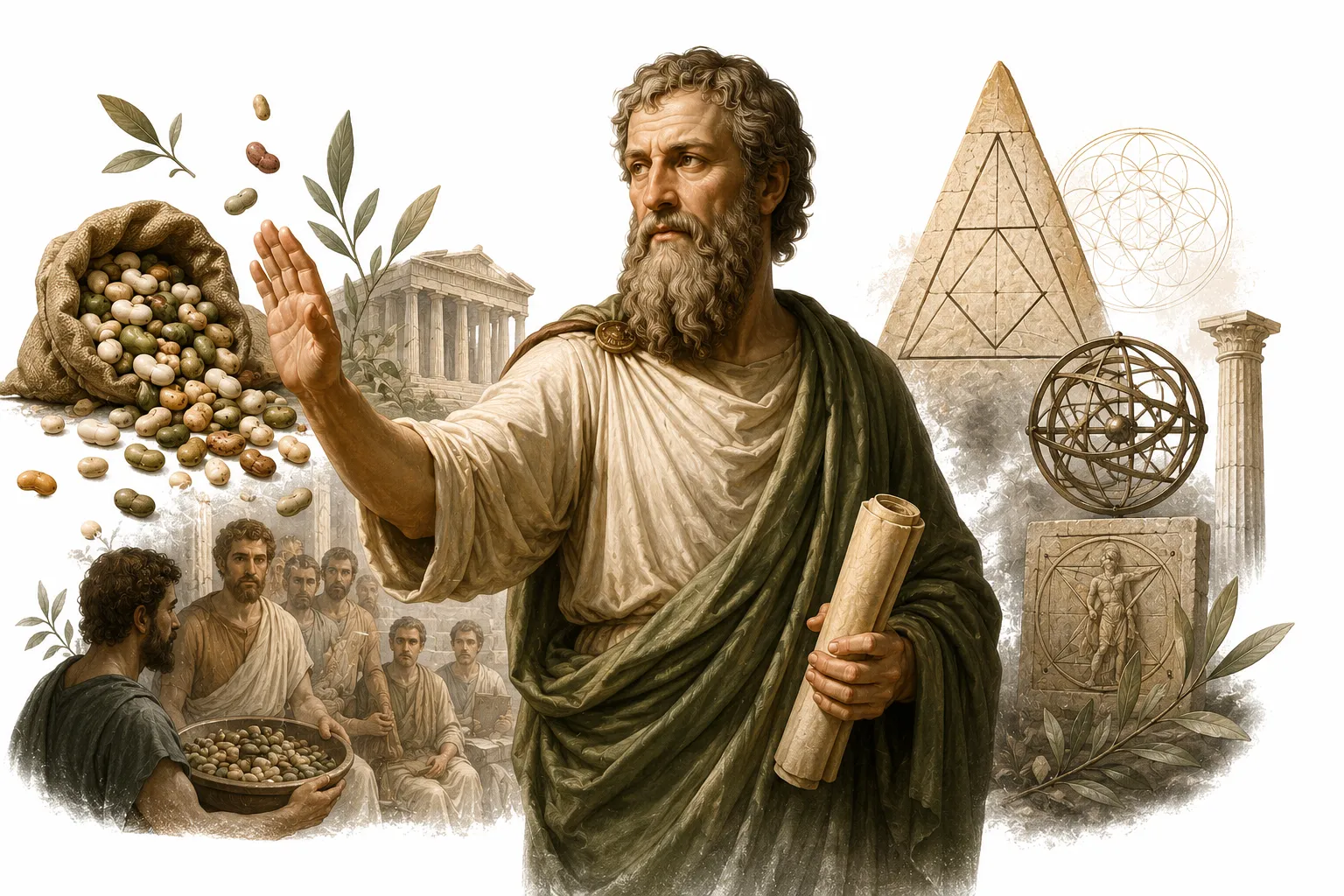
Pythagoras was pursued by enemies. He came to a bean field and refused to run through it. He was caught and killed.
Story in brief
Story in Brief
c. 530 BCE
Pythagoras establishes the Pythagorean Brotherhood in Croton, southern Italy. The community follows strict rules, including the prohibition on beans.
c. 495 BCE
According to legend, enemies of Pythagoras set fire to his house. He fled but came to a bean field. He refused to run through it, preferring to be caught.
He was killed by his pursuers. The bean phobia may have cost him his life.
Later centuries
Greek and Roman writers, including Aristotle and Cicero, report on Pythagoras's bean prohibition. They offer various explanations.
The bean story becomes one of the most famous anecdotes about Pythagoras.
Today
Pythagoras is remembered for the theorem. The bean story is a curious footnote. But it reveals a lot about his worldview.
It reminds us that ancient philosophers were not always rational by modern standards.
The Story
Pythagoras vs. The Bean
Pythagoras was a mathematician. He was also a mystic. He believed that numbers had souls. He believed that the universe was a mathematical harmony. And he believed that beans were evil.
The reasons are complicated. First, Pythagoras believed in reincarnation. He thought that souls could be reborn in animals, plants, and even beans. Eating a bean was therefore a form of cannibalism. You might be eating your grandmother.
Second, beans cause flatulence. Pythagoras believed that the 'pneuma' (breath of life) was the essence of the soul. Passing gas expelled this breath. It was a kind of spiritual leakage. Beans were therefore soul-destroying.
Third, beans resemble testicles. Some ancient Greeks believed that beans were related to human reproduction. Eating beans was therefore impure. It was like eating a human organ.
For all these reasons, Pythagoras banned beans. He would not eat them. He would not touch them. He would not even allow them on the same table as food. And according to legend, he died because of a bean field.
From Diogenes Laertius
"Pythagoras said that men should abstain from beans because they are like testicles, or because they are like the gates of Hades, or because they are harmful to the mind."
, Diogenes Laertius, Lives of Eminent Philosophers
Diogenes collected various explanations for the bean ban. Even he was not sure which one was correct.
Evidence
The Ancient Explanations
Beans contain the souls of the dead (reincarnation theory).
ModerateBeans cause flatulence, which expels the breath of life (pneuma).
ModerateBeans resemble testicles and are therefore impure.
ModerateBeans were associated with voting (black and white beans used as ballots) and Pythagoras opposed democracy.
WeakKey Points
Key Points So Far
Pythagoras banned beans for several reasons: reincarnation, flatulence, and resemblance to testicles.
He believed beans contained the souls of the dead. Eating them was cannibalism.
He believed flatulence expelled the breath of life from the body.
According to legend, he was killed because he refused to run through a bean field.
Analogy
Like a Modern Vegan Who Refuses Meat
The familiar part
Imagine a vegan who believes that animals have souls and that eating them is murder. That vegan will not eat meat. The reasons are ethical and spiritual.
How it applies
Pythagoras was a bean vegan. He believed beans had souls. He believed eating them was murder. The logic is similar. The object is different.
Where the analogy breaks
Modern vegans do not usually believe that passing gas destroys the soul. Pythagoras did.
Curiosity Notes
Details Most People Miss
Why this still matters
Why This Still Matters
The story of Pythagoras and the beans is a reminder that even geniuses have blind spots. The man who gave us the theorem that every schoolchild learns also believed that beans contained human souls. He was brilliant. He was also weird. That is not a contradiction. It is a description of humanity. We are all a mix of brilliance and absurdity. Pythagoras just had a more memorable absurdity.
Key Findings
- ✓Core findingPythagoras banned beans because he believed they contained the souls of the dead.
- ✓Strong evidenceHe also believed that flatulence expelled the 'breath of life' from the body.
- ⚠Main consequenceBeans resemble testicles, which Pythagoras found impure.
- ✓Wider legacyAccording to legend, he was killed because he refused to run through a bean field.
- ★Bottom lineThe bean ban was part of a larger set of Pythagorean dietary and behavioral rules.
Final insight
A Last Thought
Pythagoras hated beans. He thought they were full of souls. He thought they caused flatulence that destroyed the breath of life. He thought they looked like testicles. He would rather die than touch a bean. And according to legend, that is exactly what happened. He was a genius. He was also a nut. That is the story of Pythagoras. The theorem is brilliant. The beans are bizarre. Both are true.
Quick answers
Common questions
Did Pythagoras really die because of beans? +
Maybe. The story is reported by several ancient sources. It could be true. But it could also be a legend invented to explain his bean phobia. We will never know for sure.
Did Pythagoras eat meat? +
No. He was a vegetarian. His vegetarianism was based on the same belief in reincarnation that made him hate beans. He thought animals also contained human souls.