Quick Facts
Quick Facts
Marx moved to London in 1849, after being exiled from mainland Europe.
He lived in a two room apartment in Soho. His family was often hungry.
He spent most of his time in the British Library, researching 'Das Kapital.'
His original grave was in a different part of Highgate Cemetery. It was moved in 1954.
The famous bust on his grave was designed by socialist sculptor Laurence Bradshaw.
Visual answer
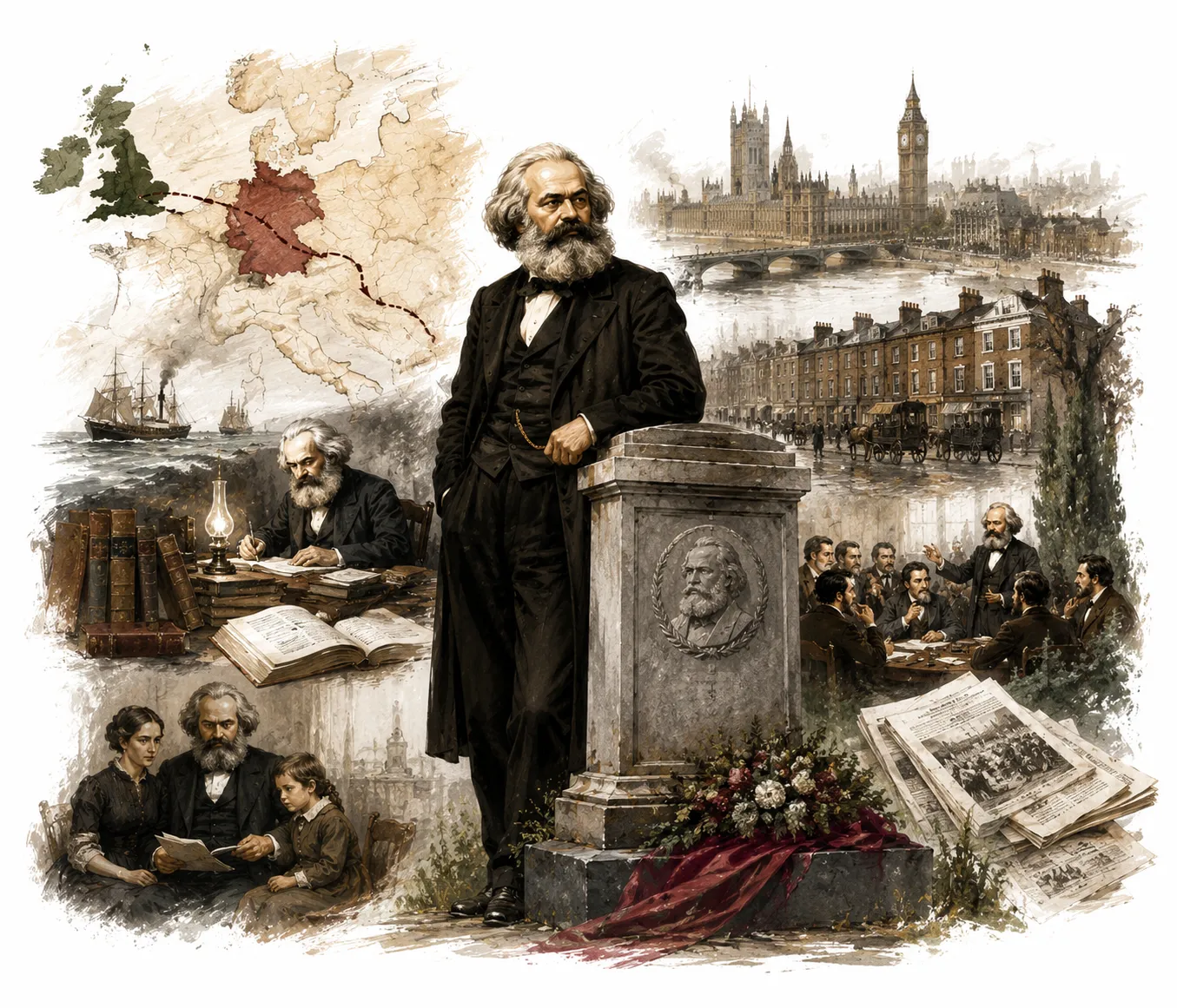
Marx's Path to London
The exiles that brought him to England.
Prussia
Marx is born in Trier. He becomes a journalist. His newspaper is shut down. He is exiled.
France
He moves to Paris. He meets Engels. He is expelled after pressure from Prussia.
Belgium
He moves to Brussels. He writes the Communist Manifesto. He is expelled after the 1848 revolutions.
London
He arrives in 1849. He stays for 34 years. He dies in 1883. He is buried in Highgate.
Story in brief
Story in Brief
1843
Marx is exiled from Prussia. His newspaper has been shut down. He moves to Paris.
His exile begins. He will never live in Germany again.
1845
Marx is expelled from France. He moves to Brussels.
He is running out of countries.
1848
The Communist Manifesto is published. Revolutions erupt across Europe. Marx is expelled from Belgium.
He moves to Cologne. He is expelled again. He goes to Paris. He is expelled again.
1849
Marx arrives in London. He is 31 years old. He will live there for the rest of his life.
London is his final exile. He stays for 34 years.
1883
Marx dies in London. He is 64 years old. He is buried in Highgate Cemetery.
The original grave is modest. A larger monument is added in 1954.
The Story
How the Capitalist Capital Became a Communist Shrine
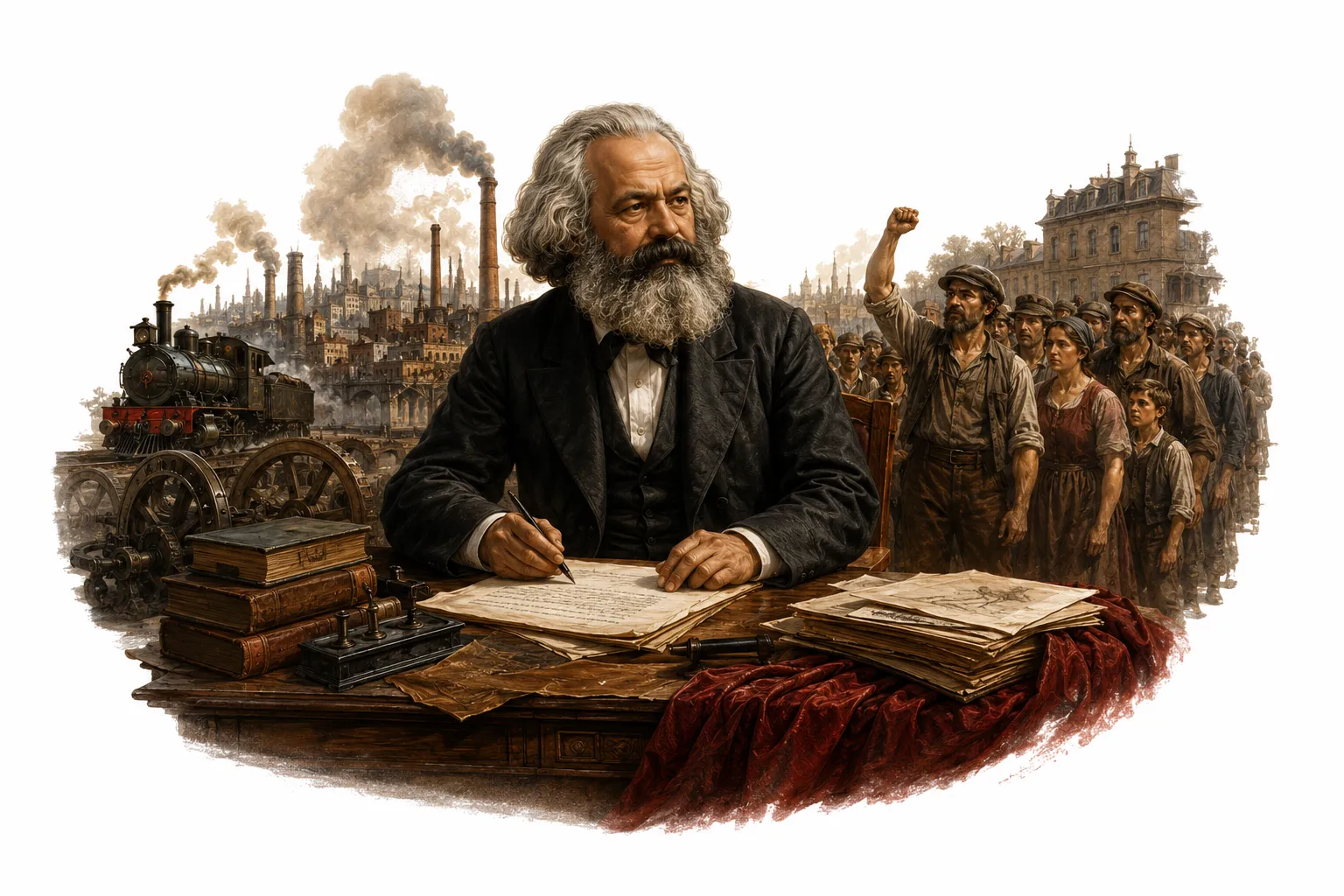
Karl Marx was a professional revolutionary. He was also a professional exile. He was kicked out of Prussia. He was kicked out of France. He was kicked out of Belgium. By 1849, he was running out of countries. London was the only place that would have him.
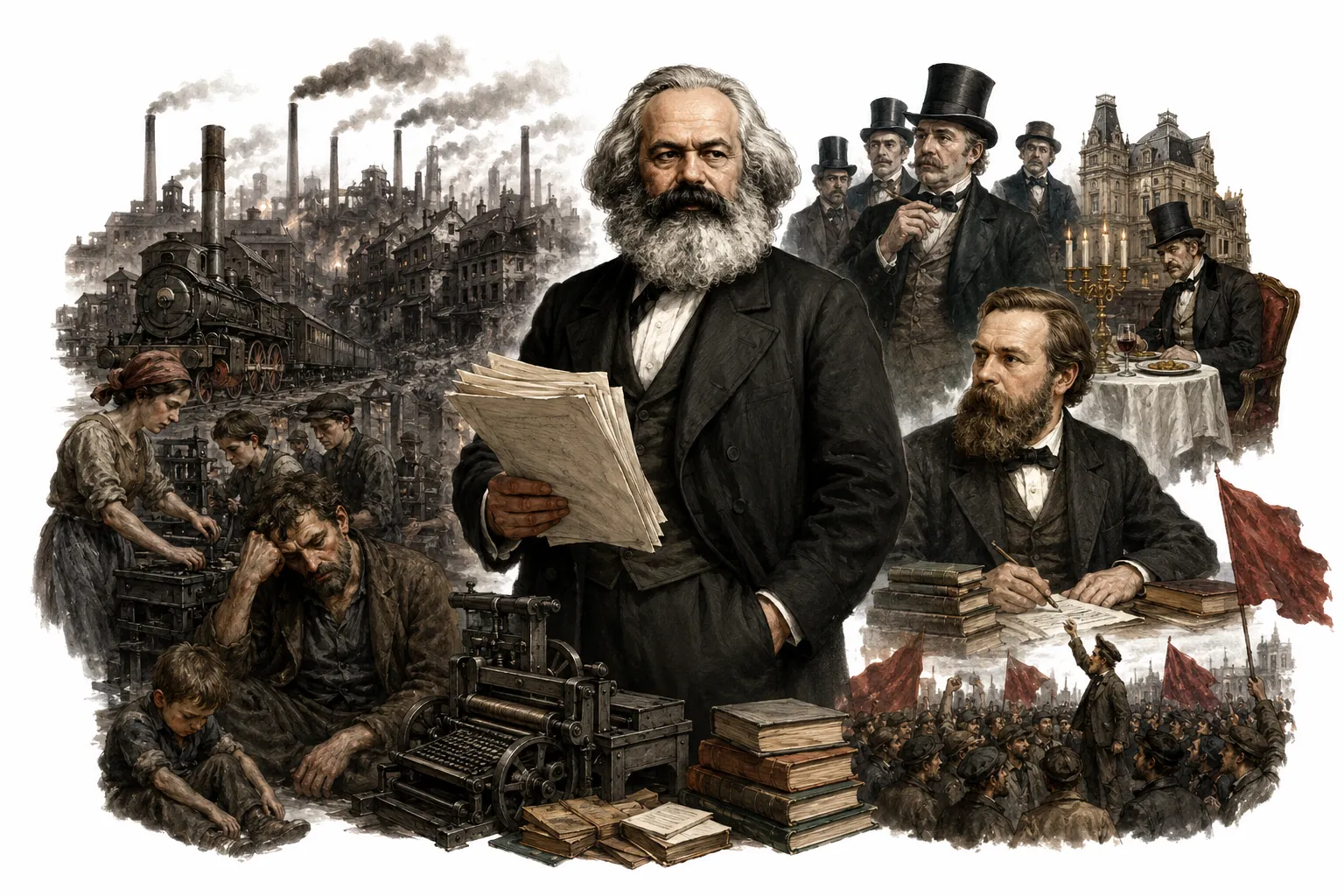
London was the heart of the British Empire. It was the capital of global capitalism. It was everything Marx opposed. But it was also a city of exiles. Revolutionaries from across Europe gathered there. Marx fit right in.
He spent 34 years in London. He wrote 'Das Kapital' in the British Library. He corresponded with socialists around the world. He died in a modest apartment in 1883. He was buried in Highgate Cemetery. His original grave was small and unremarkable. In 1954, the Communist Party of Great Britain erected a large monument with a bronze bust. It is now a pilgrimage site. The man who hated capitalism is buried in the capital of the capitalist world. The irony is not lost on visitors.
From Engels's Speech
"On the 14th of March, at a quarter to three in the afternoon, the greatest living thinker ceased to think."
, Friedrich Engels, funeral speech for Karl Marx
Engels spoke at Marx's grave. The crowd was small. The grave was modest. The words were grand.
Evidence
Why Marx Is in London
He was exiled from Prussia, France, and Belgium. London was his only option.
StrongHe lived in London from 1849 until his death in 1883.
StrongHe died in London. He was buried in Highgate Cemetery.
StrongHis original grave was modest. The current monument was installed in 1954.
StrongKey Points
Key Points So Far
Marx was exiled from Prussia, France, and Belgium. London was his last refuge.
He lived in London for 34 years, from 1849 to 1883.
He wrote 'Das Kapital' in the British Library.
He died in London and was buried in Highgate Cemetery.
His current monument was erected by the Communist Party of Great Britain in 1954.
Analogy
Like a Pilgrimage Site for Socialists
The familiar part
Imagine a cathedral built over the grave of a saint. Pilgrims come from far away to pay their respects.
How it applies
Marx's grave is that cathedral. Socialists from around the world visit Highgate Cemetery. They leave flowers. They take photos. They pay tribute to the man who inspired their ideology. The grave is modest. The pilgrimage is grand.
Where the analogy breaks
Saints are usually buried in churches. Marx was an atheist. He would have hated the analogy.
Curiosity Notes
Details Most People Miss
Why this still matters
Why This Still Matters
Karl Marx is buried in London because he had nowhere else to go. He was an exile. He was a refugee. He spent the last 34 years of his life in the capital of the empire he opposed. He died there. He is buried there. His grave is now a monument to the power of ideas. The man who hated capitalism is a tourist attraction in the capitalist capital. History is ironic. Marx would have appreciated the irony. He might even have laughed.
Key Findings
- ✓Core findingMarx was exiled from Prussia, France, and Belgium. London was his last refuge.
- ✓Strong evidenceHe lived in London for 34 years, from 1849 to 1883.
- ⚠Main consequenceHe wrote 'Das Kapital' in the British Library.
- ✓Wider legacyHe died in London and was buried in Highgate Cemetery.
- ★Bottom lineHis current monument was erected by the Communist Party of Great Britain in 1954.
Final insight
A Last Thought
Karl Marx is buried in London because he was a failed revolutionary. He was exiled from Europe. He found refuge in the heart of the empire he hated. He died there. He was buried there. His grave is now a shrine. The man who wanted to destroy capitalism is a tourist attraction in the capitalist capital. That is not a tragedy. It is not a triumph. It is just irony. History is full of it. Marx's grave is one example.
Quick answers
Common questions
Can you visit Karl Marx's grave? +
Yes. Highgate Cemetery is open to the public. The grave is a popular tourist attraction. Admission is charged.
Why did Marx not return to Germany? +
He was exiled. Returning would have meant arrest. He chose to stay in London.