Quick Facts
Quick Facts
Before this box, salt was sold in bulk bags or wooden barrels and frequently turned into solid bricks.
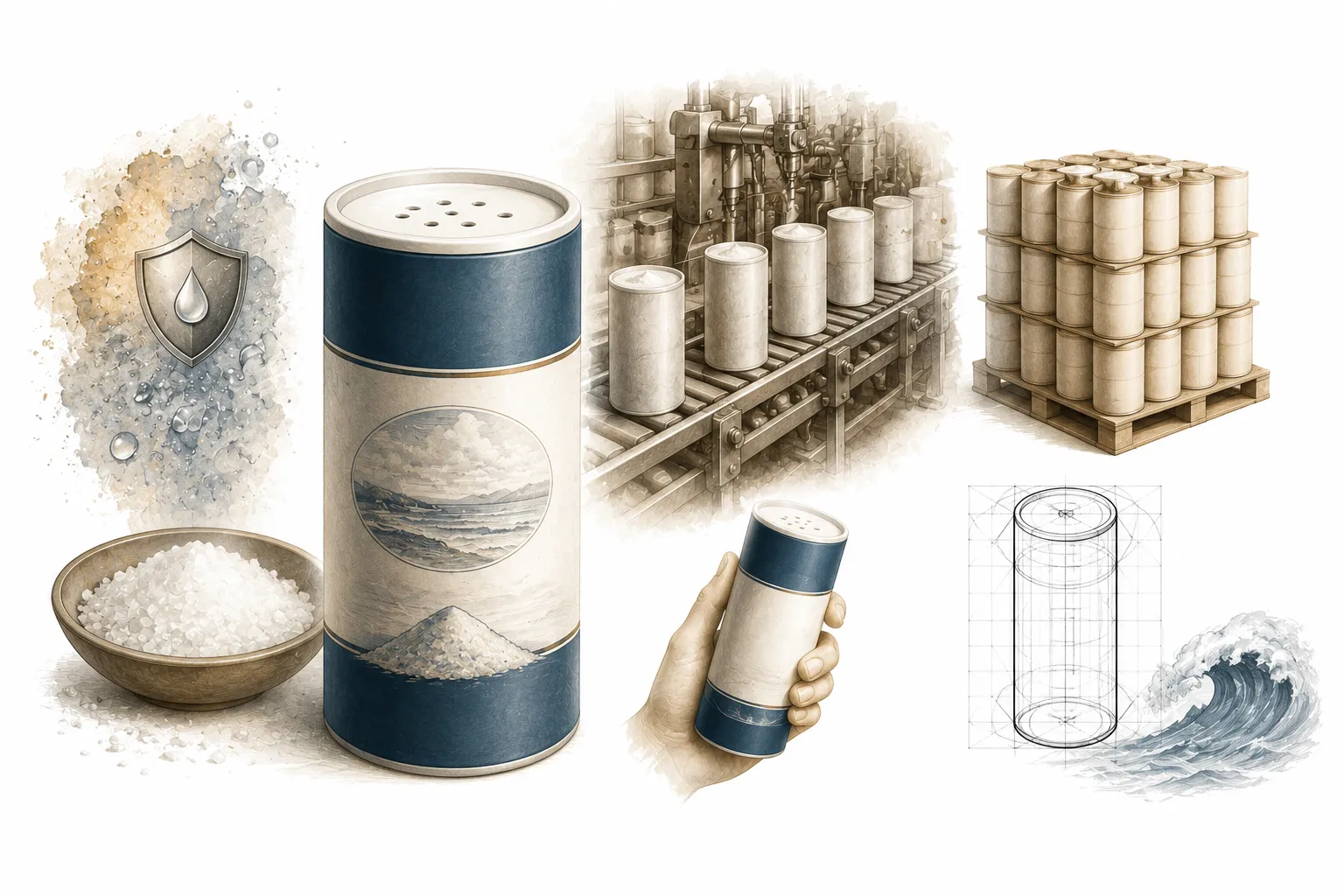
The aluminum spout was designed to be punched out by the consumer, breaking a seal that kept moisture out.
The cylindrical shape puts more downward pressure on the salt at the bottom than a wide box would, helping it flow.
The 'When it rains, it pours' slogan was created specifically to market this new moisture-resistant design.
The Clumping Problem
The War on Humidity
Salt is hygroscopic. It is a sponge for water molecules in the air. If you leave a pile of table salt on the counter on a humid day, it will literally pull water out of the air and dissolve into a little puddle, then dry into a solid rock.
In the early 20th century, this was a massive pain. You'd buy a box of salt, leave it in the pantry, and two days later you had to take a hammer to it to get some out for your eggs.
Morton Salt added magnesium carbonate to the salt to act as an anti-caking agent. But they still needed a box that would let this new, free-flowing salt actually pour. A regular square box with a flap was useless. If you tilted it, a giant clump would plug the opening.
How the Box Works
Engineering the Pour
The cylindrical box solves the clumping problem using basic physics.
1. The Narrow Tube
A tall, narrow cylinder means the weight of the salt at the top pushes down directly on the salt at the bottom. This creates pressure that forces the salt out, rather than letting it bridge across a wide opening.
Analogy
Like a funnel: narrow at the bottom to keep the flow moving.
2. The Metal Spout
The aluminum foil top is sealed until you punch it. This keeps the inside perfectly dry. Once punched, the curved metal spout directs the stream of salt exactly where you want it.
Analogy
Like the nozzle on a hose, focusing the flow.
3. The Moisture Barrier
The cardboard is coated on the inside to resist humidity, and the small opening limits how much moist kitchen air can get inside at any given time.
Analogy
Like a closed door vs. an open barn.
Curiosity Notes
Details Most People Miss
Why this still matters
Why This Still Matters
It proves that you can build a multi-billion dollar brand simply by designing a slightly better cardboard box. Morton didn't invent salt. They didn't even invent anti-caking agents. They just invented a better way to get the salt out of the container, and then told the world about it.
Key Findings
- ✓Core findingSalt naturally clumps by pulling moisture out of the air.
- ✓Strong evidenceThe tall, cylindrical shape puts downward pressure on the salt to help it flow.
- ⚠Main consequenceThe sealed metal spout keeps moisture out until you are ready to use it.
- ✓Wider legacyThe design is nearly 100 years old and hasn't changed because it works perfectly.
Final insight
A Last Thought
The cylindrical salt box is a masterpiece of invisible design. It doesn't look like much. It looks like a cardboard tube. But it is a highly engineered, anti-humidity, gravity-powered dispensing system. It’s proof that sometimes the most boring objects in your kitchen are actually the smartest.
Quick answers
Common questions
Why doesn't sugar clump like salt? +
Sugar molecules are much larger and have a different crystalline structure that doesn't bind as tightly to water vapor, though it can still clump in extreme humidity.
Is the metal spout actually aluminum? +
Yes, it is typically a thin foil or laminated aluminum membrane designed to be easily punctured.