Visual answer
The Three Lives of the Hole
How one hole serves history, geometry, and organization.
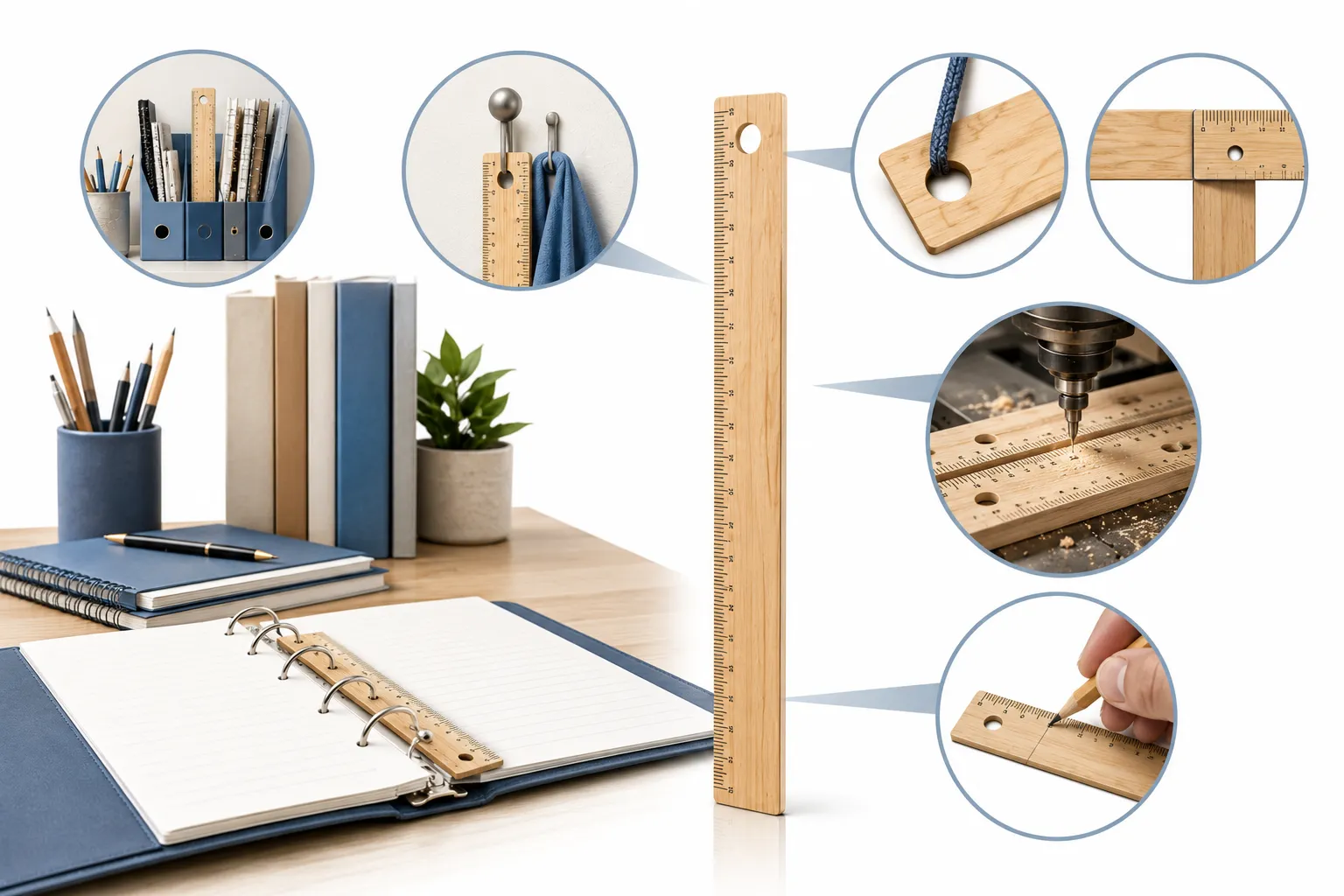
Historical Storage
Hung on a nail or hook to keep the straightedge off messy, ink-stained desks.
Geometric Pivot
A pin through the hole acts as a center point; the pencil in a measurement mark acts as the radius.
Binder Integration
The hole aligns with standard 3-ring binder spacing, keeping the tool with the notes.
Where We Stand
A Multi-Purpose Artifact
Current state
What began as a purely practical solution for 19th-century storage has evolved into a surprisingly versatile feature. Today, the ruler hole is an unspoken standard in stationery design, serving storage, geometric, and organizational functions simultaneously.
What supports this
Examine vintage wooden rulers from the early 1900s, and you'll frequently find a neatly drilled hole near the zero mark. It was an expected feature in a world where desks were cluttered with inkwells and heavy tools, and keeping a straightedge pristine was vital.
What could change this
Digital measuring tools and laser levels are replacing rulers in professional settings, but the cheap, hole-punched plastic ruler will likely persist in schools for decades due to its sheer utility and zero cost.
The Core Idea
Think of It Like the Hole in a Carpenter's Square
The familiar part
Large metal carpenter squares and specialized drafting triangles often have holes cut out of them. These aren't for hanging; they are to reduce weight, make them easier to grip, and sometimes to use as a template for drawing.
How it applies
The ruler's hole serves a similar suite of secondary functions. While its original intent was the 'hanging' function, its continued existence is justified by its usefulness as a pivot point. If you put a pin through the hole and put a pencil in the '0' or '1' inch mark, you have an instant, large-scale compass for drawing circles on a poster board.
Where the analogy breaks
Unlike a carpenter's square, the ruler hole is too small to significantly reduce the weight of a piece of plastic or wood. Its value is almost entirely functional and organizational, not structural.
The History
The Danger of the Inkwell
To understand the hole, you have to understand the 19th-century desk. It was often a sloping wooden surface littered with bottles of liquid ink, chalk, and metal nibs. If you laid a ruler flat on this desk, it would inevitably get stained, warped, or knocked to the floor.
The hole allowed the ruler to be hung on a small nail above the desk, or on a hook on a shelf. It kept the straightedge clean, dry, and perfectly flat, which was essential for draftsmen, architects, and students learning penmanship.
As manufacturing shifted to injection-molded plastic in the 20th century, the hole was retained. It became a subtle point of standardization. Someone realized that a hole punched near the end of a standard 12-inch ruler lined up almost perfectly with the holes punched in a standard piece of loose-leaf paper. The ruler became a binder accessory, ensuring it didn't get lost in the chaos of a student's backpack.
The Evidence
Reasons for the Hole
The hole allows the ruler to be hung by a nail, preserving its flatness.
StrongIt serves as a pivot point to draw circles with a pencil.
StrongIt allows the ruler to be stored in a standard 3-ring binder.
ModerateThe hole is just a remnant of the molding process where the plastic was injected.
WeakThe Big Myth
The Most Common Misconception
What people think
"The hole is where the liquid plastic was injected into the mold."
Because injection-molded plastic items often have a small rough spot called a 'gate mark' where the material entered the mold, people assume the ruler hole is just this gate mark enlarged.
What actually happens
It is a deliberately machined feature
While some very cheap rulers might utilize that area for the gate, a hole of that specific size and location requires a separate metal pin (a 'core pin') in the mold. This adds cost and complexity to the manufacturing process. They absolutely do not put a hole there by accident or for free.
What If It's True?
What If We Removed All 'Useless' Features?
Imagine this
Imagine if industrial designers stripped every object down to its absolute bare minimum function, removing the hole, the beveled edge, and the extra markings.
What would happen
We would lose serendipity. The hole was designed for hanging, but generations of students used it to draw circles, to spin the ruler, to string it onto a lanyard. Strict functionalism ignores the human capacity to find novel uses for provided geometry.
Why this matters
The ruler hole is a tiny sanctuary of improvisation. It is a feature that asks nothing of you, but is ready if you need to hang it, draw a circle, or just spin it to annoy the teacher.
Final insight
The Sanctuary of the Hole
In a world obsessed with optimizing every millimeter and stripping away the unnecessary, the ruler's hole survives. It is a small, quiet rebellion against pure utility, a tiny void that holds more uses than the solid plastic around it.
Quick answers
Common questions
Why do wooden rulers sometimes have a metal edge? +
Wood wears down over time, especially when used as a straightedge for cutting with a razor blade. Embedding a brass or steel strip along one edge ensures the ruler remains perfectly straight and sharp against the blade indefinitely.
Can you really draw a good circle with a ruler? +
It's not perfect, but it works in a pinch. Put a push pin through the hole to act as the center point. Put the tip of your pencil exactly on a measurement mark (e.g., the 3-inch mark). Hold the pin steady and rotate the ruler. You'll get a circle with a 3-inch radius.
Why are some rulers hole-less? +
Premium metal rulers (like stainless steel Machinist rulers) often omit the hole because it would compromise the structural integrity of the edge near the zero mark, which is the most critical measurement point.