Visual answer
Anatomy of a Flint Wheel Spark
Follow the path of a spark from thumb-flick to flame.
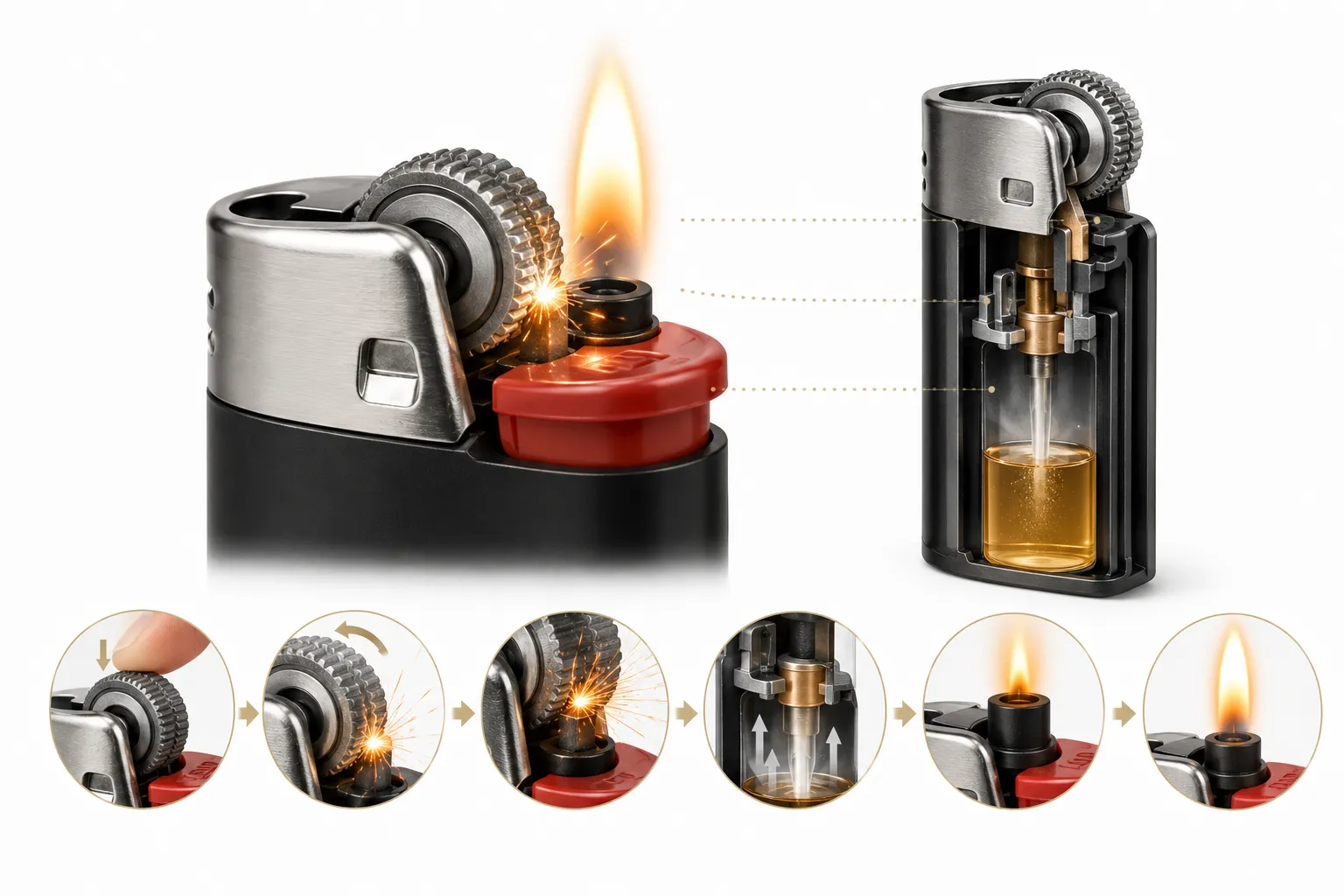
Thumb Flicks Wheel
The user rotates the serrated steel wheel backward against the spring-loaded flint.
Friction Generates Heat & Shavings
The wheel's teeth scrape the ferrocerium flint, creating microscopic shavings and intense local heat.
Pyrophoric Ignition
The shavings of ferrocerium are pyrophoric, they spontaneously ignite upon contact with oxygen, forming a shower of sparks.
Sparks Ignite Fuel
The sparks are directed upward by the wheel's shape into the stream of released butane gas, igniting the flame.
Where We Stand
The Wheel: An Enduring Standard
Current state
The serrated wheel remains the dominant ignition mechanism for disposable and reusable fuel lighters worldwide. It is a triumph of appropriate technology, simple, cheap to manufacture, and nearly indestructible in the field.
What supports this
This design was popularized by companies like Zippo and Ronson in the early 20th century. Its basic principles have changed little because they are difficult to improve upon for the cost. Modern piezoelectric and electric arc lighters offer alternatives, but the wheel remains king for butane lighters.
What could change this
A truly disruptive change would require a spark generation method that is simultaneously cheaper, more reliable, and easier to mass-produce than a stamped steel wheel and a flint. Batteries add cost and failure points; piezo crystals can be fragile. The wheel's simplicity is its greatest strength.
The Core Idea
Think of It Like a Flint & Steel from the Stone Age... Miniaturized
The familiar part
Our ancestors struck a piece of iron (pyrite or later steel) against a hard stone (like flint or quartz) to shave off tiny particles of metal that would spontaneously ignite in air, creating sparks to start a fire.
How it applies
Your lighter's wheel is doing exactly the same thing, but with extreme precision. The wheel is the steel, the flint is the stone. As you rotate the wheel, its serrated edges catch and grind against the flint, scraping off microscopic shards of ferrocerium. These shards ignite instantly upon contact with oxygen, creating a shower of sparks directed toward the fuel release valve.
Where the analogy breaks
Unlike a campfire spark, the lighter's spark is not relying on a hot ember. It relies on the pyrophoric property of the flint material (often an alloy of rare earth metals called ferrocerium), meaning the shavings spontaneously ignite below room temperature. The wheel's job is purely mechanical: to create friction and direct the sparks.
History & Design
A History of Sparks
The first true lighters, like Döbereiner's Lamp from 1816, used chemical reactions to produce hydrogen gas, which was then ignited. They were complex, dangerous, and tabletop devices. The quest for a portable, reliable flame led to the development of ferrocerium ('flint') by Carl Auer von Welsbach in 1903. This material, when scraped, produces sparks at over 3,000°C (5,400°F).
The genius was combining this super-sparky material with a simple mechanical action. The serrated wheel, often made of hardened steel, was an elegant solution. Its teeth provide multiple points of friction in a single rotation, ensuring a reliable spark with minimal effort. The design was so effective it became the standard, from the iconic Zippo (1933) to the cheap disposable lighters we use today.
The wheel's placement is also deliberate. Being thumb-operated allows for a natural, intuitive 'flick' motion that is both fast and provides good leverage. It's a piece of user-centered design that has been refined over a century but never fundamentally changed because it works so well.
The Evidence
The Case For the Wheel's Design
Serrations multiply the number of friction events per rotation, increasing spark reliability.
StrongFerrocerium (flint) shavings are pyrophoric, igniting spontaneously in air, unlike pure iron.
StrongThe mechanism is extremely cheap to manufacture at a global scale.
StrongThe wheel can become clogged with debris, affecting performance over time.
ModerateElectric arc lighters are more weatherproof and wind-resistant.
ModerateThe wheel requires a separate flint spring mechanism, adding slight complexity.
MinorThe Big Myth
The Most Common Misconception
What people think
"The wheel is just a rough surface to create friction."
People often think any rough surface would do, and the wheel is just a convenient shape.
What actually happens
It's a precision-ground spark director
The wheel's teeth are carefully shaped and angled. They are not just rough; they are specifically designed to grip the flint, scrape it at the optimal angle, and channel the shower of sparks upward in a cone toward the fuel jet. A flat file would create sparks but not direct them effectively or consistently. The wheel is a tiny, specialized spark-throwing machine.
What If It's True?
What If We Lost This Technology?
Imagine this
Imagine a world where the knowledge of ferrocerium and the wheel mechanism was lost. We'd have to revert to chemical lighters or piezoelectric ones.
What would happen
For most people, starting a fire would become harder, more expensive, and dependent on batteries or fragile crystals. The incredible convenience of a reliable, instant flame in your pocket would vanish. Campfires, candles, and cigarettes would become significantly more inconvenient to light.
Why this matters
This simple wheel is a quiet masterpiece of appropriate technology. It doesn't try to be high-tech; it perfectly solves a specific problem with minimal parts and maximum reliability. It's a reminder that the most enduring solutions are often the simplest.
Final insight
The Beauty of the Simple Solution
The wheel on your lighter is a testament to the power of engineering elegance. It doesn't need a microchip, a battery, or complex manufacturing. It takes the ancient human knowledge of making fire and distills it into a thumb-sized, mass-produced marvel of metal and spark. Sometimes, the best technology is the one you can fix with a new flint and a flick of your thumb.
Quick answers
Common questions
Who invented the flint wheel lighter? +
The modern flint wheel mechanism was popularized and refined by companies like Zippo (founded 1933) and Ronson. The key invention was the ferrocerium flint by Carl Auer von Welsbach in 1903, which made the wheel design practical and reliable.
Are there other ways to generate a spark? +
Yes, the main alternatives are: 1) Piezoelectric (a crystal that creates a spark when struck), used in many lighters and grill igniters; 2) Electric arc (using a battery to create a plasma arc between two electrodes), common in modern 'plasma' lighters; 3) Chemical (like the old Döbereiner's Lamp), now obsolete for portability.
What is the 'flint' in a lighter made of? +
It's rarely actual flint stone. It's almost always an alloy called ferrocerium, invented by Carl Auer von Welsbach in 1903. It's composed of iron oxide and rare-earth metals like cerium and lanthanum. This combination makes it extremely sparky when scraped.
Can the wheel wear out? +
Yes, over very long use, the wheel's teeth can become smooth, and the flint can be consumed. This is why lighters have a flint replacement system (a small spring and tube). The wheel itself is usually hardened steel and can last the life of the lighter.
Why do some lighters have a button instead? +
Button-operated lighters typically use a piezoelectric crystal. When clicked, it deforms and generates a high-voltage spark. This is great for electric arc lighters (plasma lighters) but requires no flint or wheel. It's a different technology with its own pros and cons (e.g., needs no consumable flint, but can be more fragile).