Visual answer
The Geometry of Grip
How different wire shapes change the pressure on paper.
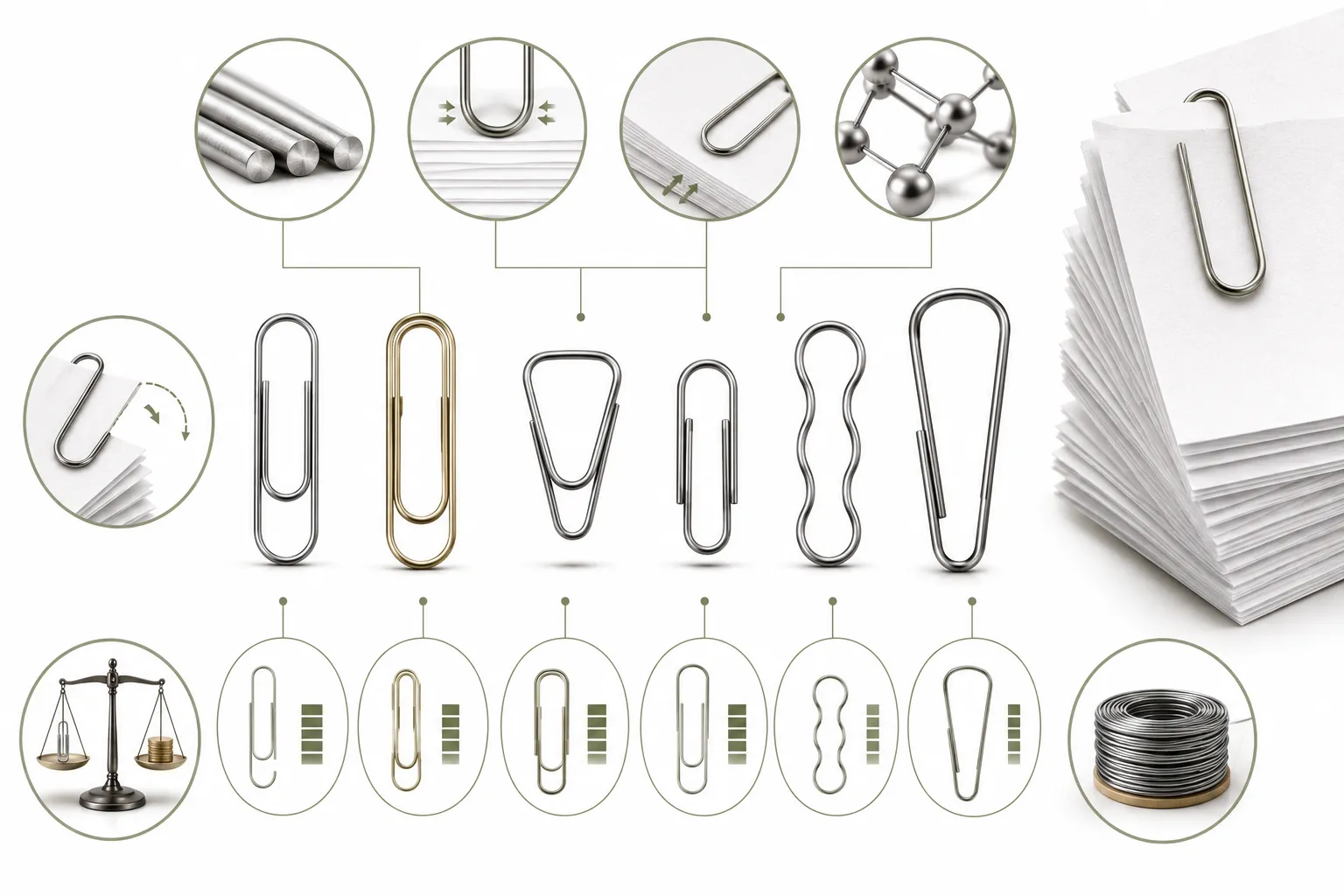
The Gem Clip
Double loop creates three lines of inward spring pressure. Wire ends are exposed on the outside.
The Ideal Clip
Triangular loop tucks the wire ends safely inside, preventing paper tears, but is slightly harder to manufacture.
The Corrugated Clip
Same shape as Gem, but with ridges stamped into the wire to increase friction for glossy papers.
Where We Stand
A Century of Wire Bending
Current state
Despite the sheer number of variants, the standard Gem paperclip still dominates the market. It remains one of the most efficient pieces of minimal design ever created, manufacturing billions of units a year for effectively zero cost. Variations exist only to solve specific problems the Gem clip creates.
What supports this
The Gem clip was never patented in its most common form, which is partly why it became a universal standard. Other shapes, like the 'Ideal' clip (which has a triangular loop to prevent the wire ends from catching on paper) or the 'Owl' clip (which doesn't tear paper), have technically superior designs for certain tasks but can't compete with the Gem's sheer manufacturing simplicity.
What could change this
Digital documents are the only thing that will truly end the paperclip's reign. Until paper is obsolete, the physics of binding thin sheets with bent wire will remain relevant.
The Core Idea
Think of It Like Different Styles of Clamps
The familiar part
In a workshop, you have gentle spring clamps for delicate wood, massive C-clamps for crushing glue joints, and locking pliers for gripping metal. They all do the same job, holding things together, but their shapes dictate their force and application.
How it applies
Paperclips are just miniature workshop clamps. The Gem clip is a light-duty spring clamp: cheap, fast, and good for 5-10 pages. The Binder clip (that black triangular hinge) is a C-clamp: it uses a lever to generate massive force, holding hundreds of pages, but it's bulky and leaves an indent. The Plastic-coated clip is like wrapping a clamp in rubber: it loses a bit of grip but won't scratch the finish.
Where the analogy breaks
Unlike workshop clamps that use separate hinges and springs, a paperclip is a single, continuous piece of wire. Its shape *is* its spring. Changing the shape changes the spring constant (how stiff it is) and the pressure points (where it touches the paper).
The Engineering
The Magic of the Double Loop
To understand why shapes differ, you have to understand why the Gem clip is shaped the way it is. If you took a straight piece of wire and wrapped it around paper, it would just be a tight circle. It wouldn't grip; it would just roll off.
The Gem clip's genius is the inner loop. When you pry the clip open to slide it on paper, you are bending the wire past its elastic limit in some places, but the inner loop acts as a continuous spring. When released, the entire length of wire wants to return to its resting state. This creates three long lines of inward pressure along the paper. It holds tightly because the wire is constantly trying to un-bend itself.
So why change it? Because the Gem clip's wire ends are on the *outside*. If you slide a Gem clip over a stack of papers, those sharp wire ends can catch and tear the top sheet. The 'Ideal' clip solves this by making a triangular shape where the wire ends are tucked safely inside the loop. The 'Non-skid' or corrugated clip has little ridges stamped into the wire to increase friction, allowing it to hold more slippery paper (like glossy photos) without sliding off.
The Evidence
Form Dictates Function
The Gem clip's double loop provides excellent spring-back grip for low page counts.
StrongTriangular loops (like the Ideal) hide the wire ends to prevent paper tearing.
StrongPlastic coatings reduce grip strength but prevent rust and scratching.
ModerateDifferent shapes are just marketing gimmicks.
WeakThe Big Myth
The Most Common Misconception
What people think
"The modern paperclip was invented by a Norwegian named Johan Vaaler."
This is a wildly popular 'fun fact,' and Norway even erected a giant paperclip statue in his honor.
What actually happens
Vaaler's clip was terrible
Johan Vaaler did patent a paper clip in 1899 in Germany, but his design was different, and functionally inferior. It lacked the inner loop of the Gem clip, meaning it didn't have the same spring tension and gripped poorly. The true 'Gem' style clip was likely being manufactured in Britain by the Gem Manufacturing Company years before Vaaler's patent. The Norwegian myth is largely a post-WWII patriotic invention.
What If It's True?
What If the Gem Clip Never Existed?
Imagine this
Imagine if we only had bulky binder clips or damaging brass fasteners, and no one had invented the infinite, reusable, zero-damage spring wire clip.
What would happen
The workflow of the 20th century would have been markedly more frustrating. Binder clips are too bulky to stack papers flat in a folder. Brass fasteners puncture and permanently damage documents. The Gem clip's ability to marshal chaos, fit in a tiny tray, and be removed without a trace is a foundational pillar of modern bureaucracy.
Why this matters
The paperclip is proof that the best designs aren't those that add features, but those that remove everything unnecessary until only the pure function remains. It is just a piece of wire, bent into a smile, refusing to let go.
Final insight
The Shape of Holding On
A paperclip is an object of profound humility. It doesn't glue, it doesn't puncture, it doesn't lock. It just holds on, using nothing but its own desire to return to its original shape. The different variations are just different ways of saying 'I won't let go', some louder, some gentler, but all relying on the simple, stubborn physics of a bent wire.
Quick answers
Common questions
Are paperclips magnetic? +
Standard steel paperclips are magnetic. However, some 'non-magnetic' paperclips are made from brass, aluminum, or plastic-coated wire, which are used in environments where magnetism would be a problem (like near hard drives or sensitive medical equipment).
How much wire is in a standard paperclip? +
A standard Gem-style paperclip is made from about 3 to 4 inches (7-10 cm) of steel wire, typically galvanized or coated to prevent rust.
Why do paperclips sometimes just fall off? +
If the stack of paper is too thick, prying the clip open bends the wire past its 'elastic limit', the point where it can no longer spring back. It permanently deforms, losing its tension and grip. You've essentially broken its spring.