Quick Facts
Quick Facts
Darwin almost became a clergyman. He studied theology at Cambridge.
His voyage on the Beagle lasted five years. He was seasick most of the time.
He developed his theory of evolution in 1838 but did not publish it until 1859.
He was pushed to publish because another scientist, Alfred Russel Wallace, had the same idea.
Darwin is buried in Westminster Abbey, near Isaac Newton.
Visual answer
How Natural Selection Works
The simple mechanism that explains all of life.
Variation
Individuals in a population are not identical. They have different traits.
Inheritance
Traits are passed from parents to offspring.
Selection
Some traits help individuals survive and reproduce more successfully.
Time
Over many generations, helpful traits become more common. The population evolves.
Story in brief
Story in Brief
1831
Darwin joins the HMS Beagle as a naturalist. He is 22 years old.
1835
He visits the Galapagos Islands and notices that finches on different islands have different beaks.
This observation was crucial to his theory.
1838
He reads Thomas Malthus on population and has the idea for natural selection.
1838-1858
Darwin works on his theory but does not publish. He fears the reaction.
He knew that evolution would be controversial.
1858
Alfred Russel Wallace sends Darwin a paper with the same idea.
1859
Darwin publishes On the Origin of Species.
The book sells out immediately. Darwin becomes famous and controversial.
1871
Darwin publishes The Descent of Man, applying evolution to humans.
The Story
The Voyage, The Finches, and The 20 Year Wait
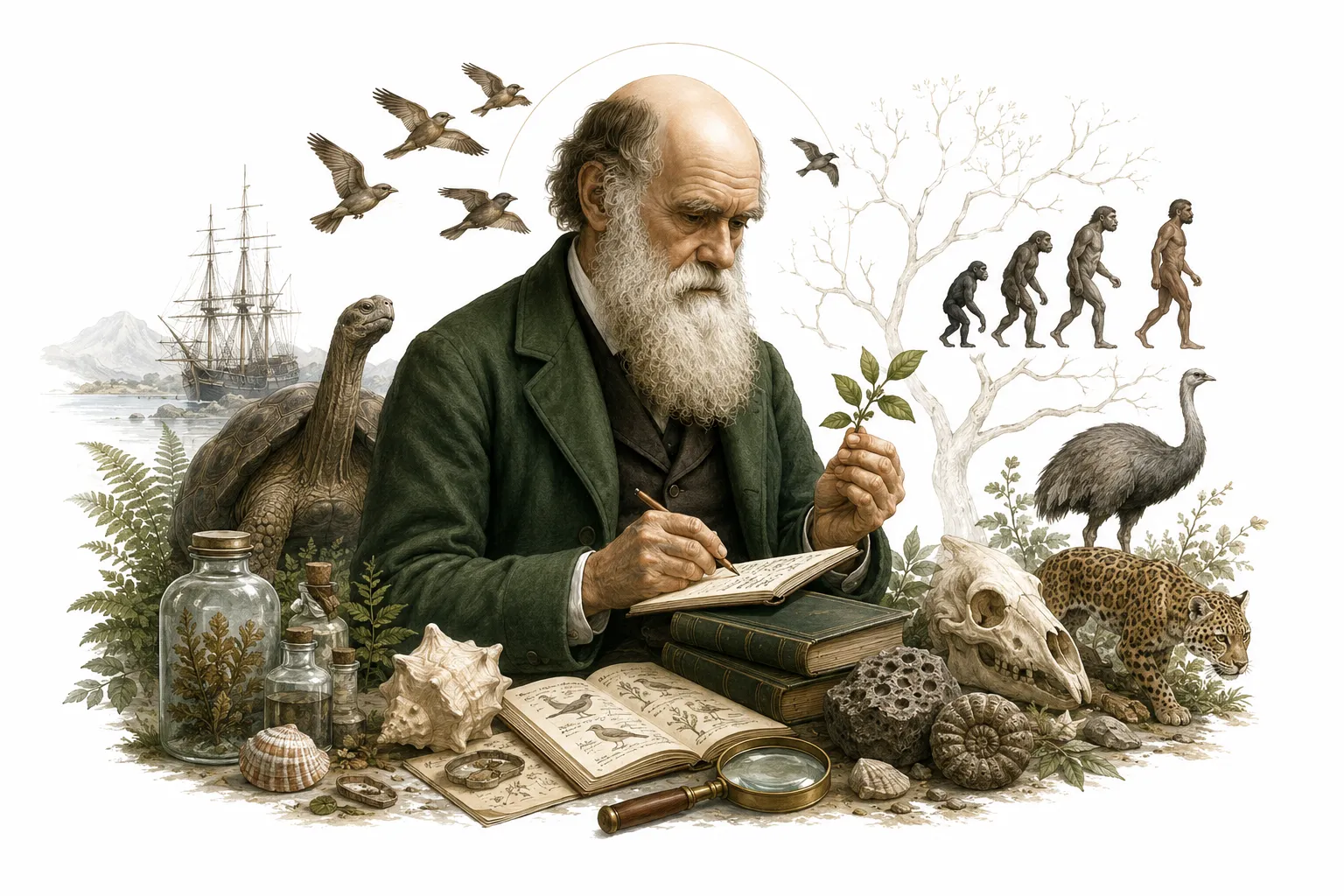
In 1831, a young Charles Darwin boarded the HMS Beagle for a five-year voyage around the world. He was not a famous scientist. He was a recent college graduate who had studied to become a clergyman. He was also, by his own admission, seasick for most of the journey.
The voyage took him to South America, the Galapagos Islands, Australia, and back. He collected thousands of specimens: fossils, birds, plants, and rocks. He noticed patterns. Fossils of extinct animals looked similar to living animals in the same region. Finches on different islands had different beaks, suited to different foods.
By 1838, back in England, Darwin had figured it out. Species change over time. The mechanism is natural selection. He wrote a 231-page summary of his theory. Then he did not publish it. He sat on it for 20 years. He knew the idea would cause an uproar. He was right.
Famous Quote
"It is not the strongest of the species that survives, nor the most intelligent. It is the one most adaptable to change."
, Charles Darwin (attributed)
This quote is often misattributed. But it captures the essence of his idea perfectly.
Evidence
Why Darwin Is Remembered
His theory of natural selection is the foundation of modern biology.
StrongOn the Origin of Species is one of the most important books ever written.
StrongHe provided evidence that all life shares a common ancestor.
StrongHis theory has been confirmed by genetics, which Darwin did not know about.
StrongKey Points
Key Points So Far
Darwin's voyage on the Beagle provided the evidence he needed.
He developed the theory of natural selection in 1838.
He waited 20 years to publish because he feared controversy.
Alfred Russel Wallace had the same idea, pushing Darwin to publish.
On the Origin of Species (1859) changed biology forever.
Analogy
Like Winning a Race Without Trying
The familiar part
Imagine a race where some runners are faster and some are slower. The fast runners win. Over many races, the population becomes faster.
How it applies
That is natural selection. The 'race' is survival. The 'fast runners' are individuals with helpful traits. They win by having more babies. Over generations, the species gets better at surviving.
Where the analogy breaks
Evolution does not have a goal. It is not trying to make 'better' species. It just happens.
Curiosity Notes
Details Most People Miss
Why this still matters
Why This Still Matters
Darwin's theory is still controversial in some circles, 160 years after he published it. That is remarkable. It is also a testament to how unsettling the idea is. If evolution is true, then humans are not special creations. We are animals, related to every other living thing on Earth. That is humbling. It is also beautiful. The same process that produced bacteria produced us. We are all cousins, in a sense. Even the trees. Even the bacteria in your gut.
Key Findings
- ✓Core findingDarwin developed the theory of evolution by natural selection.
- ✓Strong evidenceHis voyage on the HMS Beagle provided crucial evidence.
- ⚠Main consequenceHe sat on his theory for 20 years before publishing.
- ✓Wider legacyOn the Origin of Species (1859) revolutionized biology.
- ★Bottom lineHe did not know about genes. That came later.
Final insight
A Last Thought
Charles Darwin changed how we see ourselves. Before him, we were special creations, separate from the rest of nature. After him, we were part of nature, connected to every living thing. That was a demotion for human pride. It was also an invitation to humility. We are not the purpose of evolution. We are just one of its products. The same process that made us made the dinosaurs, the dodo birds, and the bacteria in the soil. We are not above nature. We are in it. Darwin showed us that. It took courage. He sat on his theory for 20 years because he knew how much it would upset people. He was right. He published anyway.
Quick answers
Common questions
Is evolution proven? +
Yes. Evolution is both a fact (populations change over time) and a theory (natural selection explains how). The evidence comes from fossils, DNA, and direct observation.
Did Darwin renounce evolution on his deathbed? +
No. This is a myth. There is no evidence that Darwin ever renounced his theory. He died an agnostic, comfortable with his work.