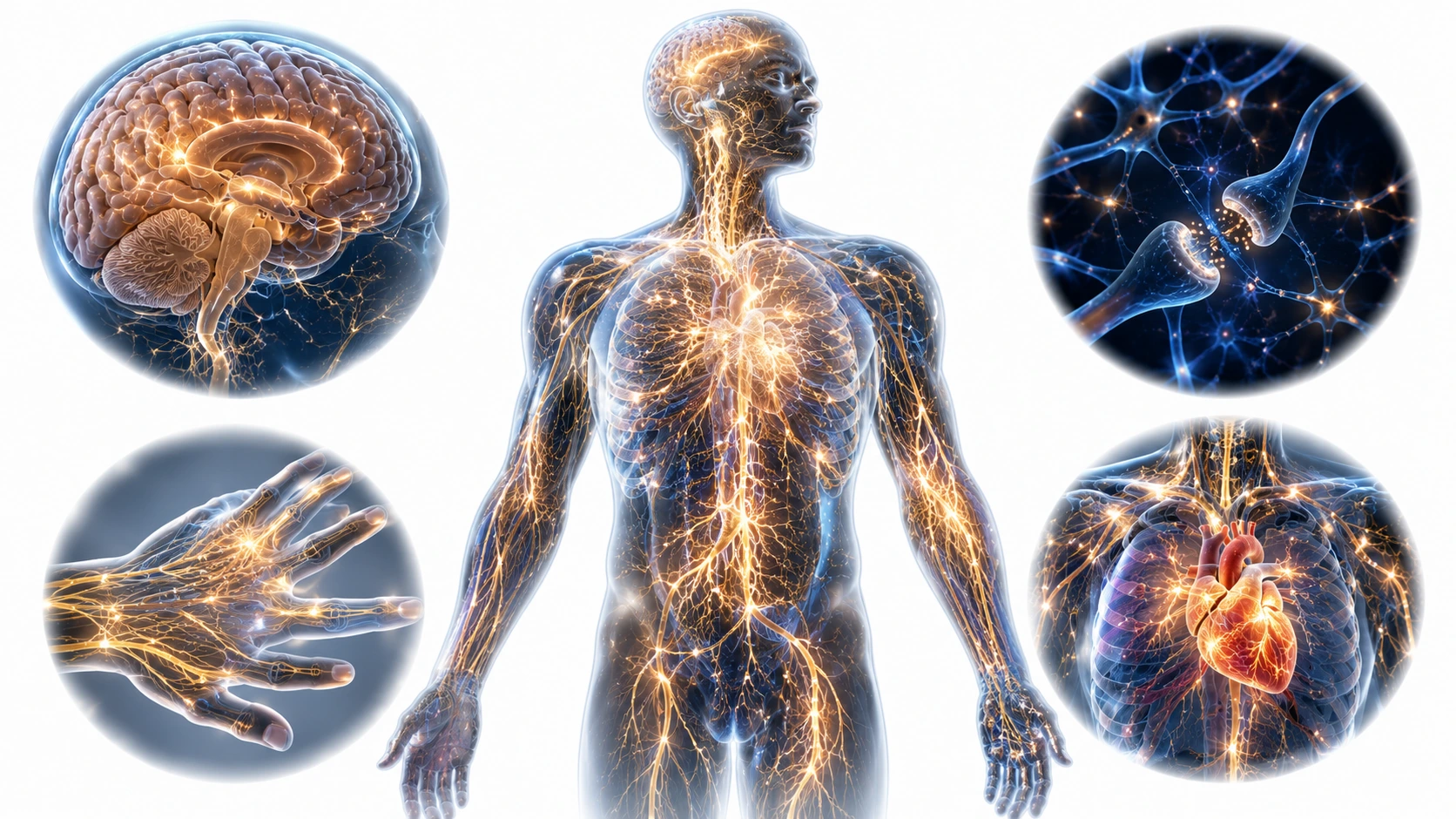
Visual answer
How a Nerve Cell Fires
A single neuron generates and transmits electricity through a precise sequence of ion movements.
Resting state
The cell is negatively charged inside relative to outside. It is loaded, waiting.
Trigger
A signal arrives. Sodium ions rush in, flipping the charge from negative to positive.
Action potential
The electrical spike travels down the neuron like a wave of falling dominoes.
Reset
Potassium ions rush out, restoring the negative charge so the cell can fire again.
The battery inside you
Every Cell Is a Tiny Battery
Think of your cell membranes as very small, very busy border crossings. Charged particles, sodium, potassium, calcium, are constantly being pushed in and out by protein pumps embedded in the membrane wall.
This pumping is deliberate. It creates a voltage difference between the inside and outside of each cell. In nerve cells, that voltage sits at around -70 millivolts at rest. Small number. Enormous consequence.
When a nerve cell receives a signal strong enough to matter, it opens its ion channels. Sodium floods in. The charge flips to positive. That flip is the electrical impulse, and it races down the length of the nerve fiber at speeds that make most machines look sluggish.
The whole spike takes about one millisecond. Then the cell resets and does it again. In your brain, this is happening billions of times per second, right now, in the dark of your skull.
The heart's own spark
Your Heart Has Its Own Electrical Generator
The most dramatic example of bioelectricity is the heart. It does not wait for the brain to tell it to beat. It generates its own electrical signal through a tiny cluster of specialized cells in the upper-right chamber called the sinoatrial node.
Every 0.8 seconds or so, that node fires. The signal spreads across the heart muscle in a coordinated wave, squeezing the chambers in exactly the right order to push blood through your body efficiently.
This is what an electrocardiogram (ECG) measures, the electrical events of your heart, picked up through electrodes on your skin. The heart's electricity is strong enough to detect from outside the body entirely.
When that electrical system misfires, the result can be an arrhythmia, an irregular rhythm. When it stops, the heart stops. Defibrillators work by delivering a controlled electrical shock that resets the heart's own electrical system. You are, quite literally, being jump-started.
The electric brain
Your Brain Is a Storm of Electrical Activity
The human brain contains roughly 86 billion neurons. Each one can connect to thousands of others. At any given moment, vast networks of these cells are firing together in coordinated patterns, patterns that produce your perceptions, your memories, your sense of self.
Different patterns produce different states. Deep sleep produces slow, rolling waves. Sharp focus produces fast, tight oscillations. Fear triggers a distinctive electrical signature. So does joy, grief, and the moment just before you recognize someone's face.
Electroencephalography, EEG, can detect these patterns through electrodes placed on the scalp. Researchers can tell whether someone is dreaming, concentrating, or drifting toward unconsciousness, all by reading the electricity leaking through the skull.
You are not a body that happens to produce electricity. You are, in a very real sense, an electrical system that happens to have a body around it.
Can you power things?
Myth vs Reality
What people think
The human body produces enough electricity to power devices
Pop science loves this idea: harvest your body heat or movement and charge your phone. The numbers are appealing on the surface.
What actually happens
The body's electricity is real but not easily harvested
The brain generates around 20 watts, enough for a very dim bulb. Researchers have made micro-devices powered by body heat, but nothing close to meaningful consumer power. The electricity is optimized for signaling, not output.
Muscles and movement
Every Movement You Make Is an Electrical Command
Pick up a cup. Blink. Clench your fist. Each of those actions began as an electrical signal in your motor cortex, a specialized region of the brain responsible for movement.
That signal travels down your spinal cord, along motor neurons, to the exact muscle fibers needed for the action. At the junction between nerve and muscle, the electrical impulse triggers the release of a chemical called acetylcholine, which then causes the muscle fiber to contract.
The process is so fast and so precise that your brain can coordinate dozens of muscle groups simultaneously without you being conscious of most of it. Walking, for instance, involves hundreds of electrical decisions per second, nearly all of them automatic.
Electromyography (EMG) can measure this muscle electricity too. Prosthetic limbs increasingly use EMG signals from residual muscles to control robotic joints. Your body's electricity, read from the outside, can now move machines.
Body electricity types
Where Body Electricity Shows Up
Brain
Neural oscillations that produce thought, memory, and consciousness. Measurable via EEG.
Heart
Self-generated electrical pulses that coordinate each heartbeat. Measurable via ECG.
Muscles
Electrical signals from motor neurons trigger contraction. Measurable via EMG.
Skin
Electrodermal activity changes with sweat and stress, the basis of lie detector tests.
Eyes
Retinal cells generate electrical responses to light, sent to the brain via the optic nerve.
Quick answers
Common questions
How much electricity does the human body produce? +
The brain generates roughly 20 watts of electrical power. The whole body together produces more, but most of it is used internally for signaling, not radiated outward as usable power.
Can the electricity in my body shock someone? +
The voltages inside your body are real but tiny, millivolts, not the hundreds of volts needed to shock someone. Static electricity from shuffling across a carpet is a completely separate phenomenon.
What happens when the body's electricity stops working? +
Cardiac arrest is the most immediate consequence, the heart's electrical system fails and pumping stops. In the brain, disrupted electrical activity can cause seizures, unconsciousness, or death depending on severity.
Is bioelectricity used in medicine? +
Extensively. EEG, ECG, and EMG all read the body's electricity. Pacemakers regulate heart rhythm electrically. Transcranial magnetic stimulation uses magnetic fields to induce electrical activity in the brain for treatment of depression.