Visual answer
Why steel wheels work on steel rails
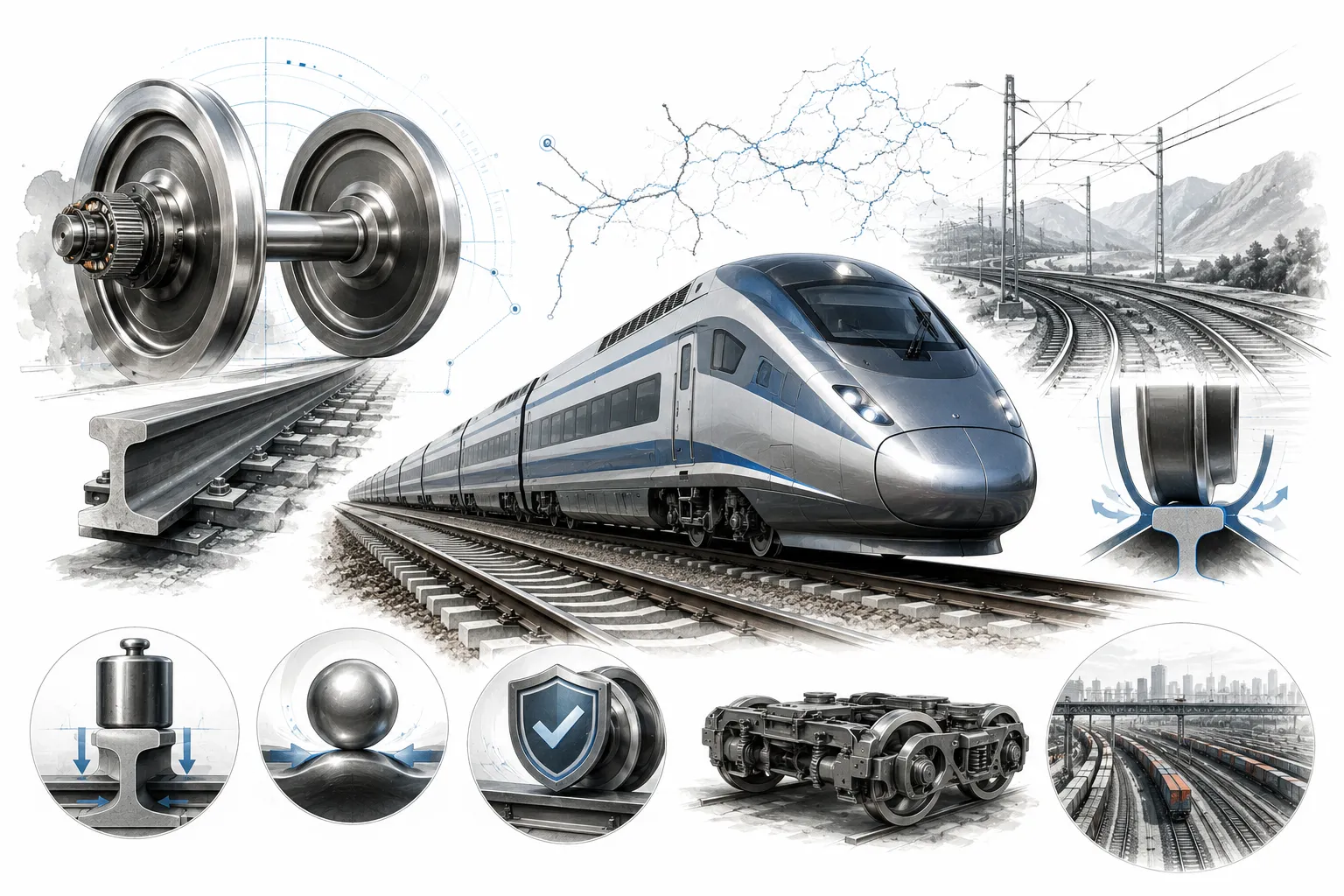
The diagram shows the tiny contact patch, low rolling resistance, flange guidance, and braking trade-off behind metal train wheels.
Tiny contact patch
A small hard contact area keeps rolling resistance extremely low.
Flange guidance
The inner wheel flange helps keep the wheelset aligned with the rail.
Grip trade-off
The same low friction that saves energy also means trains need long stopping distances.
The Physics
The Brilliance Hidden in the Simplest Joint in Transport
Current state
The contact point between a train wheel and a rail is roughly the size of a small coin. That tiny surface supports hundreds of tonnes of weight. It seems absurd, but it works because of a simple principle: when you're rolling forward (not stopping, not starting), metal on metal creates almost no friction at all.
What supports this
This is called low rolling resistance, and it's the reason trains are so extraordinarily energy-efficient over long distances. A freight train carrying 5,000 tonnes of cargo uses less fuel per tonne per kilometre than almost any other form of transport. The metal wheel is the reason. Rubber tyres grip better, which is what you want in a car that needs to stop quickly, but all that extra grip costs energy. A train doesn't need quick stops. It needs to move enormous weight over enormous distances cheaply.
What could change this
Some metro systems, most famously Paris, do use rubber-tyred trains on certain lines. Rubber gives better acceleration and braking in confined urban environments and is quieter. But these systems require extra guidance rails and consume significantly more energy. For long-distance heavy freight and high-speed rail, steel wheels on steel rails remain far superior.
The Simple Version
Think of It Like Sliding vs Rolling
The familiar part
Try sliding a heavy box across the floor, it takes effort. Now put the box on a skateboard. It rolls much more easily. Now imagine the wheels were extremely hard and smooth, and so was the floor. Even easier.
How it applies
A train wheel on a rail is the ultimate version of that skateboard. The hardness of both surfaces means almost none of the wheel's energy is lost to squishing, deforming or gripping. It just rolls. And because it just rolls, even enormous weights can be moved with modest amounts of energy.
Where the analogy breaks
The same smoothness that makes rolling so efficient makes stopping so difficult. On a wet or icy rail, a train has almost no grip at all. This is why trains start blowing sand onto the rails in difficult conditions, the sand adds friction for braking without compromising the efficiency of normal rolling.
Final insight
Friction Is the Enemy, Except When You Need It
The metal train wheel is a masterclass in trading one thing for another. You give up quick stopping in exchange for the ability to move the weight of a small town at reasonable speed and cost. For 200 years of railways, that trade has been worth it.
Quick answers
Common questions
Why don't trains use rubber tyres like cars? +
Rubber tyres would grip better for stopping and starting, but they create far more rolling resistance, meaning a train would need vastly more energy to move the same load. For heavy freight and long distances, that's unacceptable.
How do train wheels stay on the tracks? +
Each wheel has a flanged edge, a small ridge on the inside, that physically prevents the wheel from sliding off the rail sideways. The wheels are also slightly conical in shape, which helps the train self-steer gently around curves.
Why do trains take so long to stop? +
Because the same low-friction surface that makes rolling efficient also provides very little grip for braking. A high-speed train travelling at 300 km/h may need several kilometres to stop completely.