Visual answer
How speed bump shapes change behavior
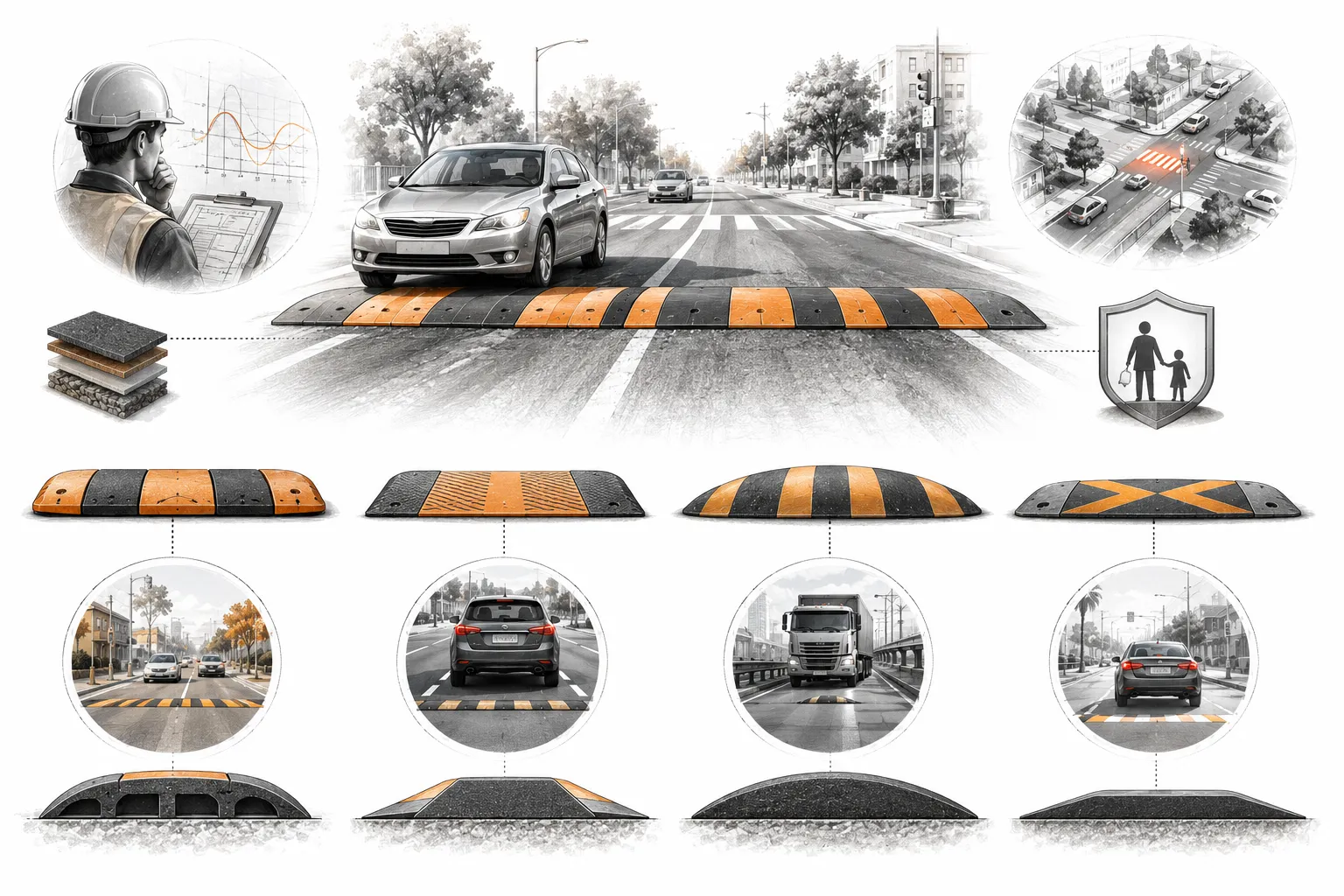
The diagram compares bumps, humps, cushions, and tables to show how each shape slows different vehicles in different ways.
Sharp bump
A narrow raised strip forces very low speed in car parks and private roads.
Gentle hump
A longer profile slows cars without requiring a full stop.
Speed cushion
Separated pads slow narrow cars while wider emergency vehicles can straddle them.
Shape by Design
The Speed Feature That Has to Please Everyone
Current state
The fundamental problem with slowing cars down is that you don't want to slow down everything equally. A residential street where children play needs cars to slow to walking pace. But the same street might be used by ambulances responding to emergencies, bin lorries that need to complete their route efficiently, and buses on a schedule. A device that stops an ambulance in its tracks is not a sensible safety measure.
What supports this
This is why traffic engineers developed a range of shapes. Speed bumps the sharp, aggressive ones found in car parks are designed for very low-speed environments where you want all vehicles to near-stop. Speed humps are shallower and longer, allowing vehicles to pass at 15–20 mph without a jarring impact. Speed cushions are the clever solution: they span only part of the lane width, with gaps sized to match the track width of large vehicles like buses and emergency ambulances. A car's wheels are narrower and hit the raised sections; a bus or ambulance is wider and straddles the gaps entirely, barely noticing them.
What could change this
Some councils are moving toward speed tables large, flat-topped raised sections that function like a raised pedestrian crossing. They force speed reduction across a wider area and, when combined with a pedestrian crossing, clearly communicate that this is a people-priority zone.
The Simple Version
Think of It Like a Doorstep
The familiar part
A doorstep slows you down just enough to make you step carefully. It's not designed to stop you just to make you pay attention for a moment. A wall, on the other hand, stops you completely.
How it applies
Speed humps are doorsteps. Speed bumps are small walls. The question is always: who do you want to slow down, by how much, and who do you want to let through relatively unimpeded?
Where the analogy breaks
Speed cushions with gaps work beautifully for buses and ambulances but motorcyclists can also thread between the raised sections, which means cushions don't slow motorbikes at all. That's a known limitation, and some areas compensate with other measures.
Final insight
The Shape Is the Policy
Every speed-reducing device on a road is a policy decision made in asphalt. Do we prioritise children over bus timetables? Do we trust drivers to slow voluntarily or force them to? The shape tells you what the community decided. It's engineering as democracy.
Quick answers
Common questions
Why do speed cushions have gaps in the middle? +
The gaps are sized to let wide vehicles buses, ambulances, fire engines straddle the cushion entirely. Their wheels pass through the gaps without hitting the raised section. Standard cars are narrower and hit the raised parts, slowing them down.
What is the difference between a speed bump and a speed hump? +
A speed bump is narrow and sharp designed to force near-complete stops, typically used in car parks. A speed hump is longer and more gradual designed for residential streets where you want traffic to slow to around 15–20 mph without stopping.