Visual answer
How crumple zones protect passengers
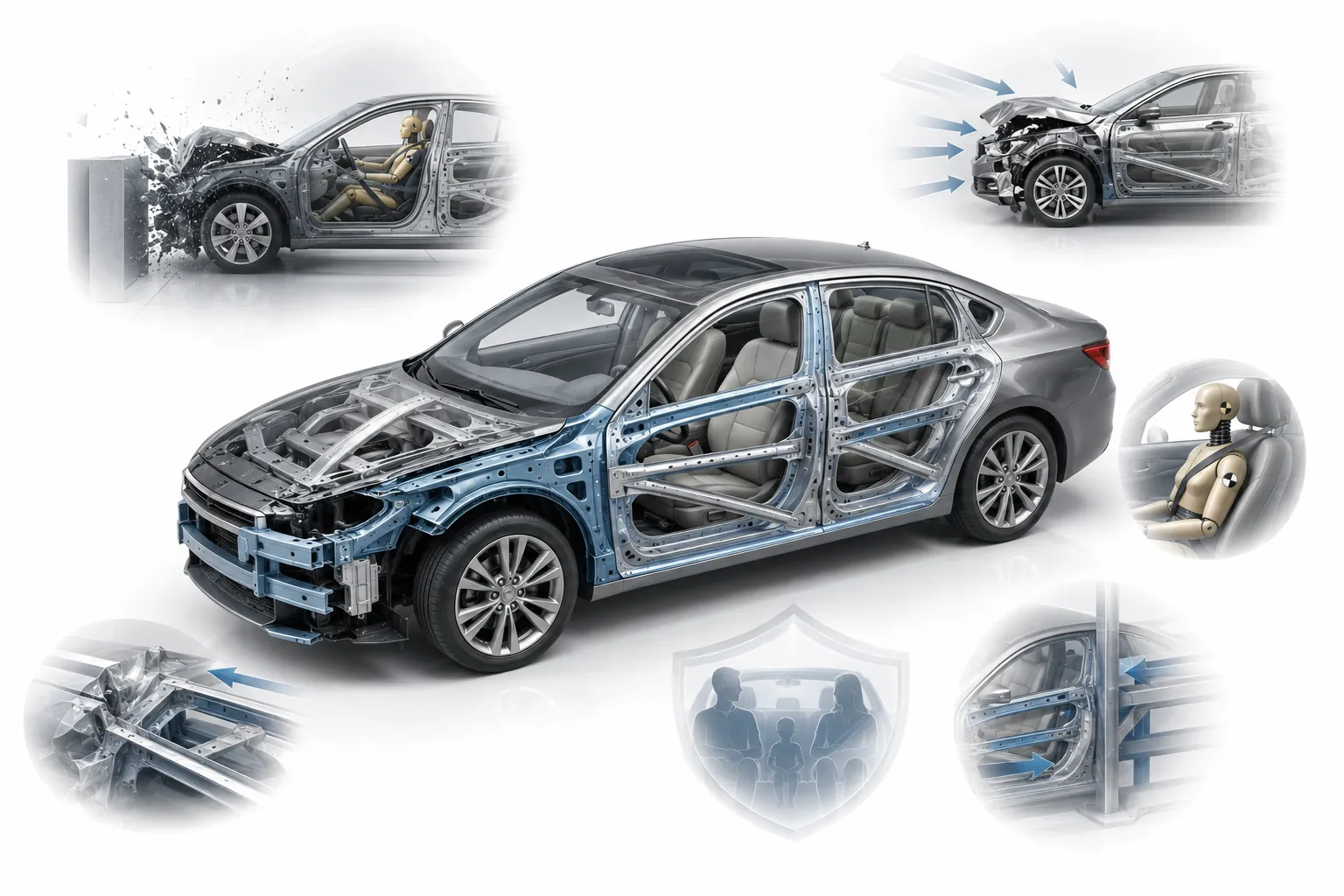
The diagram shows how controlled deformation absorbs crash energy while the safety cell around passengers stays rigid.
Impact energy
A crash forces the car to lose speed extremely quickly.
Controlled crush
Front and rear structures fold in planned ways to absorb energy over more time.
Safety cell
The passenger compartment is kept much stiffer so occupants have survival space.
The Physics
Why Slowing Down More Slowly Is Safer
Current state
The key insight behind crumple zones is a basic principle of physics: force equals mass multiplied by the rate of change of speed. In a crash, the question isn't whether you stop, you will, it's how quickly you stop. The faster you go from 60 mph to zero, the larger the force on your body. Extending the stopping time by even a fraction of a second dramatically reduces the peak force.
What supports this
A rigid, old-fashioned car transfers almost all the crash energy directly to the passenger compartment, and therefore to the people inside, in a very short time. A car with crumple zones absorbs much of that energy by deforming controlled sections of the body. The passenger compartment takes longer to stop, the peak force is lower, and survival rates improve dramatically. Mercedes-Benz introduced the first production cars with engineered crumple zones in 1959, following patents filed by engineer Béla Barényi in 1952. Modern crash test data consistently shows the life-saving difference.
What could change this
The principle is now universal across all cars sold in most markets. The current development frontier involves making crumple zones 'smarter', using materials that deform in more precisely controlled ways, and integrating with pre-collision systems that can adjust the car's structure in the milliseconds before impact.
The Simple Version
Think of It Like Landing in Sand vs Concrete
The familiar part
If you fell from a height onto sand, the sand would give way beneath you, absorbing your energy over a longer distance and time. The same fall onto concrete stops you almost instantly. The force on your body is far higher, even though you fell the same distance.
How it applies
The crumple zone is the sand. It lets the car collapse over a slightly longer time and distance, absorbing energy so the passenger compartment, and the people in it, experience a less violent deceleration.
Where the analogy breaks
Crumple zones work best in frontal collisions, which are the most common serious accidents. Side impacts are harder to manage because there's less space to crumple between the door and the driver. This is why side airbags and reinforced door pillars became important as a complementary approach.
Final insight
Sacrifice the Car. Save the Person.
The crumple zone represents a philosophical shift in how we think about cars in crashes. The old instinct was to build the car as strong and rigid as possible, protect the vehicle and the person will be protected too. The insight of Barényi and those who followed was the opposite: the car is replaceable. The person is not. Let the car take the damage.
Quick answers
Common questions
Does a crumpled car mean it failed? +
The opposite, a car that crumples significantly in a crash has done its job correctly. The damage you see is energy that was absorbed by the structure rather than transferred to the passengers.
Who invented crumple zones? +
Béla Barényi, an engineer at Mercedes-Benz, filed the patents for crumple zone technology in 1952. The first production cars with engineered crumple zones were introduced by Mercedes-Benz in 1959.
Are newer cars safer because they crumple more? +
In general, yes, modern cars are engineered with much more sophisticated crumple zone geometry than older ones. A modern small car is typically far safer in a crash than a large, rigid car from the 1970s.