Visual answer
The Anvil's Dual Geometry
How flipping a piece of metal changes the fate of a staple.
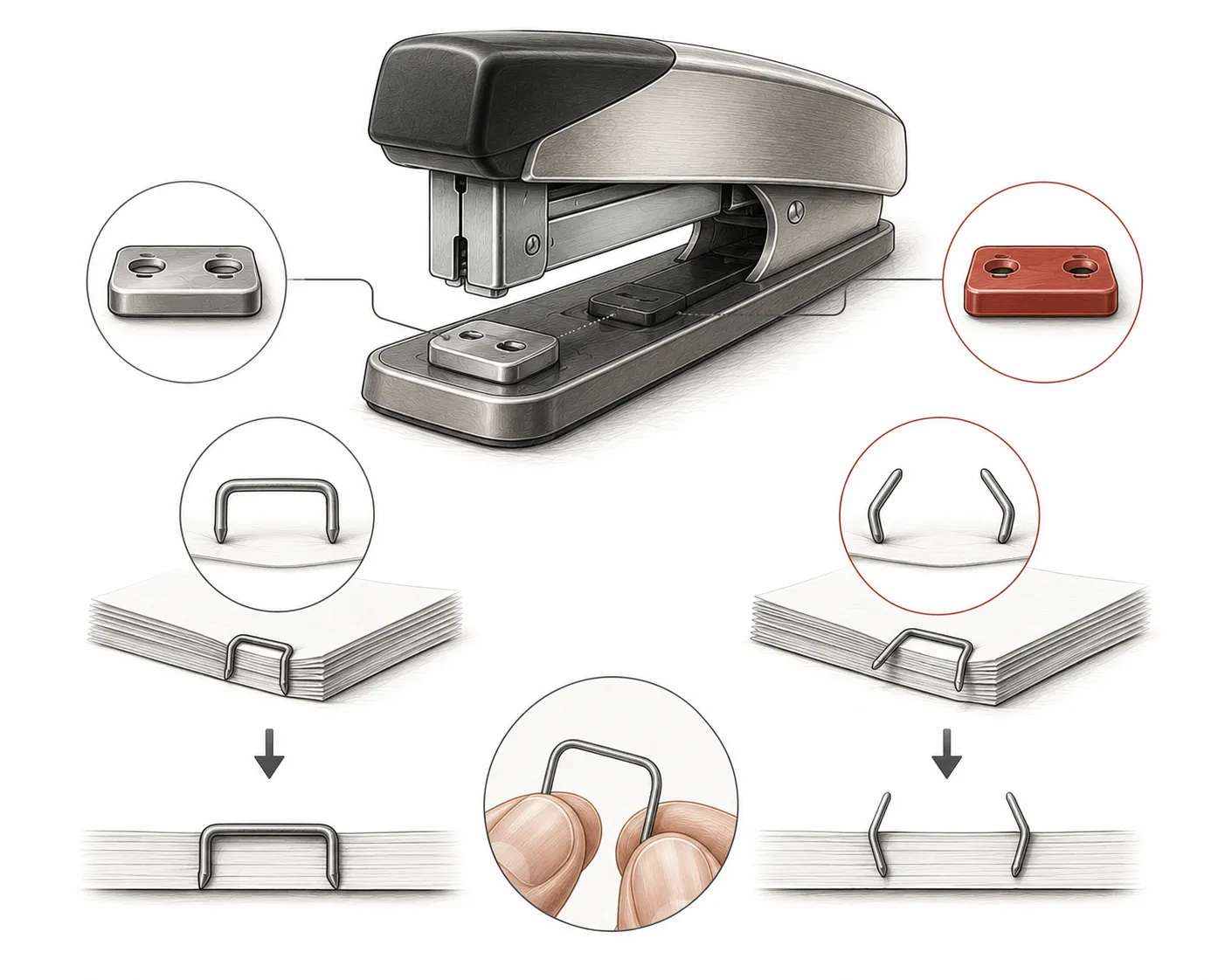
The Drive
The hammer pushes the staple through the paper and into the anvil plate.
Normal Clinch (Inward)
The anvil grooves curve inward, forcing the legs to fold flat. Creates a permanent, tight bind.
Temporary Pin (Outward)
The rotated anvil grooves curve outward, forcing the legs to splay. Creates a weak, removable friction fit.
Where We Stand
A Feature Hiding in Plain Sight
Current state
The reversible anvil is a standard feature on almost all traditional, spring-loaded staplers, yet a staggering number of people have never noticed it or don't know what it does. It remains one of the most successful examples of 'hidden' dual-functionality in consumer products.
What supports this
You can find this feature on vintage Swingline, Ace, and Bostitch staplers from the mid-20th century. It was originally marketed as a way to save money on paper clips and to allow for the temporary binding of legal or medical documents that couldn't be damaged by staple removal.
What could change this
Modern 'flat clinch' staplers, which bend the staple completely flat to save space, are losing this feature. And electric staplers often lack the mechanical anvil entirely. The reversible setting may slowly fade away as office technology evolves.
The Core Idea
Think of It Like a Nail vs. a Picture Hook
The familiar part
If you hammer a nail into a wall to hang a picture, it's meant to be permanent. To get it out, you need a pry bar, and it leaves a hole. But if you use a removable picture hook with a tiny metal tab, it holds the picture firmly, but you can pull the tab to release it cleanly.
How it applies
A normal stapler drives a nail. The legs go through and are folded tight. Removing it requires prying, which tears the paper fibers. The reversed stapler drives a picture hook. The legs go through and are folded outward, barely gripping the back of the paper. You can just pinch the legs and slide the staple out, leaving the paper completely unharmed.
Where the analogy breaks
Unlike a specialized picture hook, the stapler achieves this dual functionality without adding any extra moving parts. It simply reuses the exact same driving mechanism and the exact same staple, changing the outcome purely through geometry.
The Mechanics
The Geometry of the Anvil
When you smack the top of a stapler, a spring-loaded hammer pushes the staple through the paper. The staple exits the throat and hits the metal base, the anvil. The anvil has two shallow grooves or 'dies' cut into it.
In the normal setting, these grooves curve *inward*. As the hammer forces the staple legs into the grooves, the metal is guided to fold flat against itself, clinching the pages tightly together. It's a locked mechanical joint.
When you rotate the anvil 180 degrees, the grooves now curve *outward*. When the staple legs are forced into these reversed grooves, they are bent away from each other, looking like little tent pegs. They still pass through the paper, but they don't fold back down. They just stick out the back, holding the papers together purely by friction and the slight rigidity of the bent wire. Pull them straight out, and the paper is fine.
The Evidence
The Reversible Plate in Action
Rotating the anvil changes the direction of the grooves from inward to outward.
StrongOutward-bent staples can be removed by hand without a staple remover.
StrongUsing the reverse setting prevents tearing paper fibers upon removal.
StrongThe reverse setting makes the staple hold more securely.
StrongThe Big Myth
The Most Common Misconception
What people think
"The reverse setting is for stapling thicker stacks of paper."
People assume that because the staple bends outward, it must be providing some sort of extra grip or reach for thick booklets.
What actually happens
It actually holds *less* securely
The reverse setting makes the staple significantly weaker. It relies only on the friction of the wire against the paper, with no mechanical clinch. If you use it on a thick stack, the staple will likely just pull straight out under its own tension. It is specifically designed for temporary pinning of a few pages where document preservation is paramount.
What If It's True?
What If All Fasteners Were Permanent?
Imagine this
Imagine a world where we didn't have temporary fastening options, no paperclips, no binder clips, no reverse-staple pins.
What would happen
The workflow of almost every office, courtroom, and hospital would collapse. Drafting a document would mean committing to its binding. Editing would involve destroying the physical medium to rearrange it. The ability to temporarily marshal chaos into order, while retaining the ability to set it free, is a foundational requirement of intellectual work.
Why this matters
The reverse setting on a stapler is a profound philosophical statement baked into cheap sheet metal: not everything needs to be permanent. Some things just need to be held together for a little while.
Final insight
The Grace of Impermanence
We use staplers every day, treating them as brute-force permanent binders. But hidden on the bottom is a gentle reminder that not everything needs to be nailed down. It’s a small piece of rotating metal that allows us to commit to an idea just enough to see if it works, without destroying the page if it doesn't.
Quick answers
Common questions
Who invented the stapler? +
The first stapler-like device was patented in 1866 by George McGill, but it only fed single staples. The modern, spring-loaded stapler that uses a strip of connected staples was patented by Charles H. Gould in 1879 and heavily refined by the Hotchkiss company and later Swingline.
How do I know if my stapler has this setting? +
Look at the bottom metal plate where the staple hits. If there is a small lip or tab on one end of that plate, you can usually push it and rotate it 180 degrees. If the plate is welded solidly flat with no movement, it’s a permanent-clinch-only model.
What is it called when the staple bends outward? +
In the industry, this is often called 'pinning' or a 'temporary clinch'. The normal inward bend is called a 'standard clinch' or 'permanent clinch'.