Visual answer
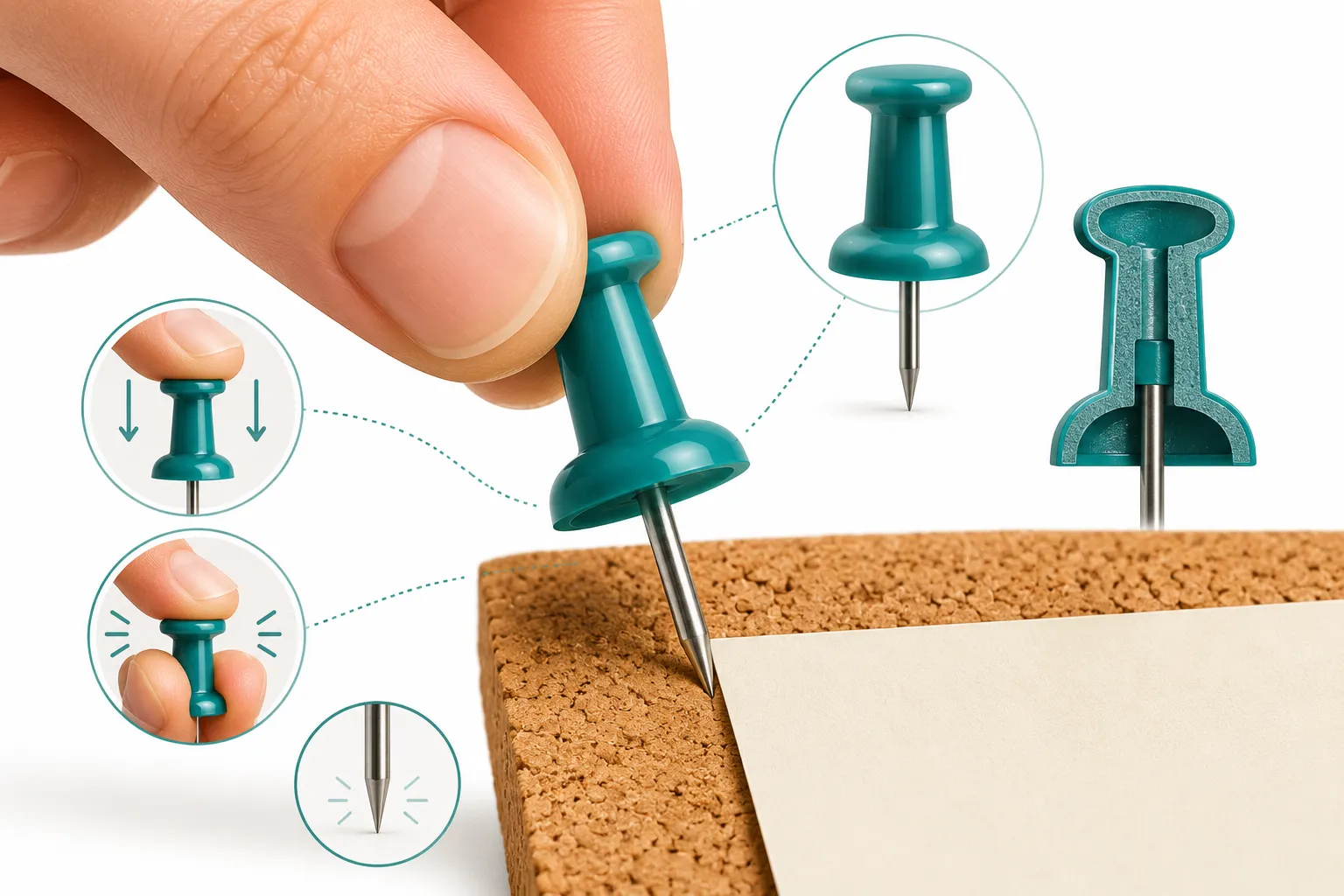
The Reinforced Column
How plastic changes the structural physics of the pin.
Ergonomic Dome
The broad, textured surface provides grip and distributes pressure on the thumb.
Plastic Barrel (Reinforcement)
The plastic encases the metal shaft, dramatically increasing its resistance to bending.
Depth Stop Base
The wide base rests on the board surface, preventing the pin from sinking out of sight into soft cork.
Where We Stand
Specialized Fastening for the Real World
Current state
While the flat metal thumbtack is the minimalist ideal, it has weaknesses. It bends easily, it disappears into soft cork, and it can be hard to grip. The plastic-handled push pin sacrifices minimalism to solve these practical, everyday frustrations.
What supports this
The rise of plastic push pins aligns with the post-WWII boom in cheap injection molding. Once it became virtually free to mass-produce complex plastic shapes, designers could prioritize human ergonomics over material efficiency.
What could change this
A shift toward magnetic boards or digital displays reduces the need for pins entirely. But for heavy-duty corkboards or industrial fabric displays, the reinforced plastic pin remains superior to the flimsy metal tack.
The Core Idea
Think of It Like a Drill Bit vs. A Drill
The familiar part
A drill bit by itself is sharp and effective, but if you try to turn it with your bare fingers, it slips, it hurts, and if it hits a hard knot in the wood, it snaps. Put it in a drill, and you have grip, torque, and a chuck that keeps it straight.
How it applies
The metal shaft of a push pin is the drill bit. The plastic handle is the drill. The plastic encases the top of the metal shaft, creating a rigid column that resists bending under lateral force. It provides a wider, textured surface for your fingers to grip, and it acts like the drill's chuck, keeping the force perfectly aligned with the point.
Where the analogy breaks
Unlike a drill, a push pin has no motor. You still have to provide the pushing force. But the plastic handle ensures that the force you *do* provide is transferred straight down the axis of the pin, maximizing efficiency and minimizing bending.
The Engineering
The Depth Stop and the Reinforced Column
Corkboards are wonderfully soft, which is great for piercing, but terrible for retention. If you push a flat metal thumbtack into cheap cork, it often sinks until only the very edge of the metal disc is visible. It looks messy, and it's hard to grab when you want to pull it out. The plastic handle has a broad base that rests on the surface of the board. It physically cannot sink past that point. It is a built-in depth stop.
Furthermore, consider the physics of a column. A thin steel pin pushed against hardwood will buckle if it's even slightly off-center. By molding a thick plastic barrel around the top inch of the pin, you dramatically increase its 'moment of inertia' (resistance to bending). You are essentially turning a flimsy wire into a rigid column.
Finally, there is the human element. Arthritic hands, small children, or simply wet hands cannot easily grip a slick metal disc. The textured, domed plastic handle is an ergonomic interface designed to accommodate the frailties of the human body.
The Evidence
Plastic vs. Metal
The plastic barrel increases the pin's resistance to bending under lateral loads.
StrongThe wide base prevents the pin from sinking entirely into soft materials.
StrongPlastic handles are purely aesthetic or marketing-driven.
WeakPlastic handles make the pin take up too much space on a crowded board.
ModerateThe Big Myth
The Most Common Misconception
What people think
"Plastic push pins are just cheaper, lower-quality versions of metal thumbtacks."
Because they are often sold in massive, cheap packs, there's an assumption they are inferior.
What actually happens
They are actually higher-performance tools
While the metal tack is a triumph of minimalism, the plastic push pin is objectively better at penetrating hard surfaces without bending, and better at staying accessible in soft surfaces. They are specialized tools, not cheap knock-offs.
What If It's True?
What If All Tools Prioritized Minimalism Over Ergonomics?
Imagine this
Imagine if we stripped away every handle, grip, and guard from every tool because the bare metal was 'more elegant.'
What would happen
We'd have hammers with no grip, scissors with bare blades, and pins we couldn't push. The history of technology is largely the history of adding interfaces between human bodies and raw physics. The plastic push pin is a perfect micro-example of this.
Why this matters
The plastic handle is an acknowledgment that humans are not perfect pushing machines. We slip, we are weak, and our skin is soft. Wrapping a tool in plastic is a way of forgiving ourselves for our biological limitations.
Final insight
Forgiving Our Frailty
The flat metal thumbtack says, 'Here is the math; make your thumb fit it.' The plastic push pin says, 'I know your thumb is soft and your aim is bad, so I brought a handle and a bumper.' It is a less elegant object, perhaps, but a more kind one.
Quick answers
Common questions
Who invented the plastic push pin? +
There isn't one single inventor of the *plastic* push pin, as it was a natural evolution of Edwin Moore's push-pin once injection molding became ubiquitous in the mid-20th century. The design was driven by manufacturing capabilities rather than a single eureka moment.
Why are they often shaped like mushrooms? +
The domed 'mushroom' shape is incredibly strong under compression (it distributes the pushing force evenly into the base) and provides a naturally comfortable curve for the pad of the thumb.
Can you recycle plastic push pins? +
It is very difficult. They are a hybrid of steel and plastic (often different types of plastic for the head vs. the gripping ring). Separating them is labor-intensive, so they almost always end up in landfill. Reuse is the best option.