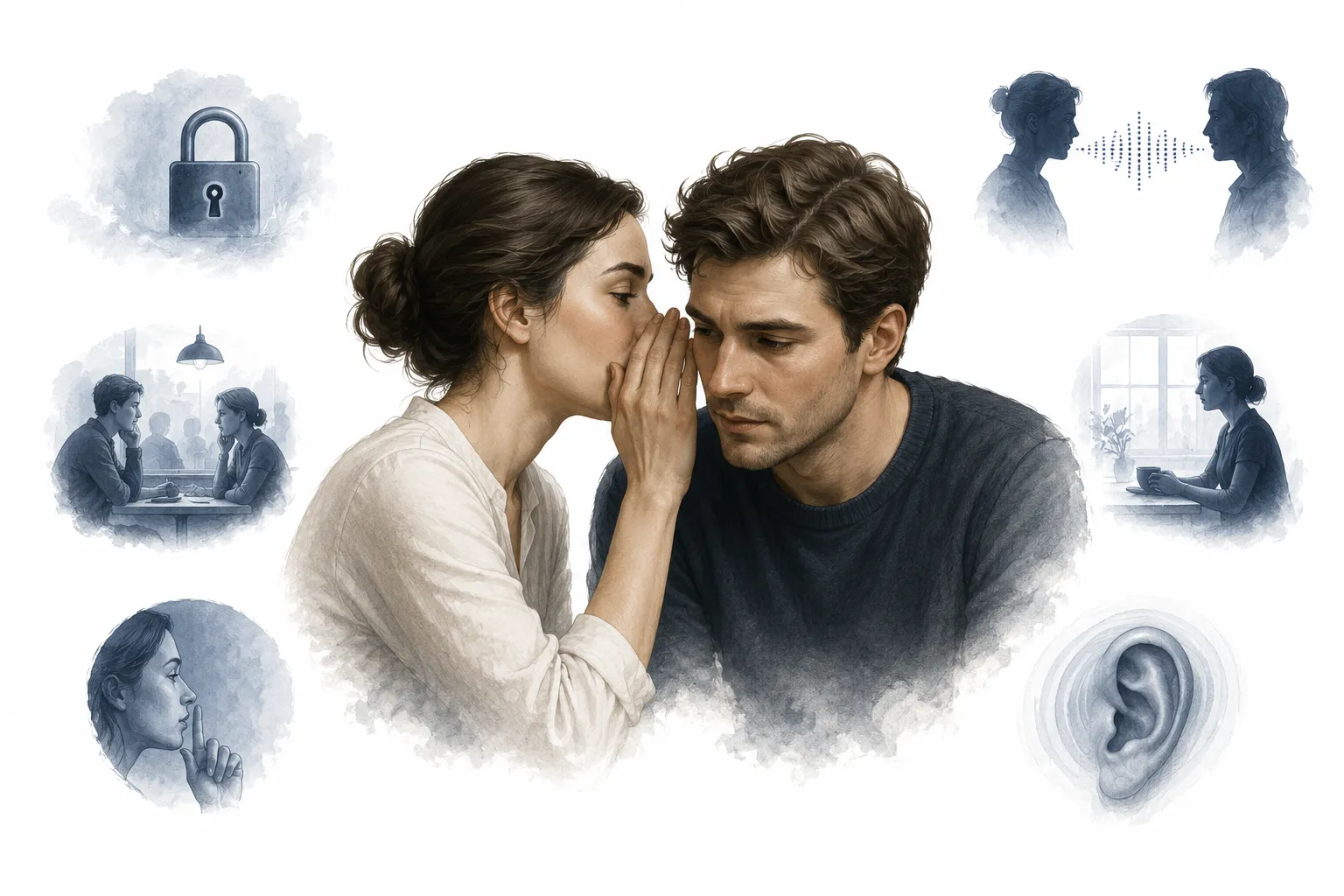
Visual answer
Two Paths Your Voice Takes to Reach Your Own Ears
Why your internal experience of your voice is fundamentally different from what a microphone captures.
You produce sound
Your vocal cords vibrate, producing sound waves that travel outward through the air and simultaneously send vibrations through the tissues of your head and jaw.
Bone conduction pathway
Vibrations travel through your skull directly to your cochlea. This pathway emphasizes low frequencies, adding warmth and depth to what you perceive as your voice.
Airborne pathway
Sound waves travel through the air and enter your outer ear the same way all other sounds do. This is the only path a microphone captures.
What you hear vs what everyone else hears
Your brain blends both pathways into your internal voice. Everyone else, and every recording device, only gets the airborne version, which is thinner and higher-pitched.
Why bone conduction matters
Your Skull Is Acting as a Built-In Bass Boost
Bone conduction is not a minor contributor. Studies measuring the frequency response of bone-conducted sound show it adds significant energy in the 100 to 500 Hz range, exactly where vocal warmth and fullness live. When you listen to a recording, that entire frequency band is gone from your self-perception.
This is also why speaking into a cupped hand held over your ear gives you a faint approximation of how others hear you. You are briefly blocking some of the bone conduction pathway and replacing it with a reflected airborne signal. It still sounds odd because it is not a perfect match, but it demonstrates how much of your self-perceived voice is created inside your own head.
Singers and professional speakers who work with recordings regularly report that the discomfort fades after weeks of deliberate exposure. The brain updates its reference model. The recorded voice stops feeling foreign and starts feeling accurate.
Myth vs reality
Myth vs Reality
What people think
The microphone is making your voice sound bad
Most microphones capture airborne sound with high accuracy. Unless you are using very cheap equipment or a heavily processed filter, what you hear in the recording is genuinely what you sound like to other people. The mic is not the problem.
What actually happens
Your internal model is the inaccurate version
Your bone-conduction-enhanced internal voice is a biased representation that only you experience. Everyone else has always heard your recorded version. From their perspective, nothing sounds strange at all.
Quick answers
Common questions
Does everyone hate their recorded voice? +
Mild discomfort is nearly universal. Strong aversion affects roughly a third of people. A small group, usually those who work with audio regularly, feel neutral or positive about it.
Can you train yourself to like your recorded voice? +
Yes. Repeated exposure is the most effective method. Singers, actors, and broadcasters do this professionally. The brain adjusts its reference point over weeks of regular listening.
Does your voice actually change with age? +
Yes. Vocal cords thin and lose elasticity with age, gradually raising pitch and reducing volume. This is a real change, separate from the perception issue, and recordings will capture it accurately.
Why do some people like their recorded voice? +
People who grew up singing, acting, or using recording equipment develop familiarity early. Their brain's reference model already includes the airborne version, so there is no jarring mismatch.
Is the voice we hear in our heads the same as our inner monologue? +
Not quite. The inner monologue uses sub-vocal muscle movements and bone conduction without full vocal cord activation. Research on inner speech suggests it shares neural pathways with actual speech but produces no meaningful airborne sound.