Visual answer
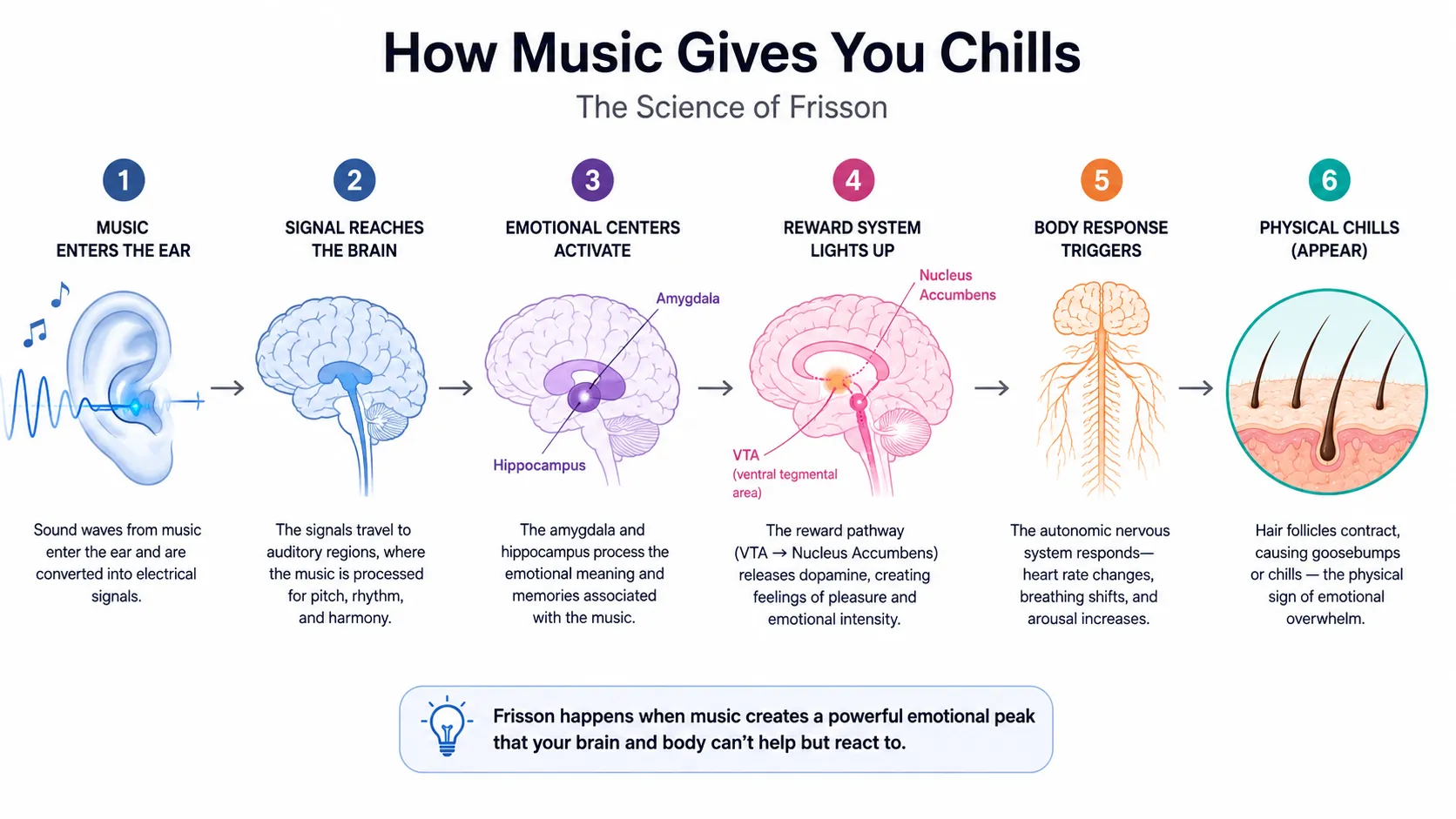
What Happens in Your Brain During a Music Chill
The sequence from musical event to physical response in under two seconds.
Auditory cortex processes the sound
The auditory cortex receives the musical signal and begins pattern matching against expectations built from years of listening. A surprising or emotionally loaded moment breaks the pattern.
Emotional centers activate
The amygdala and anterior insula activate in response to the emotional significance of the sound. These regions flag the moment as meaningful and trigger physiological arousal.
Dopamine is released
The nucleus accumbens, the brain's primary reward hub, releases dopamine. This produces the subjective sense of pleasure and intensifies the emotional response.
The autonomic nervous system fires
The sympathetic nervous system triggers piloerection (goosebumps), increased heart rate, and the characteristic tingling sensation that travels from the scalp or neck down the spine.
The science
Anticipation Matters as Much as the Moment Itself
Brain imaging research by Valorie Salimpoor and colleagues at McGill University showed that dopamine is released in two distinct phases during music-induced chills. The first surge happens during the anticipation of the emotional peak, when the listener senses something significant is coming. The second hits at the peak itself. This mirrors how the brain handles other rewards and explains why familiarity with a piece intensifies chills rather than reducing them.
Musical surprise is a major trigger because the brain is a prediction machine. It constantly models what should come next in a melody based on learned patterns. When music violates that expectation in a satisfying way, an unexpected modulation, a voice entry that felt impossible a moment before, the reward signal fires. The violation has to feel resolved eventually, which is why random noise does not produce frisson even though it is unpredictable.
Chills are more likely when listening alone, in the dark, at higher volumes, and through headphones. Each of these conditions increases emotional immersion and reduces the competing sensory input that dilutes the brain's focus on the music.
Myth vs reality
Myth vs Reality
What people think
Only classical music causes chills
Any genre can trigger frisson. What matters is emotional weight and musical surprise, not the style. Rock, film scores, electronic music, gospel, and folk all produce chills in listeners attuned to them. The musical grammar differs, but the neural mechanism is the same.
What actually happens
Personal musical history shapes what triggers chills
Because frisson depends on learned expectations being violated, chills tend to happen in music you know reasonably well, not music you are hearing for the first time. Complete novelty gives the brain nothing to violate. The deepest chills often come from songs you have heard hundreds of times but that still hit the same peak.
Quick answers
Common questions
Is it normal to never get chills from music? +
Yes. Between 35 and 45 percent of people never experience it. Research shows no relationship between musical taste, intelligence, or emotional capacity and the ability to experience frisson. It reflects how your auditory and reward circuits are wired.
Can the same song cause chills every time? +
For some people, yes. The dopamine anticipation effect means familiarity can actually deepen the response. You know the moment is coming, and the anticipation itself triggers dopamine before it arrives.
Why do some songs stop giving me chills over time? +
This is called neural adaptation. Repeated exposure to the same stimulus reduces the surprise element. The brain's prediction model updates to include the peak moment, and the violation response weakens. Taking a break from a song often restores the effect.
Do animals experience anything similar? +
No confirmed evidence of frisson in animals. Some research suggests chimpanzees show emotional responses to rhythm, but the specific goosebump-and-tingling response associated with frisson has not been documented outside humans.
Can other art forms cause the same chills? +
Yes. Film scenes, poetry, visual art, and even mathematics have been reported to cause frisson in some individuals. The trigger is the same: an emotionally loaded moment of surprise or resolution processed through the reward system.