Visual answer
Why mirrors make elevators feel better
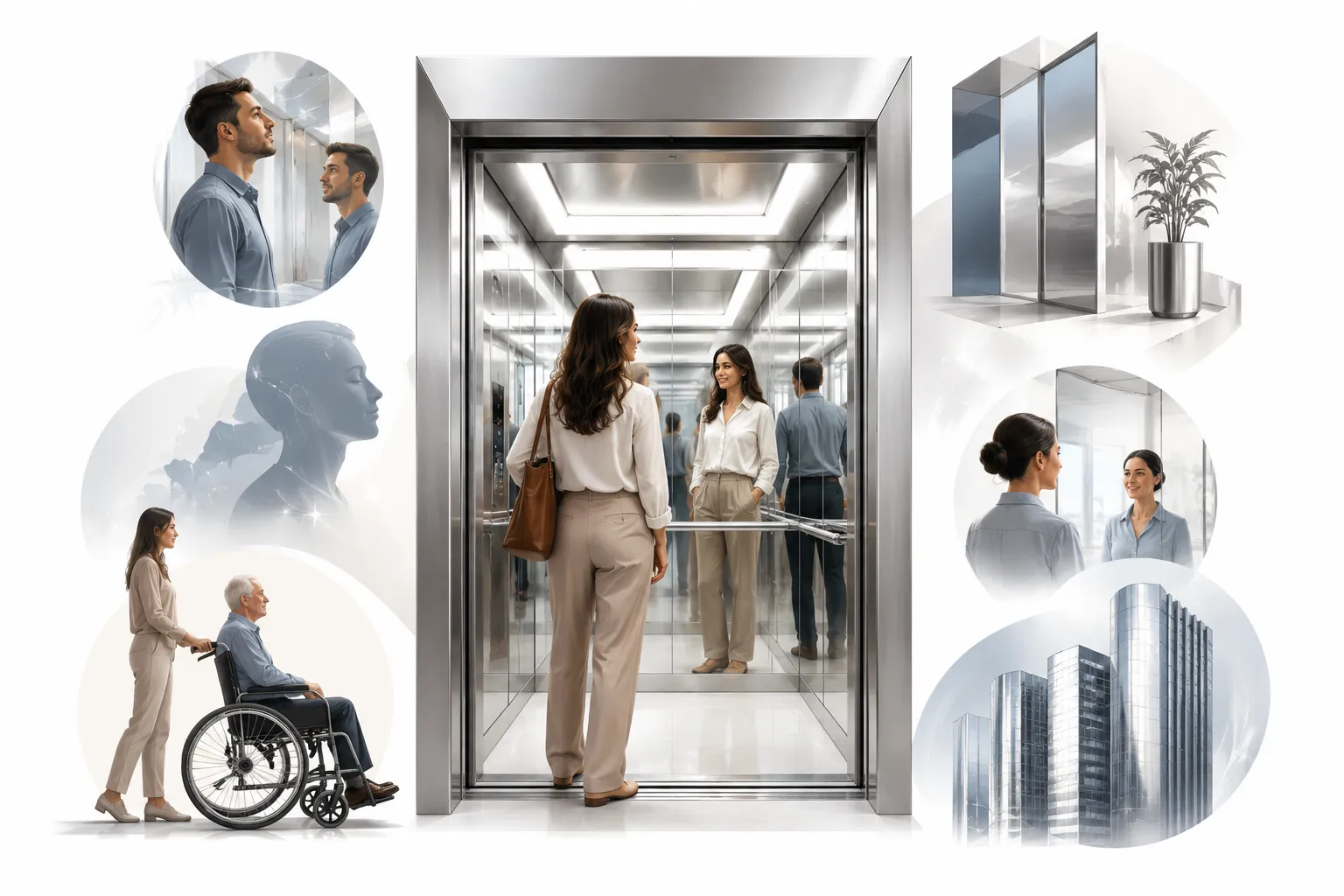
The diagram shows how mirrors occupy attention, make the cabin feel larger, and help riders perceive the wait as shorter.
Attention occupied
A reflection gives riders something to look at during a dull wait.
Larger-feeling space
Mirrors visually extend the cabin and can reduce the cramped feeling.
Practical view
They can help riders see behind them without turning around.
The Story
The Problem Wasn't the Speed. It Was the Boredom.
Current state
Post-war building booms in the mid-20th century created a surge in skyscrapers, and a surge in complaints about lifts. Tenants in tall buildings were furious about slow elevators. Building managers investigated the obvious solutions: adding more lifts, upgrading the motors, improving the scheduling systems. All of these were expensive.
What supports this
Someone, the story is told in various ways by different sources, suggested consulting a psychologist. The psychologist pointed out that the problem wasn't actually the speed of the lifts. It was the boredom of waiting in them. Time passes more slowly when you have nothing to do. The solution: give people something to do. Specifically, give people mirrors. Looking at yourself, adjusting your hair, straightening your collar, just existing in front of your own reflection, occupies attention in a way that makes time feel like it's passing more quickly. Mirrors were installed. Complaints dropped dramatically. No new motors required.
What could change this
Modern lifts often add screens showing news, weather or floor information, the same psychological principle applied with more technology. But the mirror remains the most cost-effective version of the same trick.
The Psychology
Think of It Like a Waiting Room Magazine
The familiar part
Doctors' waiting rooms have magazines. Not because reading improves your health, but because sitting in silence staring at a wall makes five minutes feel like twenty. The magazine makes the wait feel shorter.
How it applies
The elevator mirror is the same thing. You're not going anywhere interesting. The journey is dull. But if you have something to look at, particularly something as personally compelling as your own face, the brain registers the time as occupied rather than wasted. Occupied time feels shorter.
Where the analogy breaks
The effect depends on the mirror being reasonably flattering and the space not being too crowded. A cramped lift full of strangers all trying not to make eye contact in the mirrors is not a calming experience.
Final insight
The Cheapest Fix Is Often the Cleverest
You could spend millions upgrading an elevator to make it 15% faster. Or you could spend a fraction of that on mirrors and achieve the same reduction in complaints, because the problem was never really the speed. The lesson applies well beyond lifts: before you fix the system, make sure you've correctly identified what's actually bothering people.
Quick answers
Common questions
Do elevator mirrors actually make people feel better? +
Yes, the evidence is well-supported in the psychology of waiting. Occupied time is consistently perceived as passing faster than unoccupied time. Mirrors are a cheap, passive way to occupy time.
Are there other reasons for elevator mirrors? +
Yes. Mirrors make small spaces feel larger, which reduces claustrophobia. They're also a practical accessibility feature, wheelchair users can see the floor indicator or doorway behind them without having to turn around.