Visual answer
How Standing Upright Helps Meerkats Survive
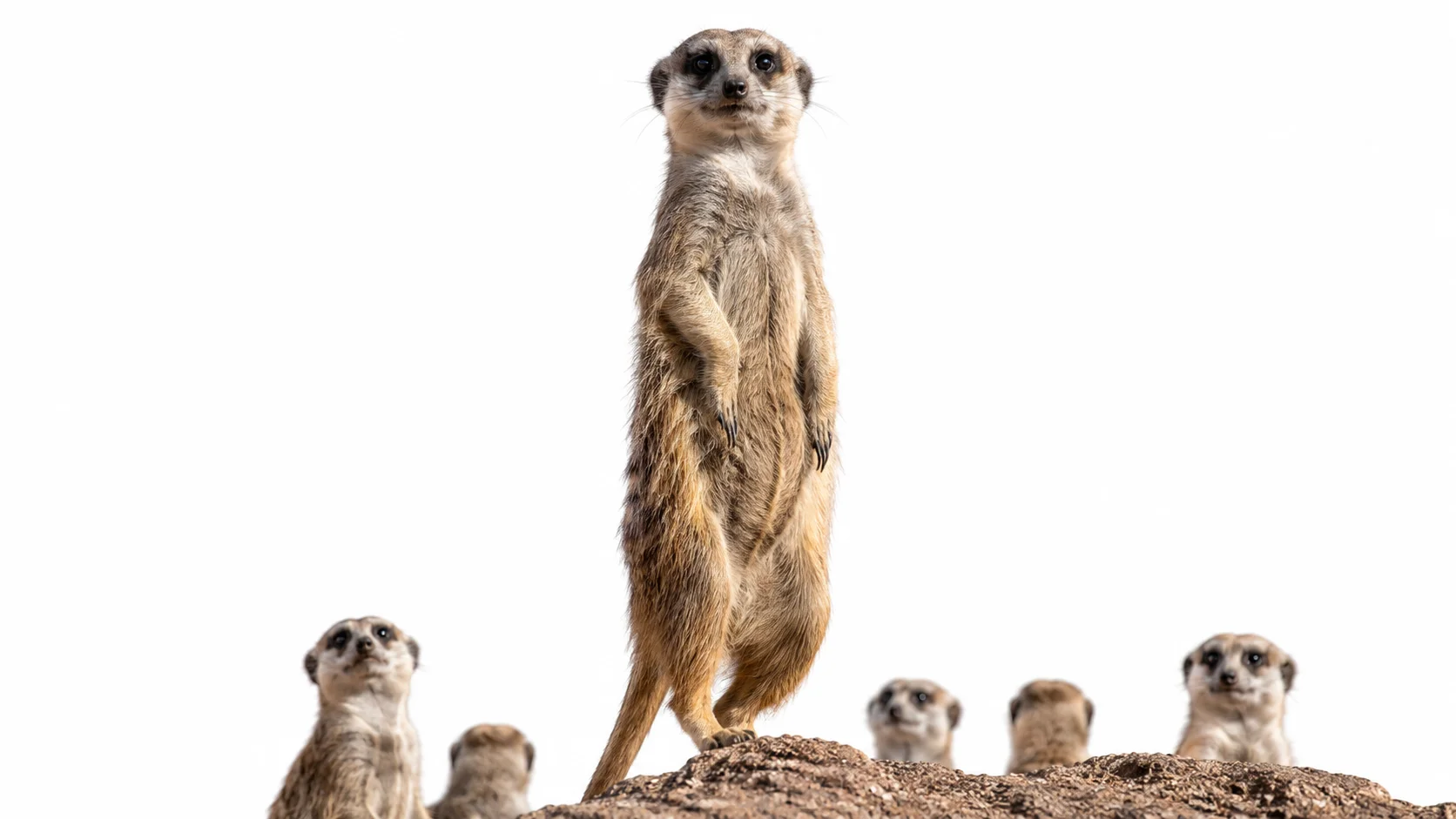
The posture gives meerkats a better view and helps protect the group.
Raised viewpoint
Standing upright allows the meerkat to see farther over grass and uneven terrain.
Predator detection
The meerkat searches for birds of prey, snakes, and mammalian predators.
Alarm call
If danger is spotted, warning calls alert the rest of the group.
Group response
Other meerkats immediately seek cover or move toward safety.
Danger everywhere
A Small Animal in a Very Dangerous World
Meerkats live in southern Africa, where many predators would happily eat them.
From above come eagles and hawks.
From the ground come jackals, wild cats, and snakes.
For a small mammal, survival depends heavily on seeing trouble before trouble sees you.
That creates strong pressure to stay alert.
The upright posture is one of the simplest and most effective solutions.
The higher the eyes, the sooner danger can be spotted.
The lookout
Some Meerkats Become Full-Time Lookouts
Meerkats are highly social animals.
They live in groups that cooperate in ways many mammals do not.
While some members search for food, another individual may climb onto a rock, termite mound, or elevated position and act as a sentinel.
This lookout scans continuously for threats.
If danger appears, the sentinel produces alarm calls that can send the entire group running for cover.
The result is a shared security system built entirely from animal behavior.
Everyone benefits when somebody keeps watch.
Warning language
They Do Not Just Shout 'Danger'
One of the most remarkable discoveries about meerkats involves their alarm calls.
Researchers have found that different calls can communicate different kinds of threats.
An eagle overhead may trigger a different response than a snake on the ground.
This allows the group to react appropriately.
Running into a burrow may help against a bird.
Looking downward may help against a snake.
The warning system is more sophisticated than it first appears.
Better view
A Small Increase in Height Makes a Big Difference
The desert is not perfectly flat.
Grass, rocks, bushes, and small rises in terrain can block a low animal's view.
Standing upright gives a meerkat a better angle over these obstacles.
The gain may only be a few inches, but for a small mammal those inches matter.
Spotting a predator a few seconds earlier can be enough to reach safety.
Evolution often rewards tiny advantages when survival is at stake.
Other reasons
Predators Are Not the Only Thing They Watch
Although predator detection is the main reason, standing upright can serve other purposes too.
Meerkats may use the posture to investigate unfamiliar sounds or movements.
They may also scan for neighboring groups, food opportunities, or changes in their environment.
The posture is versatile.
Once an animal has evolved an excellent observation platform, it can use it for more than one task.
Still, survival remains the primary reason the behavior became so common.
Myth vs reality
Myth vs Reality
What people think
Meerkats stand up because they are naturally curious
Popular documentaries and cartoons often portray meerkats as tiny animals constantly investigating the world around them.
What actually happens
The behavior evolved mainly for survival
Curiosity exists, but standing upright is primarily a surveillance strategy that helps detect predators and protect the group.
Quick answers
Common questions
Do all meerkats take turns being lookouts? +
Many group members may act as sentinels at different times, although some individuals perform the role more often than others.
How do meerkats warn each other about predators? +
They use alarm calls that can communicate both danger and the type of threat approaching.
Can meerkats spot predators from far away? +
Yes. Their elevated posture helps them detect approaching threats earlier than if they remained low to the ground.
Do meerkats only stand up when danger is nearby? +
No. They often stand upright while routinely scanning the environment, even when no immediate threat is visible.