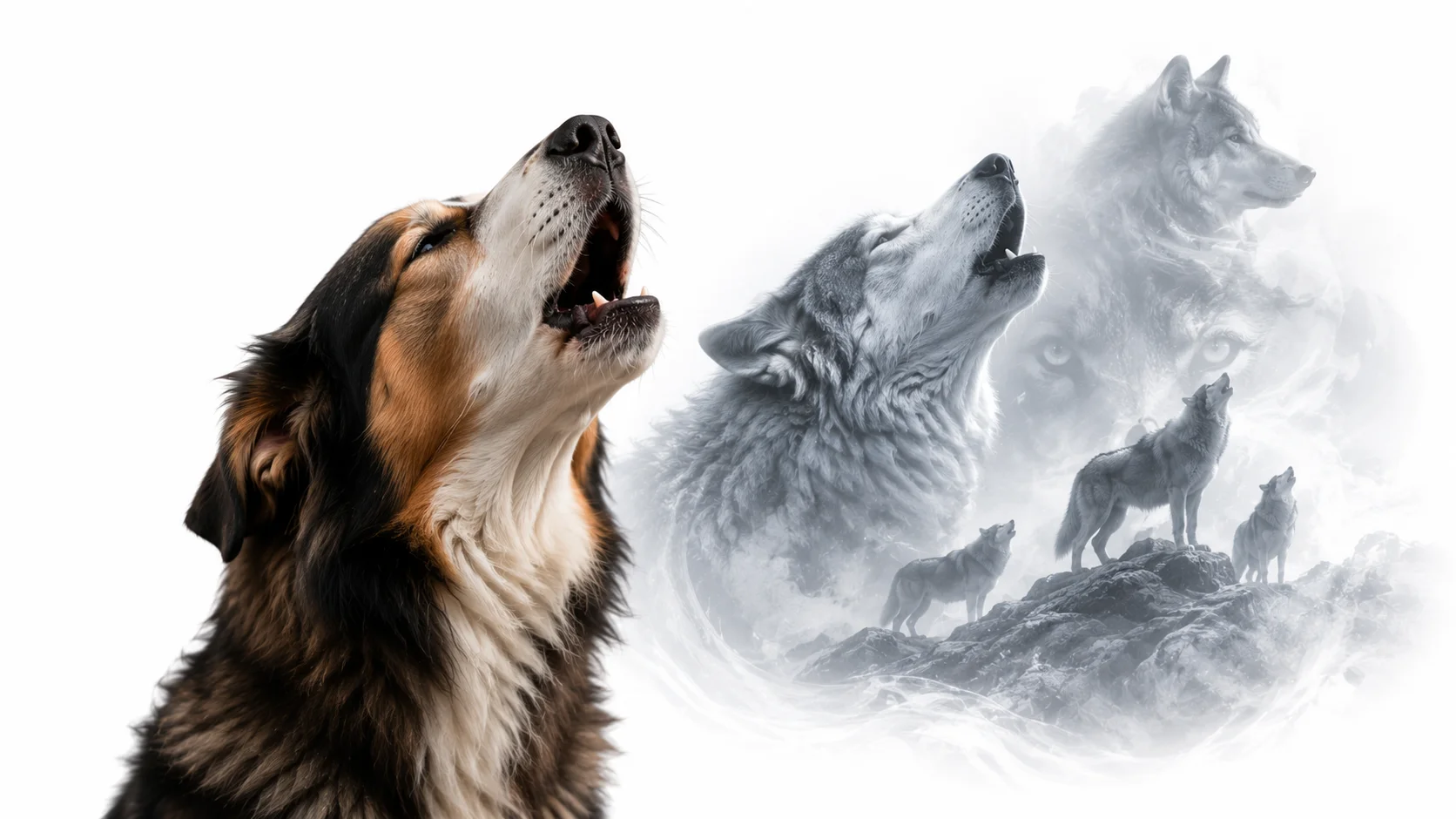
Visual answer
Why Dogs Howl
A howl can serve several communication functions depending on the situation.
Group communication
Howls help dogs and wolves communicate over long distances.
Response to sounds
Certain noises can trigger instinctive vocal responses.
Attention seeking
Some dogs learn that howling successfully gets a human response.
Separation distress
Dogs may howl when isolated from people or companions they are attached to.
Wolf origins
The Sound Comes From a Much Older World
Long before dogs learned to live alongside humans, their ancestors depended on communication across large distances.
A howl can travel much farther than a bark.
In wolves, these calls help pack members locate one another, coordinate movement, and maintain social connections when separated.
Modern dogs inherited that vocal machinery even though most no longer need it for survival.
When a dog howls today, you are hearing a behavior that evolved long before dog parks, leashes, or living rooms existed.
It is one of the clearest reminders that beneath the domestic exterior, dogs still carry traces of their wild ancestry.
Communication
A Howl Travels Farther Than a Bark
Barks are excellent for nearby communication.
Howls are built for distance.
The long sustained sound can travel across much greater areas, making it useful for broadcasting information.
A dog may be communicating location, excitement, social connection, or simply responding to a sound it perceives as meaningful.
In the wild, distance mattered. The ability to send a signal over large areas could help reunite separated animals.
That ancient purpose still echoes through the howl today.
Sirens
Why Sirens Make Some Dogs Howl
Many dog owners have seen it happen.
An ambulance passes, a siren begins to rise and fall, and suddenly the dog joins in.
The exact reason is not fully understood, but many researchers believe certain sounds resemble the long vocal calls dogs are already wired to recognize.
To the dog, the siren may sound less like a machine and more like a distant voice.
The howl may be a response, an attempt to communicate, or simply an instinctive reaction to a familiar acoustic pattern.
The dog is not trying to imitate the siren. It may be treating it as part of a conversation.
Attention
Some Dogs Learn That Howling Works
Dogs are excellent students when it comes to human behavior.
If a dog howls and a person immediately responds, the dog learns something valuable.
The howl produced attention.
That attention does not even need to be positive. Looking at the dog, speaking to it, or walking across the room may all count as a reward from the dog's perspective.
Over time, some dogs discover that howling is one of the fastest ways to get a human's focus.
Once learned, the behavior can become surprisingly persistent.
Separation
When Howling Signals Loneliness
Not every howl is playful or social.
Some dogs howl when left alone because they are distressed by separation.
In these cases, the howl may function much like a contact call. The dog is attempting to reconnect with family members who are suddenly gone.
This type of howling often appears alongside pacing, destructive behavior, excessive barking, or signs of anxiety.
Understanding the context matters. A lonely howl carries a very different meaning from a playful howl triggered by music.
The sound may be the same, but the emotion behind it is not.
Head position
Why Dogs Lift Their Heads While Howling
The image of a howling dog is almost always the same: nose upward, neck extended, sound aimed at the sky.
This posture looks dramatic, but it probably has practical origins.
Raising the head helps project the sound efficiently and may improve the acoustics of the call.
The posture also changes the shape of the airway and vocal tract, helping produce the long sustained note.
The dog is not aiming a message at the moon.
It is simply using a position that works well for broadcasting a powerful sound.
Myth vs reality
Myth vs Reality
What people think
Dogs howl because they are talking to the moon
The image is so common in stories and movies that many people assume the moon somehow triggers the behavior.
What actually happens
Dogs howl because they are communicating
Howling is a communication behavior rooted in canine evolution. The upward head position is about sound production, not lunar conversation.
Quick answers
Common questions
Why does my dog howl when I leave? +
Your dog may be experiencing separation distress or attempting to reconnect with you through long-distance communication behavior.
Why do dogs howl at sirens? +
Many dogs appear to interpret sirens as sounds similar to long-distance canine vocalizations and respond instinctively.
Do all dogs howl? +
No. Some dogs rarely howl, while others do it frequently. Breed, personality, environment, and learning all influence the behavior.
Is howling a sign of pain? +
Sometimes. A sudden unusual howl can indicate discomfort or injury, especially if accompanied by other signs of distress.
Are dogs copying wolves when they howl? +
Not consciously. Dogs and wolves share a common evolutionary history, and howling is one of the inherited communication behaviors that survived domestication.