Visual answer
Two Reasons Eagles Lock Talons
The same aerial maneuver can serve very different purposes depending on the situation.
Approach
Two eagles maneuver toward one another high in the air.
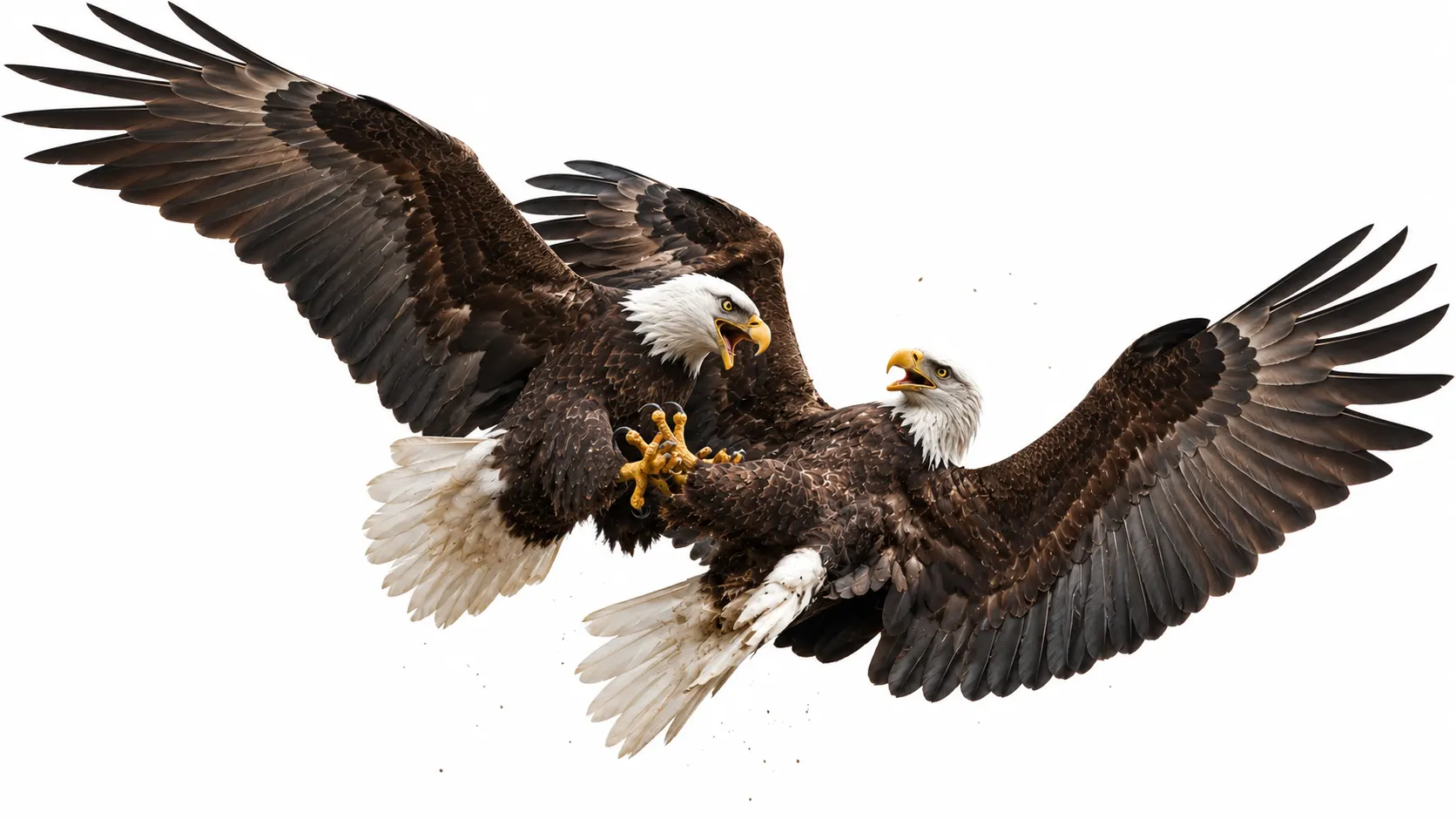
Talon lock
Their feet connect, creating a temporary physical link.
Spiral descent
The pair spins downward while maintaining contact.
Release
They separate before impact and continue flying.
Love or war
The Same Behavior Can Mean Opposite Things
One reason eagle talon-locking fascinates people is that it appears so dangerous.
Two large birds deliberately connect themselves in mid-air and begin falling.
Yet the behavior serves very different purposes depending on context.
A bonded pair may perform the maneuver as part of courtship and relationship maintenance.
Two rivals may perform almost the exact same maneuver while trying to dominate each other.
To a human observer, the scenes can look nearly identical.
To the eagles, the difference is enormous.
Courtship
When Freefall Becomes a Courtship Ritual
Many eagle species form long-term pair bonds.
Maintaining those partnerships requires communication and coordination.
The cartwheel display is one of the most spectacular examples.
The pair circles, approaches, locks talons, and drops together before releasing near the ground.
Researchers believe the display may help strengthen pair bonds while also demonstrating physical ability and trust.
Both birds must coordinate their actions perfectly.
A mistake could be costly.
Territorial fights
Sometimes It Is a Fight
Eagles invest heavily in territory.
A good nesting site may be used for years and can be critical to reproductive success.
When rivals challenge ownership, aerial confrontations can occur.
In these cases, talon-locking becomes a contest of dominance rather than cooperation.
Each bird attempts to gain an advantage and force the other to yield.
The stakes are much higher than simple display.
Access to territory can determine future breeding success.
Talons
The Same Talons Used for Hunting
Eagle talons are among the most powerful gripping tools in the bird world.
They evolved primarily for capturing and holding prey.
When those same structures connect to another eagle, the grip can be remarkably strong.
That is part of what makes the aerial display so dramatic.
The birds are not gently touching feet.
They are using equipment capable of restraining struggling animals.
The fact that they usually separate safely is a testament to their control and experience.
Why release
Why They Let Go at the Last Moment
The most obvious question is simple.
Why do they not crash?
The answer is that both birds remain in control for much of the descent.
Even while connected, they can adjust wing position and body orientation.
In courtship displays, releasing safely is part of the performance.
In fights, releasing prevents both birds from suffering the consequences of a collision.
The maneuver looks reckless, but experienced eagles perform it with extraordinary precision.
Myth vs reality
Myth vs Reality
What people think
Eagles only lock talons when they are mating
Because the display is famous in wildlife photography, many people assume every talon lock is part of courtship.
What actually happens
Talon locking happens in both courtship and conflict
The same physical behavior can help strengthen a pair bond or help settle a territorial dispute. Context determines the meaning.
Quick answers
Common questions
Do all eagle species lock talons? +
Not all species have been observed doing it regularly, but talon-locking displays are well known in several eagle species, including bald eagles and golden eagles.
Why do eagles spin while locking talons? +
The spin results from the combined motion of two large birds connected in flight while gravity pulls them downward.
Can eagles get injured during these encounters? +
Yes. Although most encounters end safely, injuries and fatal accidents have occasionally been documented.
Do eagle pairs stay together for life? +
Many eagle species form long-term pair bonds that can last for years, often until one partner dies.