Visual answer
Reading a Dog's Tail
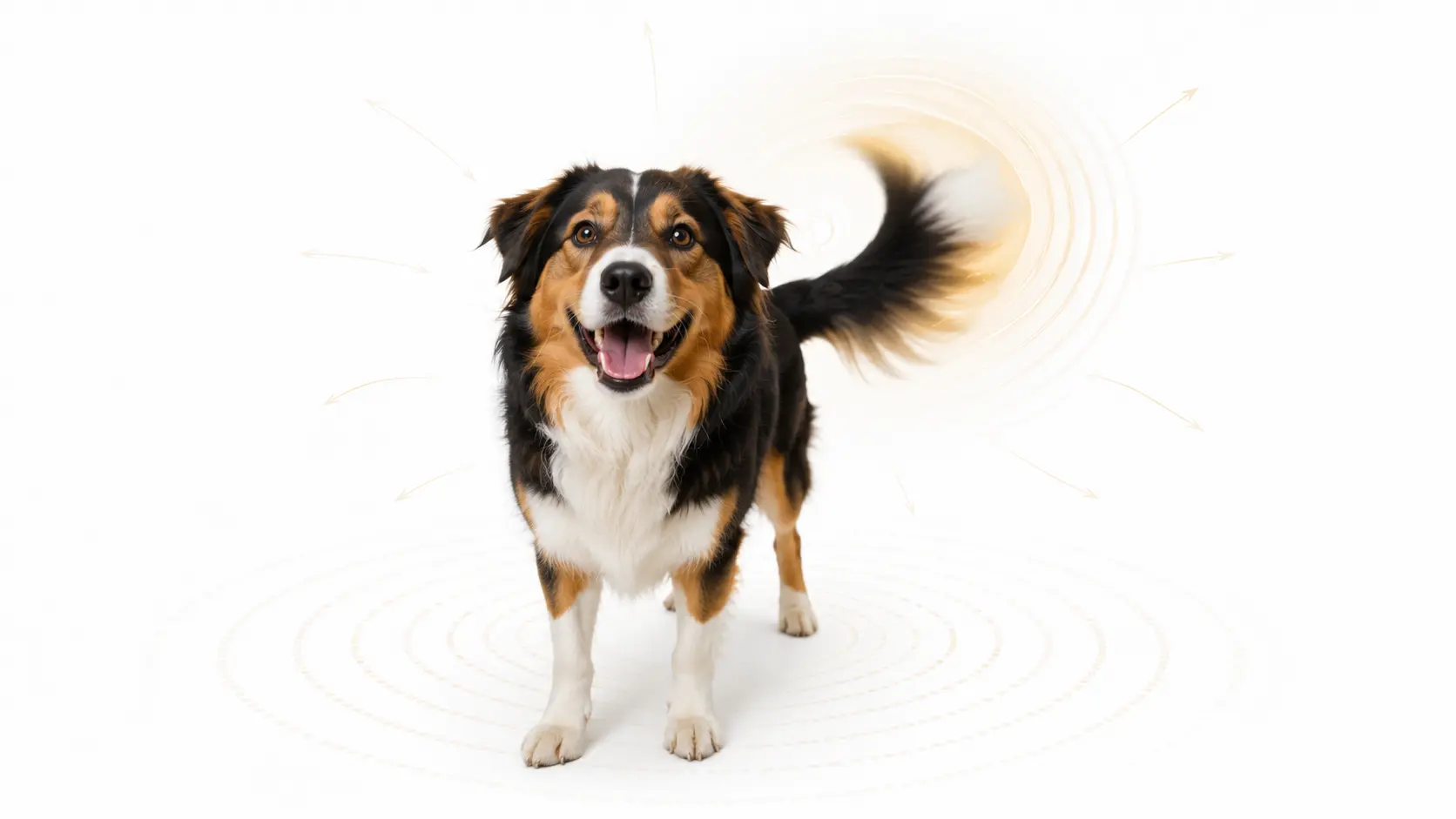
The meaning of a wag depends on speed, height, stiffness, and the rest of the body.
Loose wag
Often associated with relaxation, friendliness, and social comfort.
Fast excited wag
Usually appears when the dog is highly engaged or anticipating something enjoyable.
High stiff wag
May signal alertness, confidence, or potential tension.
Low wag
Can be linked to uncertainty, caution, or submission depending on context.
Tail language
A Tail Is Part of a Dog's Language
Humans rely heavily on words. Dogs rely heavily on movement.
Long before a dog barks, growls, or whines, its body is already communicating.
The tail is one of the most visible parts of that system.
A wagging tail sends information to other dogs and to people. It reveals emotional arousal, attention, confidence, uncertainty, and social intentions.
The mistake humans often make is treating every wag as if it means the same thing.
To a dog, a tail wag is closer to a sentence than a single word.
Happy wagging
The Wag People Know Best
The classic happy wag is easy to recognize once you have seen it.
The tail moves loosely. The hips may sway with it. The dog's body looks soft rather than stiff.
This kind of wag often appears during greetings, play, affection, and moments of excitement.
The dog is not simply moving its tail. The entire body seems involved.
This is the wag that created the popular belief that wagging always means happiness.
It is common, but it is not the only kind.
Not always happy
Why Some Wagging Dogs Should Be Left Alone
A dog can wag its tail while feeling nervous, conflicted, or defensive.
Imagine a stranger approaching. The dog is interested but uncertain.
The tail may move, yet the body becomes stiff. The ears shift. The posture changes.
In this case, the wag is not an invitation. It is part of the dog's attempt to process the situation.
Some aggressive dogs wag immediately before a bite. The tail movement signals emotional activation, not friendliness.
That is why experienced trainers watch the entire dog, not just the tail.
Left vs right
Dogs May Wag Differently Depending on Emotion
One of the more surprising discoveries in canine behavior came from studying wagging in slow motion.
Researchers found evidence that dogs sometimes favor one side more than the other depending on what they are experiencing.
When seeing something positive, dogs often show stronger movement toward the right side of their body. More negative or uncertain situations may produce stronger movement toward the left.
The effect is linked to how the brain processes emotion.
Dogs are not consciously choosing a direction. The pattern emerges naturally from the nervous system.
It is a reminder that even a simple wag can contain more information than it first appears.
Evolution
Why Evolution Kept the Wag
The ancestors of modern dogs lived in social groups where communication mattered.
A signal that helped avoid unnecessary fights or strengthen social bonds would have been valuable.
The tail became one of the easiest body parts to see from a distance.
Over time, movement of the tail became linked with emotional state and social interaction.
Domestic dogs later evolved alongside humans, and people became surprisingly good at reading those signals.
Today, a wagging tail is one of the clearest examples of communication crossing species boundaries.
Short tails
What About Dogs With Very Short Tails?
Not every dog has a long expressive tail.
Some breeds naturally have short tails. Others have historically been docked.
These dogs still communicate, but they rely more heavily on posture, ear position, facial expression, and movement.
Communication becomes slightly harder because one of the major visual signals is reduced.
Studies suggest that other dogs can sometimes find tailless dogs more difficult to read.
The tail is not the only communication tool, but it is an important one.
Myth vs reality
Myth vs Reality
What people think
A wagging tail means a dog is friendly
Many people assume a wagging dog is automatically safe to approach.
What actually happens
A wagging tail means the dog is emotionally engaged
The dog may be happy, excited, nervous, uncertain, alert, or even defensive. The meaning depends on the rest of the body language.
Quick answers
Common questions
Does a wagging tail always mean a dog is happy? +
No. Wagging usually means the dog is emotionally engaged, but the emotion can be positive, negative, or mixed depending on the situation.
Why does my dog wag its tail when I come home? +
Your dog is likely excited by your return and associating you with positive experiences, attention, and routine.
Can a dog wag its tail before biting? +
Yes. Tail wagging alone is not a reliable indicator of friendliness. Stiff posture and other warning signals may appear at the same time.
Why do puppies wag their tails so much? +
Puppies are highly social and often experience strong emotional reactions to people, play, food, and exploration. Wagging becomes a common communication tool.
Do wolves wag their tails? +
Yes. Wolves use tail movements for communication, though domestic dogs generally wag more frequently and in a wider range of social situations.