Visual answer
Why red became the stop signal
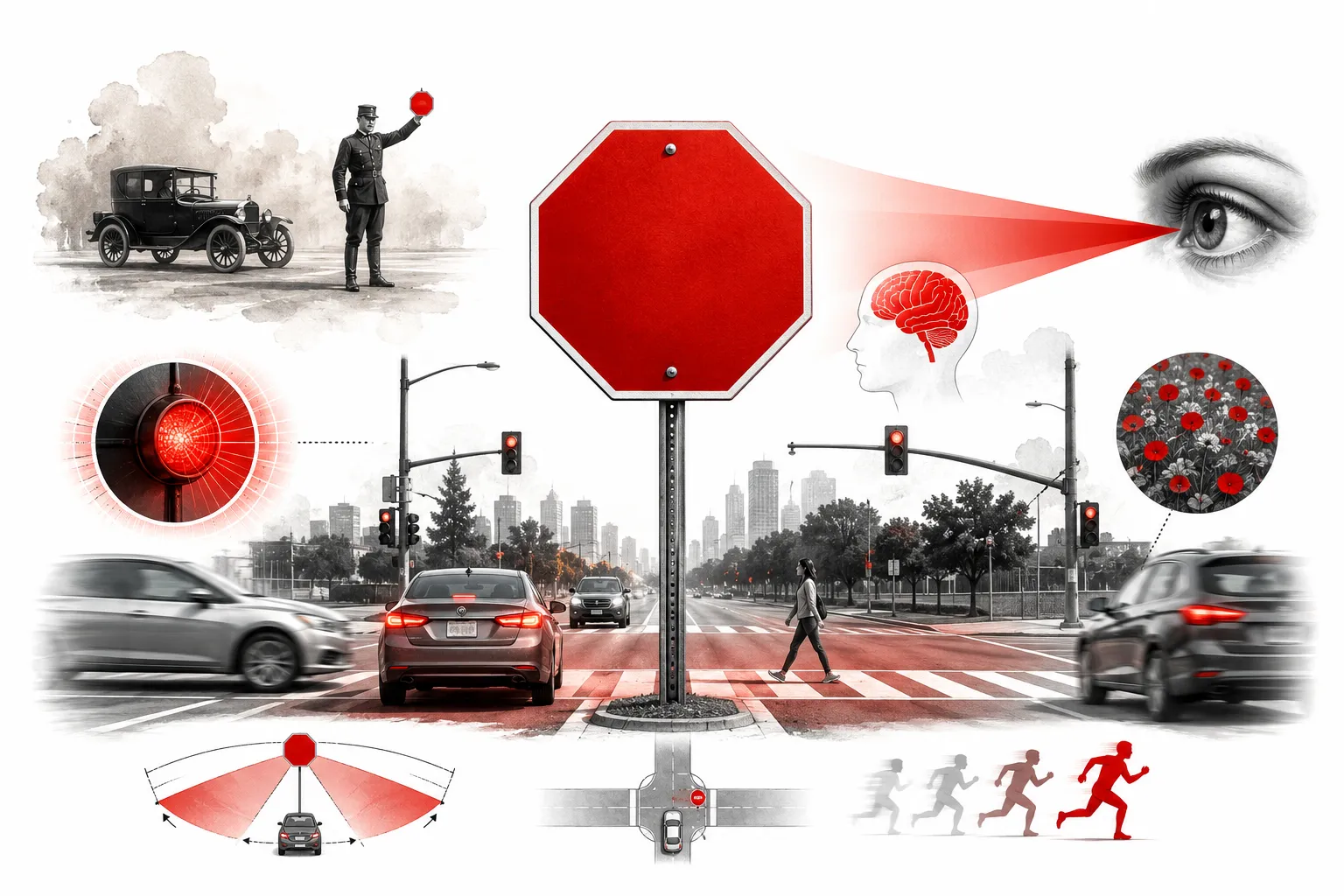
The diagram shows how older danger signals, railway practice, better reflective materials, and international standards all converged on the modern red stop sign.
Danger cue
Red already carried strong warning associations from blood, fire, and hazard signals.
Railway signal
Railways used red to mean stop before cars became common.
Modern standard
Durable reflective red materials made the color practical for road signs.
The Story
The Surprisingly Recent History of the Red Stop Sign
Current state
Red means danger. That association is so old and so universal that we barely think about it, but it didn't happen by accident. Red is the colour of blood, of fire, of things that can kill you. Long before anyone had a car, railway engineers were using red signals to mean 'stop immediately' because red is visible from far away and carries a gut-level warning that other colours simply don't.
What supports this
When the first stop signs appeared in Detroit in 1915, they were actually yellow with black letters. The reason is almost comically practical: the red paints available at the time faded quickly in sunlight. A faded stop sign is worse than no stop sign at all. So yellow it was. It wasn't until reflective red materials improved significantly that the US standardised on red in 1954. The octagonal shape was chosen even earlier, in 1923, specifically so that drivers could recognise it from behind, even if they couldn't read the word on it.
What could change this
Red is now locked in by international convention. The Vienna Convention on Road Signs and Signals, signed by dozens of countries, standardises red for stop signs across most of the world. Changing it now would require renegotiating international treaties and replacing millions of signs. It's not happening.
Why Red Works
Think of It Like a Fire Alarm
The familiar part
Fire alarms are almost always red. Not because someone decreed it, but because over time, red became the universal shorthand for 'this is urgent, pay attention right now.'
How it applies
Stop signs work the same way. The colour doesn't just tell you what to do, it bypasses your thinking brain and hits something more instinctive. Red triggers alertness. By the time you've consciously read the word STOP, your foot is already moving toward the brake.
Where the analogy breaks
This only works because we've all learned it. Red means stop because we were taught it means stop. A person who had never encountered road signs would have no particular reason to treat red as more urgent than blue or green.
Final insight
The Colour That Couldn't Be Argued With
Red didn't become the colour of stop signs because a committee voted on it. It became the colour because centuries of human experience, blood, fire, warning, had already made the association. The sign is just catching up with instinct.
Quick answers
Common questions
Were stop signs always red? +
No. The earliest stop signs were yellow with black lettering, because durable red paint didn't exist yet. The US only standardised red stop signs in 1954.
Why is a stop sign octagonal? +
The eight-sided shape was chosen in 1923 so that drivers approaching from behind could recognise it by shape alone, even without seeing the word STOP on the front.
Do all countries use red stop signs? +
Most do, thanks to international road sign conventions. A handful of countries have historical variations, but the red octagonal stop sign is recognised almost everywhere on Earth.