Everyday Science

Why Does Tin Foil Dull in the Dishwasher?

What happens when alkaline detergent meets aluminium at high temperature - and why the result is permanent. Brilliant silver aluminium foil goes into the dishwasher and comes out dull, matte, and slightly ghostly looking. This is not the dishwasher's fault, exactly, nor the foil's. It is a chemical reaction that the combination of hot water, alkaline detergent, and aluminium basically cannot avoid. The answer involves aluminium oxide, alkaline chemistry, and why aluminium handles acidic and neutral conditions well but struggles specifically with alkaline ones.

Quick answer

Tin foil, which is actually aluminium, dulls in the dishwasher because the strongly alkaline detergent at high temperatures dissolves the protective aluminium oxide layer on the foil's surface and attacks the aluminium itself, creating a rough, matte surface that scatters light rather than reflecting it. Aluminium is normally protected from corrosion by a thin oxide layer that forms almost instantly on contact with air. Alkaline conditions dissolve this protective layer and attack the underlying metal, which is why aluminium and dishwashers are considered incompatible.
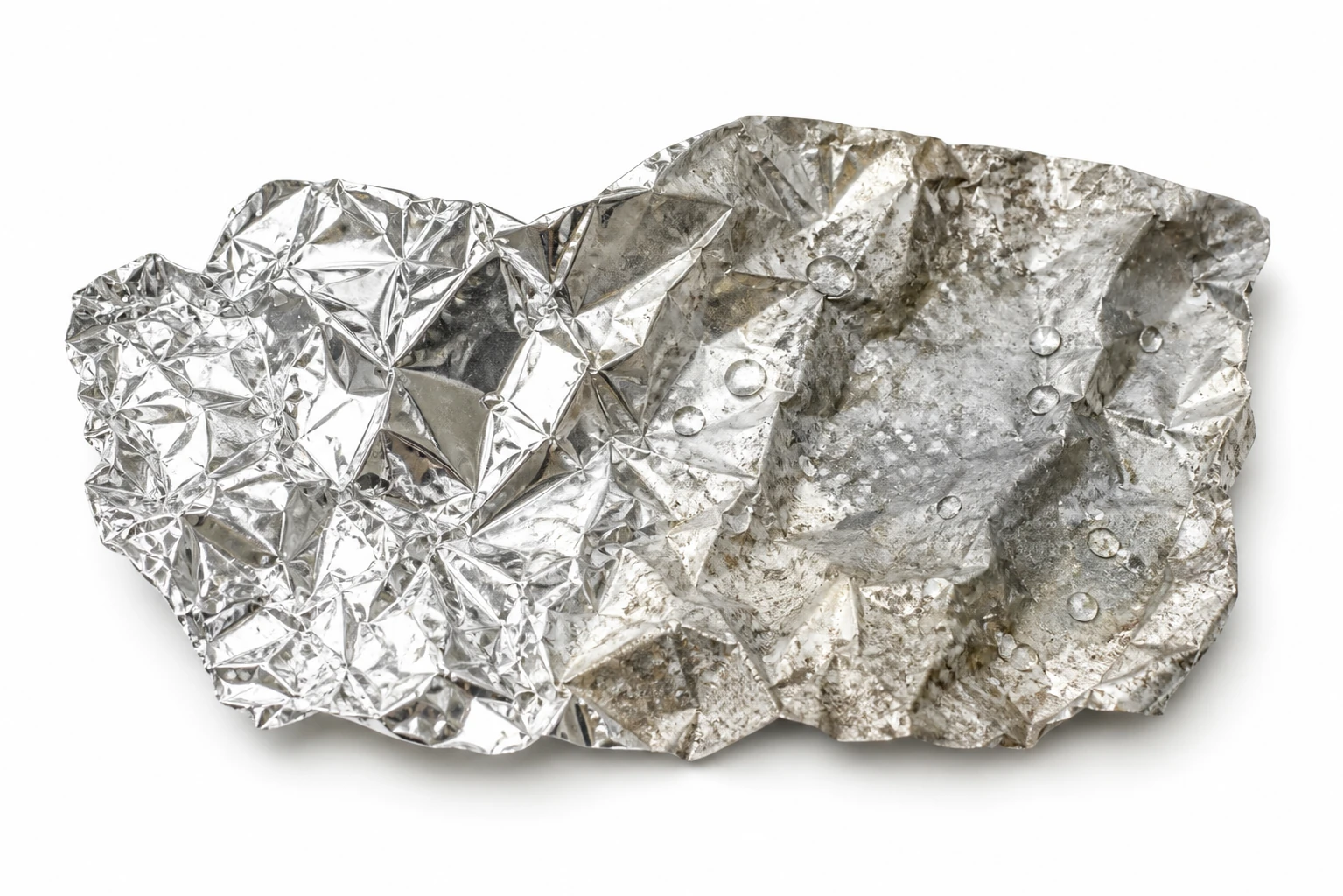
Why Does Tin Foil Dull in the Dishwasher? hero image

The mystery

The answer involves aluminium oxide, alkaline chemistry, and why aluminium handles acidic and neutral conditions well but struggles specifically with alkaline ones.

The short answer

Tin foil, which is actually aluminium, dulls in the dishwasher because the strongly alkaline detergent at high temperatures dissolves the protective aluminium oxide layer on the foil's surface and attacks the aluminium itself, creating a rough, matte surface that scatters light rather than reflecting it.

The twist

Aluminium is normally protected from corrosion by a thin oxide layer that forms almost instantly on contact with air. Alkaline conditions dissolve this protective layer and attack the underlying metal, which is why aluminium and dishwashers are considered incompatible.

Common mistake

Some assume that multiple dishwasher exposures accumulate damage progressively.

Alkaline detergent versus aluminium's oxide shield

Aluminium's durability in most conditions comes from a specific surface layer that alkaline dishwasher detergent removes very effectively.

Aluminium is protected by its own oxide

When aluminium is exposed to air, it immediately forms a thin layer of aluminium oxide on its surface. This oxide layer is tightly adherent, transparent, and chemically resistant, protecting the softer metal beneath from most corrosive conditions.

This is why aluminium cookware and foil can handle acidic foods and humid environments without obvious degradation.

Aluminium dresses itself in its own corrosion product and, remarkably, this improves its durability rather than worsening it.

Alkaline detergent dissolves the oxide layer

Dishwasher detergents are strongly alkaline, with high pH needed to emulsify grease and remove food residues effectively.

At elevated dishwasher temperatures, this alkaline solution dissolves aluminium oxide efficiently, stripping away the protective layer and exposing bare aluminium to chemical attack.

Dishwasher detergent removes grease by being aggressively alkaline, and aluminium oxide has the misfortune of dissolving under the same conditions.

Exposed aluminium reacts to form a rough, irregular surface

Once the oxide layer is removed, bare aluminium reacts with the alkaline solution in an uncontrolled way, creating an irregular, pitted surface with a rough texture at the microscopic level.

This rough surface scatters incident light in all directions rather than reflecting it specularly, producing the characteristic dull, matte appearance.

The shininess of aluminium comes from its smooth, regular surface. One dishwasher cycle later, that smoothness is gone.

From shiny to dull in one wash cycle

A short sequence explains the chemistry of dishwasher-induced dulling.

1

01. Foil enters the dishwasher with intact oxide layer

Normal, protective aluminium oxide surface is present.

2

02. Alkaline detergent at high temperature attacks the oxide

The protective layer is dissolved by the alkaline wash solution.

3

03. Exposed aluminium reacts unevenly with the solution

Chemical attack creates a microscopically rough, irregular surface.

4

04. Rough surface scatters light and appears dull

The loss of surface regularity eliminates the specular reflection that produces shininess.

Why this damage is permanent

The roughened surface created by alkaline attack is a physical alteration to the aluminium's microstructure, not simply the removal of a coating.

Although a new oxide layer forms quickly on exposure to air after the wash cycle, this new layer conforms to the now-rough surface and does not restore the original smooth, reflective appearance.

Surprising aluminium chemistry facts

Anodizing artificially thickens the oxide layer
Anodized aluminium has a much thicker, electrochemically grown oxide layer that is significantly more resistant to alkaline attack, which is why anodized cookware is safer in dishwashers.
Aluminium is the most abundant metal in Earth's crust
Yet it was once more valuable than gold, because refining it from ore was extremely difficult before electrolytic methods were developed.
The term 'tin foil' is incorrect
Modern kitchen foil has been made from aluminium since the mid-20th century; the name 'tin foil' is a historical holdover from when foil was actually made from tin.

Does dishwasher foil damage become worse over repeated washes?

Myth

Some assume that multiple dishwasher exposures accumulate damage progressively.

Progressive deterioration is a common pattern for many dishwasher-damaged items, though aluminium's damage mechanism is largely complete after the first cycle.

Reality

The most significant damage occurs in the first wash when the initial oxide layer is removed; subsequent washes continue attacking the newly reformed oxide but the surface is already roughened.

The most significant damage occurs in the first wash when the initial oxide layer is removed; subsequent washes continue attacking the newly reformed oxide but the surface is already roughened.

Where alkaline attack on metals matters

Aluminium cookware in the dishwasher
Non-anodized aluminium pots and pans undergo the same dulling and surface damage for identical chemical reasons.
Copper and its alloys
Brass and copper items also suffer in dishwashers, though through different but related electrochemical reactions.

Why this matters for kitchen decision-making

Understanding which materials tolerate dishwasher conditions and why directly informs which cookware and food storage items should be hand-washed.

Aluminium, copper, cast iron, and non-anodized non-stick pans all degrade in dishwashers for specific chemical reasons that hand-washing avoids.

Worth noting

A protective layer that could not protect against detergent

Aluminium's self-protective oxide has defended it against rain, acids, and atmospheric humidity for decades, and then met its match in a standard dishwasher tablet. The chemistry that makes aluminium one of the most durable everyday metals is also exactly why it should never be put in the dishwasher.

Quick answers

Common questions

Is it safe to use dishwasher-dulled aluminium foil with food?

Yes, the chemical changes are cosmetic; the dulled foil remains food-safe for typical uses.

Everyday Science

Related questions

Partially, using acidic cleaners like cream of tartar or commercial aluminium polish, which clean the surface but cannot fully restore the original surface texture.

The chemistry of protective oxide layers

Passive Oxide Layer Theory

The understanding that certain metals self-protect through spontaneous surface oxide formation, developed systematically in the 19th century.

Where alkaline attack on metals matters

Aluminium cookware in the dishwasher

Non-anodized aluminium pots and pans undergo the same dulling and surface damage for identical chemical reasons.

Where alkaline attack on metals matters

Copper and its alloys

Brass and copper items also suffer in dishwashers, though through different but related electrochemical reactions.

Does dishwasher foil damage become worse over repeated washes?

The most significant damage occurs in the first wash when the initial oxide layer is removed; subsequent washes continue attacking the newly reformed oxide but the surface is already roughened.

The most significant damage occurs in the first wash when the initial oxide layer is removed; subsequent washes continue attacking the newly reformed oxide but the surface is already roughened.