Everyday Science

Why Does Plastic Wrap Stick to Itself?

A material designed to be inconvenient in specifically the way that makes it useful. Plastic wrap sticks to itself with infuriating determination and to almost nothing else with any reliability whatsoever, unless that nothing else happens to be your hand, the edge of the box, or another piece of plastic wrap that is now utterly inseparable from the first piece. This behavior is not an accident. It is chemistry, and it works exactly as designed. The answer involves electrostatic charge, molecular polarity, and the specific reason plastic wrap sticks enthusiastically to glass and stainless steel while barely bothering with wood.

Quick answer

Plastic wrap sticks through a combination of very weak electrostatic charges accumulated during unrolling, molecular polar interactions between the plastic and certain surfaces, and the flexibility of the thin film itself allowing maximum molecular contact area with smooth surfaces. Plastic wrap sticks better to some surfaces than others because of chemistry - it clings well to glass and polished metal due to polar molecular interactions, while struggling with polyethylene and wood, which have incompatible surface chemistry.
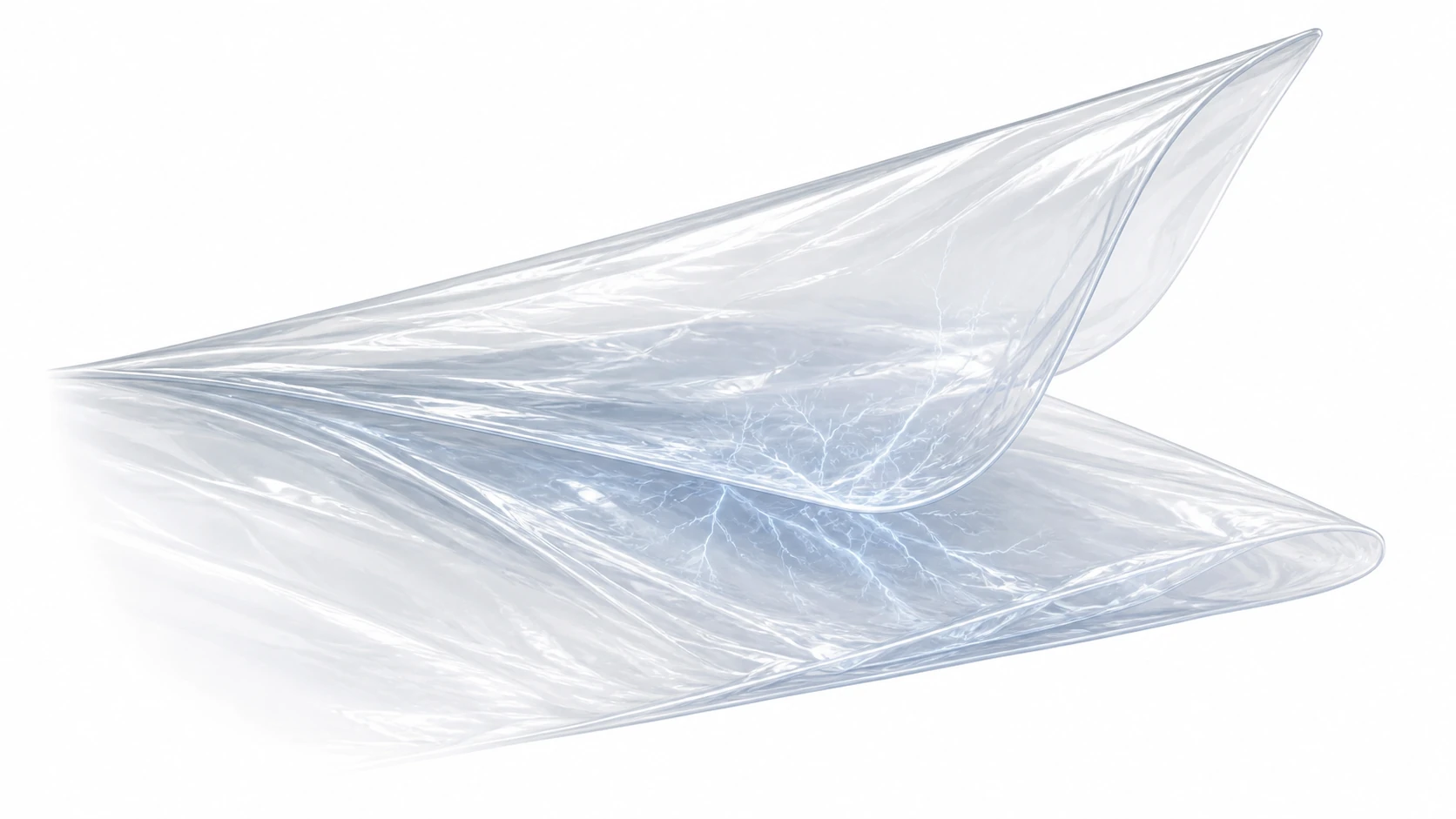
Why Does Plastic Wrap Stick to Itself? hero image

The mystery

The answer involves electrostatic charge, molecular polarity, and the specific reason plastic wrap sticks enthusiastically to glass and stainless steel while barely bothering with wood.

The short answer

Plastic wrap sticks through a combination of very weak electrostatic charges accumulated during unrolling, molecular polar interactions between the plastic and certain surfaces, and the flexibility of the thin film itself allowing maximum molecular contact area with smooth surfaces.

The twist

Plastic wrap sticks better to some surfaces than others because of chemistry - it clings well to glass and polished metal due to polar molecular interactions, while struggling with polyethylene and wood, which have incompatible surface chemistry.

Common mistake

Many people assume plastic wrap creates a completely airtight seal around food.

Thin film, large surface contact, and convenient molecular attraction

Plastic wrap's stickiness comes from how thin it is and what happens when it charges during unrolling.

Unrolling creates electrostatic charge

As plastic wrap is pulled from the roll, friction between the layers transfers electrons, giving the freshly unrolled surface a small electrostatic charge.

This charge attracts the wrap to nearby surfaces and other pieces of wrap through the same induced-charge mechanism that makes a balloon stick to a ceiling.

Every meter of plastic wrap you pull off the roll is a small static electricity experiment happening in your kitchen.

The film's flexibility maximizes molecular contact

Because the film is extremely thin and flexible, it conforms tightly to the microscopic surface topography of whatever it is placed against, maximizing the area of molecular contact.

More contact area means more total intermolecular attractive force, which is why smooth surfaces attract plastic wrap more than rough ones.

Plastic wrap does not grip surfaces; it simply touches them at every possible point simultaneously.

Different formulations have different amounts of tackiness

Earlier plastic wraps used PVDC, which had stronger self-adhesion and better oxygen barrier properties. Newer wraps use less tacky polyethylene formulations that are safer but require the electrostatic mechanism to carry more of the adhesion work.

This is why some plastic wraps feel noticeably stickier than others from different eras or manufacturers.

The era of your plastic wrap and its specific polymer formulation determines whether it performs reliably or requires an argument.

From roll to stuck

A short sequence explains why plastic wrap behaves the way it does.

1

01. Unrolling generates electrostatic charge

Friction between film layers transfers electrons.

2

02. Charged film is attracted to nearby surfaces

Induced charges on surrounding surfaces attract the wrap.

3

03. Thin film conforms to maximize contact area

Flexibility allows molecular-level contact with smooth surfaces.

4

04. Intermolecular forces accumulate across the contact area

Total adhesion from many small forces produces a useful level of stickiness.

Why it sticks to glass better than to itself sometimes

Glass surfaces are highly polar, matching the polar character of many plastic wrap formulations and producing stronger molecular attraction than plastic-to-plastic contact in some cases.

This explains the frustrating experience of plastic wrap that will stick to a clean bowl with determination but collapses in the middle of a frustrating self-adhesion tangle.

Surprising plastic wrap facts

PVDC wrap was superior but phased out for safety reasons
Polyvinylidene chloride, which produced the stickiest wrap, was largely replaced by safer alternatives that are somewhat less adhesive.
Humidity affects plastic wrap's stickiness
Very dry conditions increase electrostatic charge; very humid conditions allow charges to dissipate faster, reducing stickiness.
Beeswax wraps work completely differently
Modern beeswax food wraps use warmth from the hands to make the wax slightly tacky, creating a completely different adhesion mechanism.

Does plastic wrap actually create an airtight seal?

Myth

Many people assume plastic wrap creates a completely airtight seal around food.

The visible cling of the film creates an impression of complete sealing even when gas exchange continues.

Reality

Standard plastic wrap is gas-permeable to varying degrees, though PVDC-based wraps had significantly better oxygen barrier properties than modern polyethylene versions.

Standard plastic wrap is gas-permeable to varying degrees, though PVDC-based wraps had significantly better oxygen barrier properties than modern polyethylene versions.

Where thin-film adhesion matters

Window films
Tinted window films use similar electrostatic and molecular adhesion principles to attach to glass surfaces without liquid adhesives.
Food packaging films
Industrial food packaging uses engineered film adhesion for precise oxygen and moisture barrier properties.

Why this frustrating material is worth understanding

Understanding why plastic wrap behaves as it does suggests practical strategies - wet surfaces increase adhesion to bowls, while completely dry conditions improve self-adhesion.

It also reveals why different wrap brands perform so differently despite looking identical.

Worth noting

The kitchen's most deliberately inconvenient material

Plastic wrap is sticky exactly where and how it needs to be to be useful, and infuriating exactly where and how it needs to be to generate decades of quiet domestic frustration. Few materials have ever been simultaneously this useful and this annoying, for such deeply related chemical reasons.

Quick answers

Common questions

How do you stop two pieces of plastic wrap from sticking together?

Keeping your hands dry and working quickly minimizes charge transfer between pieces, though the problem is largely inherent to the material.

Everyday Science

Related questions

The torn edge has lost the accumulated charge from unrolling, and the self-adhesion chemistry requires fresh charge to work effectively.

The inventor of Saran Wrap

Ralph Wiley

A Dow Chemical worker who discovered polyvinylidene chloride accidentally in 1933 while cleaning lab equipment; the material was initially used as a military equipment coating before becoming the first commercial food wrap.

Where thin-film adhesion matters

Window films

Tinted window films use similar electrostatic and molecular adhesion principles to attach to glass surfaces without liquid adhesives.

Where thin-film adhesion matters

Food packaging films

Industrial food packaging uses engineered film adhesion for precise oxygen and moisture barrier properties.

Does plastic wrap actually create an airtight seal?

Standard plastic wrap is gas-permeable to varying degrees, though PVDC-based wraps had significantly better oxygen barrier properties than modern polyethylene versions.

Standard plastic wrap is gas-permeable to varying degrees, though PVDC-based wraps had significantly better oxygen barrier properties than modern polyethylene versions.