1
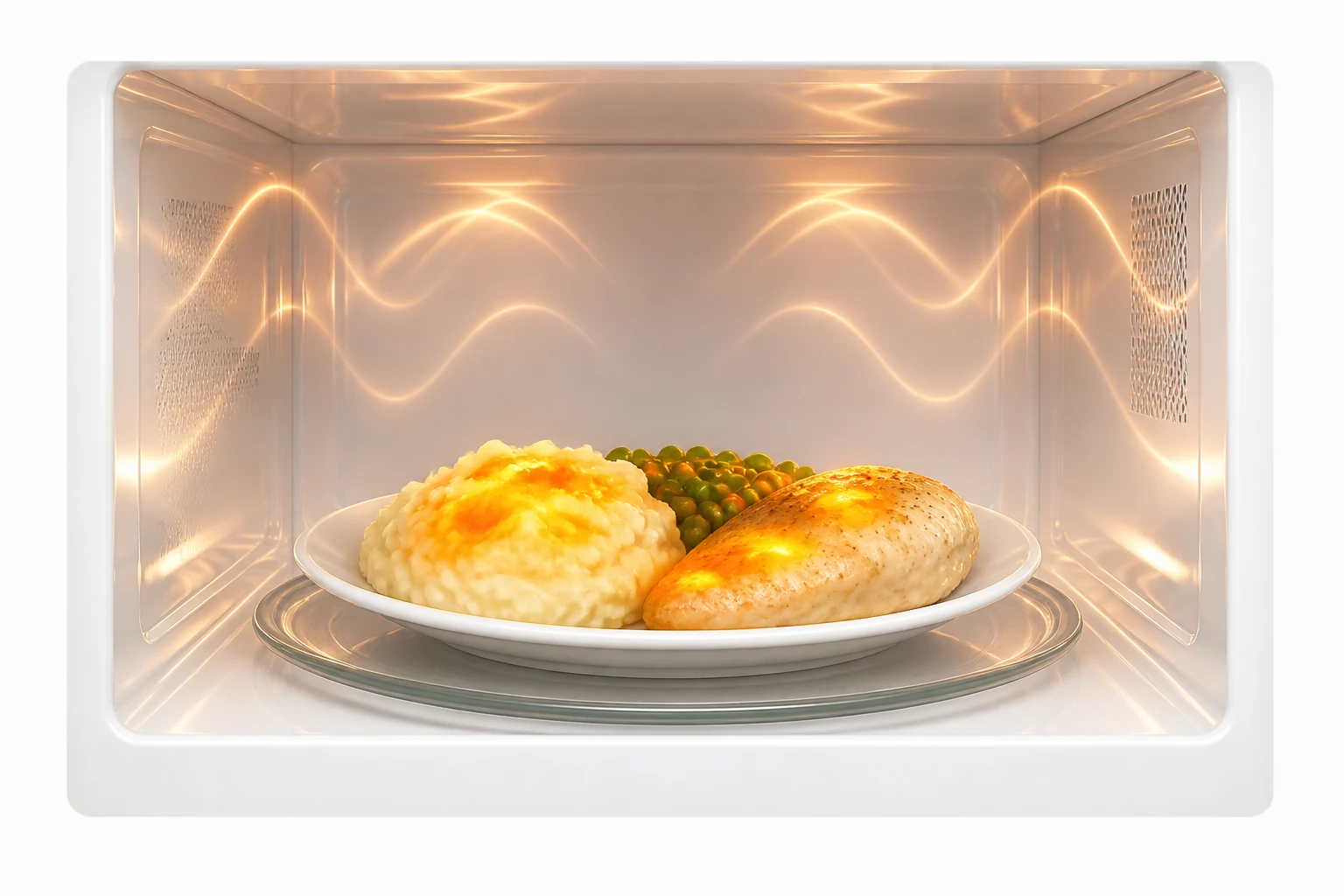
01. Microwaves enter the oven cavity
Waves are emitted from the magnetron and fill the interior.
Everyday Science
The science behind the burning-hot edge and the frozen center that ruins everything. You heat a meal in the microwave, reach in, and discover that the outside is practically volcanic while the center is still cold. You put it back in. The center remains cold. The edges are now generating smoke. This is not a random failure. It is physics working exactly as it should, just not helpfully. The answer involves standing wave patterns, edge effects, and why rotating turntables exist despite not fully solving the problem.
Quick answer
Microwave food heats unevenly because microwaves form standing wave patterns inside the oven cavity, creating fixed hot and cold spots, while food edges and corners receive microwaves from multiple angles simultaneously and heat faster than central areas. The rotating turntable was specifically added to microwave ovens to address uneven heating, and it helps, but the fundamental standing wave problem means hot and cold spots can never be completely eliminated.
The mystery
The answer involves standing wave patterns, edge effects, and why rotating turntables exist despite not fully solving the problem.
The short answer
Microwave food heats unevenly because microwaves form standing wave patterns inside the oven cavity, creating fixed hot and cold spots, while food edges and corners receive microwaves from multiple angles simultaneously and heat faster than central areas.
The twist
The rotating turntable was specifically added to microwave ovens to address uneven heating, and it helps, but the fundamental standing wave problem means hot and cold spots can never be completely eliminated.
Common mistake
Many assume heating longer will eventually produce even temperature throughout.
Everyday Science
Moisture near cold spots can still evaporate from hot regions conducted along the food surface while the interior remains cool.
The accidental inventor of the microwave
The Raytheon engineer who discovered microwave cooking accidentally in 1945 and developed it into a commercial product.
Where standing wave patterns matter
Radio waves from a Wi-Fi router reflect off walls and create standing wave interference patterns that produce strong and weak signal spots in a room.
Does a longer microwave time guarantee even heating?
Longer heating intensifies hot spots before it equalizes cold ones - the standing wave pattern ensures this.
Continue learning
Everyday Science
Another familiar question explained by simple physics.
Everyday Science
Another familiar question explained by simple physics.

Everyday Science
Another familiar question explained by simple physics.