Everyday Science

Why Does a Hard-Boiled Egg Spin Faster Than a Raw One?

The world's least violent way to settle a breakfast argument. Somewhere in your kitchen there is a trick that lets you identify a boiled egg without cracking it open, and it works every single time, with the reliability of a law of physics - because it is one. Spin two identical-looking eggs side by side, and one will whirl along smoothly while the other wobbles, stumbles, and gives up early. The difference is entirely about what is sloshing around inside. The answer involves liquid physics, a property called angular momentum, and a clever trick chefs have used for generations.

Quick answer

A hard-boiled egg spins faster and more steadily because its insides are solid and rotate as one unit, while a raw egg's liquid interior lags behind, dragging on the shell and slowing the spin. If you stop a spinning raw egg with your finger and let go quickly, it will start spinning again on its own, because the liquid inside is still moving.
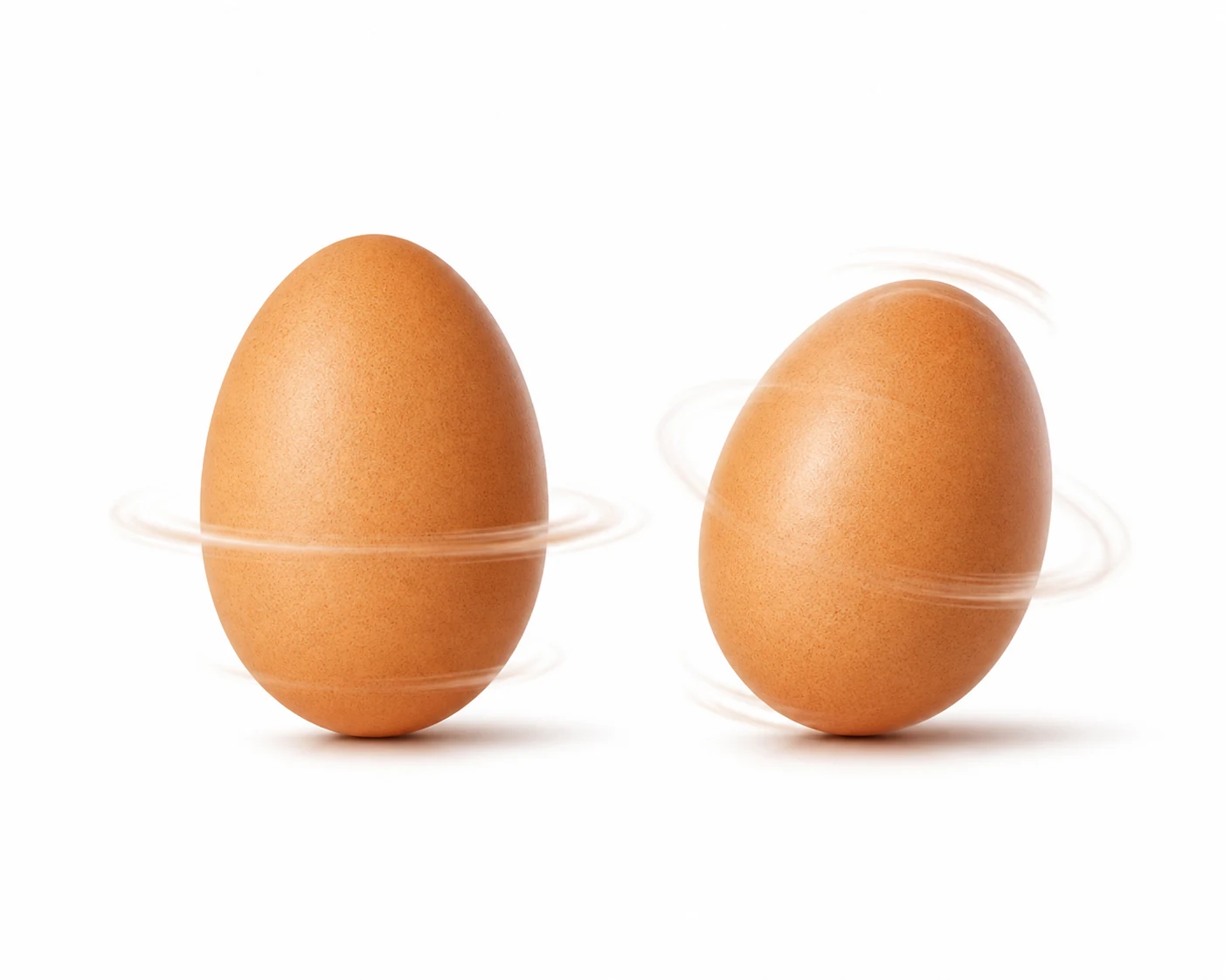
Why Does a Hard-Boiled Egg Spin Faster Than a Raw One? hero image

The mystery

The answer involves liquid physics, a property called angular momentum, and a clever trick chefs have used for generations.

The short answer

A hard-boiled egg spins faster and more steadily because its insides are solid and rotate as one unit, while a raw egg's liquid interior lags behind, dragging on the shell and slowing the spin.

The twist

If you stop a spinning raw egg with your finger and let go quickly, it will start spinning again on its own, because the liquid inside is still moving.

Common mistake

Many people assume boiled eggs spin faster simply because cooking changes the egg's weight.

What is actually happening inside the shell

An egg is a small sealed container, and what is inside that container decides how it behaves once it starts to turn.

Solid versus liquid rotation

In a hard-boiled egg, the white and yolk have set into a single solid mass that moves exactly in sync with the shell.

In a raw egg, the liquid interior is only loosely connected to the shell by friction, so it takes time to catch up to the shell's spin.

A boiled egg spins like a single object. A raw egg spins like a shell arguing with its own contents.

Internal friction acts as a brake

As the raw egg's shell spins, it drags the inner liquid along slowly, and that liquid resists the shell's motion in return, sapping energy from the spin.

This constant internal drag is why raw eggs wobble, slow down quickly, and never spin as gracefully as their boiled counterparts.

A raw egg is, mechanically speaking, fighting itself the entire time it spins.

The famous stop-and-release trick

If you briefly stop a raw egg and release it, it noticeably resumes spinning, because the still-moving liquid inside nudges the shell back into motion.

A boiled egg, by contrast, stops dead and stays that way, since there is no separate moving mass left to keep it going.

Stop a raw egg and it gets back up. Stop a boiled egg and it stays down, like it has nothing left to prove.

The physics in four steps

What separates a clean spin from a wobbly one comes down to a short chain of cause and effect.

1

01. You apply a spin to the shell

Your fingers transfer rotational energy directly to the eggshell.

2

02. Solid contents move together

In a boiled egg, the set interior instantly shares the shell's motion.

3

03. Liquid contents resist

In a raw egg, the fluid interior lags, creating drag against the rotating shell.

4

04. Energy is lost differently

The raw egg loses spin energy to internal sloshing, while the boiled egg loses it only to outside friction.

What this reveals about angular momentum

The egg trick is a tidy demonstration of how mass distribution and internal coupling affect rotation, a principle that governs everything from figure skaters pulling in their arms to the wobble of planets.

A raw egg is, in miniature, a system fighting against its own moving parts - which is a surprisingly elegant thing to find in a breakfast item.

More spinning surprises

The same trick works on coconuts
Liquid-filled coconuts wobble in flight the same way raw eggs wobble on a table.
Astronauts have studied egg-like rotation
Spacecraft engineers study fluid-filled rotating bodies for similar reasons, since sloshing fuel can destabilize a spinning satellite.
Earth has a tiny version of this problem
The planet's molten core behaves somewhat like the liquid inside a raw egg, subtly affecting Earth's rotation.

Isn't it just about the egg's weight?

Myth

Many people assume boiled eggs spin faster simply because cooking changes the egg's weight.

Weight feels like the obvious explanation for any difference in physical behavior, even when it is not the actual cause.

Reality

Boiled and raw eggs weigh almost exactly the same; the difference is entirely about how the mass inside moves.

Boiled and raw eggs weigh almost exactly the same; the difference is entirely about how the mass inside moves.

Where this principle shows up elsewhere

Washing machines
Unevenly distributed wet laundry causes the same kind of wobble during a spin cycle.
Car tires
Unbalanced tires wobble at speed for related reasons involving uneven mass distribution.

Why a kitchen trick is worth taking seriously

The egg spin test is one of the few pieces of folk physics that is both completely true and genuinely useful.

It demonstrates, without any equipment, how internal mass distribution governs rotational behavior in everyday objects.

Worth noting

A tiny lesson in rotation

An egg on a kitchen counter is, briefly, a working model of how mass and motion interact - which is more than most breakfasts can claim. Few foods double as physics demonstrations, but an egg has been moonlighting as one for as long as people have been spinning them.

Quick answers

Common questions

Is this test accurate every time?

Yes, the spin test reliably distinguishes raw from boiled eggs as long as both are spun on a flat, hard surface.

Does egg size affect the result?

No, the underlying physics works the same regardless of egg size, since it depends on internal state rather than scale.

Everyday Science

Related questions

Yes - a partially set interior produces a spin somewhere between raw and fully hard-boiled.

The everyday physicist's favorite trick

The Spinning Egg Test

A kitchen demonstration passed down for generations, used long before anyone explained the physics behind it.

Related questions

Why do gyroscopes resist tipping over?

Solid, evenly distributed spinning mass creates stable angular momentum, much like a boiled egg.

Where this principle shows up elsewhere

Washing machines

Unevenly distributed wet laundry causes the same kind of wobble during a spin cycle.

Where this principle shows up elsewhere

Car tires

Unbalanced tires wobble at speed for related reasons involving uneven mass distribution.

Isn't it just about the egg's weight?

Boiled and raw eggs weigh almost exactly the same; the difference is entirely about how the mass inside moves.

Boiled and raw eggs weigh almost exactly the same; the difference is entirely about how the mass inside moves.