Everyday Science

Why Do Bubbles Pop?

A perfect, fragile sphere that was always living on borrowed time. A soap bubble drifts through the air, shimmering with color, holding an almost impossibly thin film of liquid into a perfect sphere - and then, with no warning at all, it simply vanishes. It was never going to last. A bubble's entire existence is a brief, losing struggle against forces working to destroy it from the very first moment it forms. The answer involves evaporation, gravity's slow pull, and a delicate balancing act between three layers of liquid working together to hold the whole thing up.

Quick answer

A bubble pops when its thin soap film becomes weak enough to break, most commonly because water evaporates from the film, gravity drains liquid downward making the top thinner, or outside contact disrupts the delicate molecular structure holding the film together. Soap bubbles only exist at all because soap molecules reduce water's surface tension just enough to let a thin film stretch into a sphere without immediately collapsing - plain water alone cannot form a stable bubble.
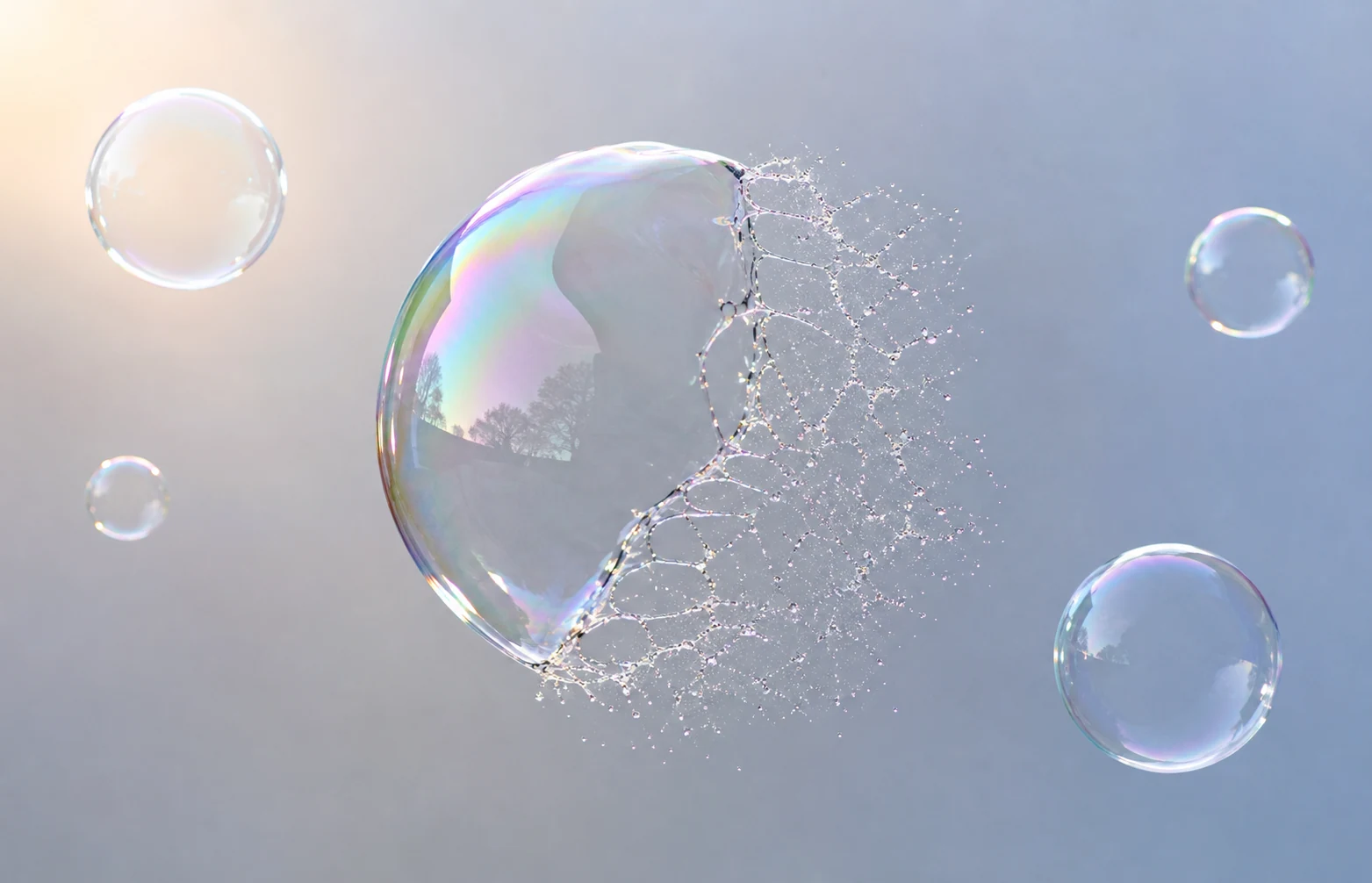
Why Do Bubbles Pop? hero image

The mystery

The answer involves evaporation, gravity's slow pull, and a delicate balancing act between three layers of liquid working together to hold the whole thing up.

The short answer

A bubble pops when its thin soap film becomes weak enough to break, most commonly because water evaporates from the film, gravity drains liquid downward making the top thinner, or outside contact disrupts the delicate molecular structure holding the film together.

The twist

Soap bubbles only exist at all because soap molecules reduce water's surface tension just enough to let a thin film stretch into a sphere without immediately collapsing - plain water alone cannot form a stable bubble.

Common mistake

A common assumption is that bubble size alone determines when and why a bubble pops.

A bubble is a tiny, temporary balancing act

A bubble's fragile structure depends on multiple competing forces holding steady at once, and it only takes one of them failing to end the whole thing.

Soap molecules are what make a bubble possible at all

Soap molecules have a water-attracting end and a water-repelling end, allowing them to arrange themselves in two thin layers sandwiching a layer of water in between.

This three-layer structure significantly reduces surface tension compared to plain water, allowing the thin film to stretch into a stable, sphere-shaped bubble.

A bubble is not simply water stretched thin; it is water held together by a small army of soap molecules doing very particular, very temporary work.

Evaporation slowly thins the film

Over time, water within the bubble's thin film gradually evaporates into the surrounding air, making the film progressively thinner and weaker.

Once the film becomes thin enough, it can no longer maintain structural integrity and ruptures, often within seconds to a few minutes depending on humidity.

A bubble is quietly losing a slow race against evaporation from the very instant it forms.

Gravity and outside contact accelerate the end

Gravity continuously pulls liquid downward within the bubble's film, making the upper portion thinner and more fragile over time, while any contact with dust, dry surfaces, or sharp objects can instantly disrupt the delicate molecular structure.

This combination of slow internal weakening and sudden external disruption explains why bubbles can pop either gradually or instantaneously.

Gravity is patiently working to thin a bubble from above, while almost anything it touches can finish the job in an instant.

The life cycle of a soap bubble

A short sequence explains the journey from formation to inevitable collapse.

1

01. Soap molecules form a stabilizing three-layer film

This structure allows a thin water film to stretch into a stable spherical shape.

2

02. Gravity pulls liquid downward within the film

This gradually thins the upper portion of the bubble over time.

3

03. Evaporation continues thinning the film further

Water loss into the surrounding air weakens the bubble's structural integrity.

4

04. The weakened film eventually ruptures

Either gradual thinning or sudden outside contact causes the bubble to collapse and pop.

What soap bubbles reveal about surface tension

Soap bubbles are one of the clearest, most visually striking everyday demonstrations of surface tension and molecular self-assembly, principles that also underpin biological cell membranes and various industrial foam technologies.

Scientists studying bubble physics have even used soap film behavior to help model and understand certain minimal-surface mathematical problems, connecting a simple childhood toy to genuinely advanced areas of physics and mathematics.

Surprising bubble facts

Humidity significantly affects bubble lifespan
Bubbles last considerably longer in humid air, since slower evaporation helps preserve the thin film's structure.
Some bubbles can be made remarkably long-lasting
Special bubble solutions with added glycerin or polymers can produce bubbles that last for many minutes or even hours.
Bubble shape is mathematically optimal
A sphere is the shape that encloses the maximum volume with the minimum possible surface area, which is why bubbles naturally form spheres.

Don't bubbles just pop because they're too big?

Myth

A common assumption is that bubble size alone determines when and why a bubble pops.

Large bubbles do appear to pop more readily, making size feel like the obvious explanation even though it is only one contributing factor.

Reality

While larger bubbles are generally more fragile, the real cause of popping is film thinning through evaporation, gravity, or external disruption, not size by itself.

While larger bubbles are generally more fragile, the real cause of popping is film thinning through evaporation, gravity, or external disruption, not size by itself.

Where similar thin-film physics applies

Cell membranes
Biological cell membranes rely on a related layered molecular structure to maintain stability, similar in principle to a soap film.
Industrial foams
Manufacturing and food industries rely on careful control of thin-film stability to create stable foams in products ranging from insulation to whipped desserts.

Why bubble physics is more significant than it looks

The principles behind bubble formation and collapse extend well beyond children's toys, informing fields from materials science to biology.

Research into thin-film stability has practical applications ranging from industrial foam engineering to a deeper understanding of biological membrane behavior.

Worth noting

A small, beautiful structure built to fail

Every soap bubble is, from the very moment it forms, in a quiet and ultimately unwinnable struggle against evaporation, gravity, and the world around it - which may be part of why people find them so charming to watch. Few things in nature are this beautiful while being quite this doomed from the start.

Quick answers

Common questions

Why do bubbles last longer on humid days?

Higher humidity slows evaporation from the bubble's film, helping preserve its structure for longer.

Can you touch a bubble without popping it?

Yes, with wet hands or a wet surface, since dryness is often what disrupts the delicate soap film on contact.

Everyday Science

Related questions

A sphere minimizes surface area for a given volume, making it the most stable, energy-efficient shape for a bubble.

The physicist who modeled minimal surfaces

Joseph Plateau

A 19th-century Belgian physicist whose extensive experiments with soap films helped establish the mathematical principles governing minimal surface area shapes.

Related questions

Why do bubbles show rainbow colors?

Light reflecting off the thin film's two surfaces interferes with itself, separating colors based on the film's changing thickness.

Where similar thin-film physics applies

Cell membranes

Biological cell membranes rely on a related layered molecular structure to maintain stability, similar in principle to a soap film.

Where similar thin-film physics applies

Industrial foams

Manufacturing and food industries rely on careful control of thin-film stability to create stable foams in products ranging from insulation to whipped desserts.

Don't bubbles just pop because they're too big?

While larger bubbles are generally more fragile, the real cause of popping is film thinning through evaporation, gravity, or external disruption, not size by itself.

While larger bubbles are generally more fragile, the real cause of popping is film thinning through evaporation, gravity, or external disruption, not size by itself.