1
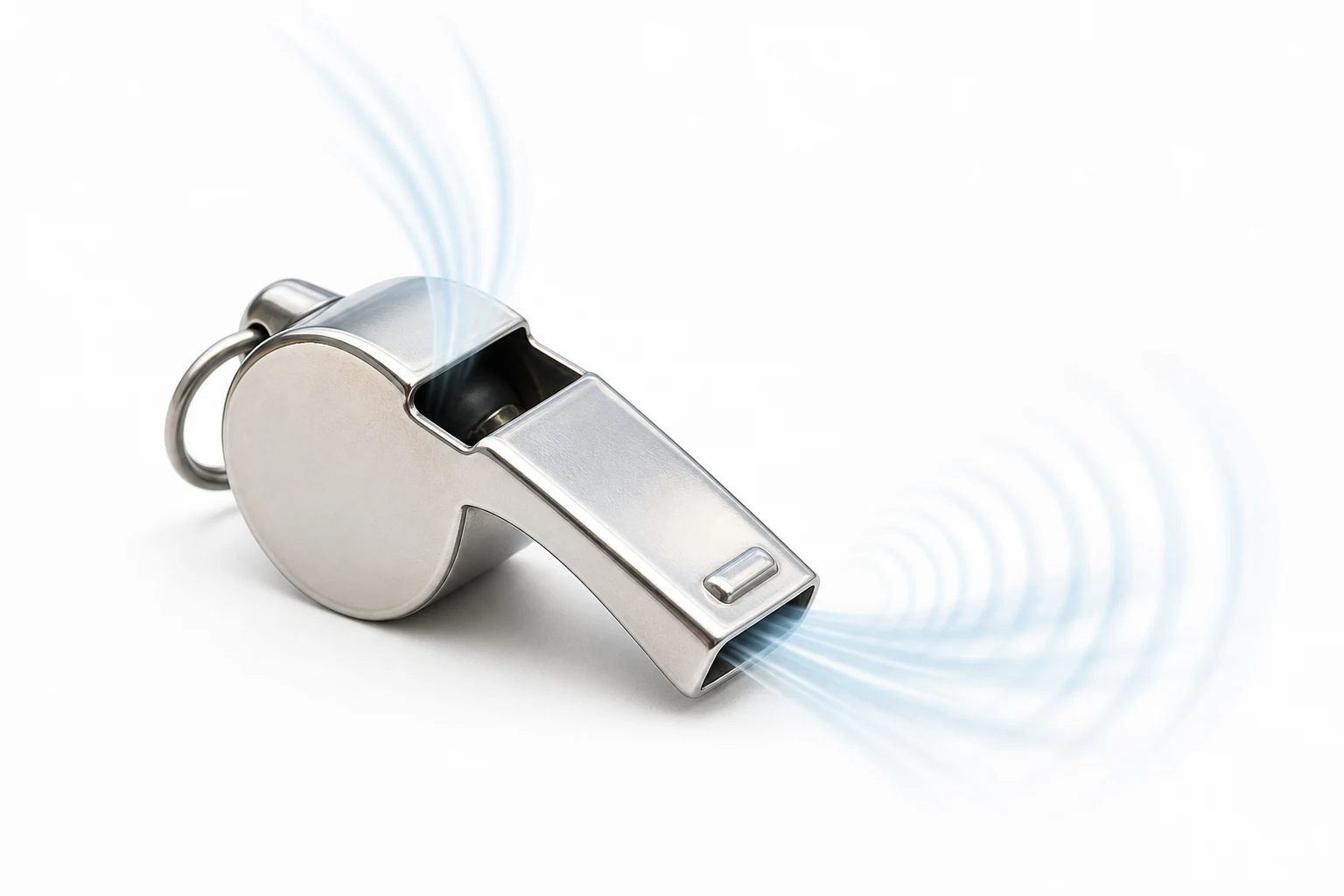
01. Air is forced through a narrow opening
Breath enters the whistle under pressure through a tight slot.
Everyday Science
A tiny chamber of air, engineered to scream on command. Blow into a plain metal tube and you get nothing but the sound of breath. Blow into a whistle, shaped almost identically, and you get a piercing shriek loud enough to stop traffic. The difference between silence and that shriek comes down to a small internal trick most people have never actually looked closely at. The answer involves turbulent air, a vibrating chamber, and the same basic physics that makes flutes and bottles hum when you blow across them.
Quick answer
A whistle works by forcing air through a narrow opening against a sharp edge, which creates turbulence that causes air inside an internal chamber to vibrate rapidly at a specific frequency, producing a clear, sustained tone. Many whistles contain a small ball, called a pea, whose chaotic bouncing motion modulates the airflow to create the distinctive warbling trill of a traditional referee's whistle.
The mystery
The answer involves turbulent air, a vibrating chamber, and the same basic physics that makes flutes and bottles hum when you blow across them.
The short answer
A whistle works by forcing air through a narrow opening against a sharp edge, which creates turbulence that causes air inside an internal chamber to vibrate rapidly at a specific frequency, producing a clear, sustained tone.
The twist
Many whistles contain a small ball, called a pea, whose chaotic bouncing motion modulates the airflow to create the distinctive warbling trill of a traditional referee's whistle.
Common mistake
Some assume a whistle simply makes the natural sound of blowing air louder.
Everyday Science
They are tuned to ultrasonic frequencies above the upper limit of human hearing, but audible to dogs.
The man behind the modern referee's whistle
A 19th-century English toolmaker who invented the pea whistle, widely adopted by police and sports officials for its piercing, attention-grabbing trill.
Related questions
It triggers the same edge-tone and resonance effect found inside a whistle's internal chamber.
Where this principle appears in instruments
These instruments use a nearly identical edge-tone mechanism, with pitch controlled by finger holes changing the resonant air column.
Where this principle appears in instruments
Blowing across a bottle's opening creates the same turbulence-and-resonance effect, with pitch determined by the bottle's air volume.
Isn't a whistle just amplifying the sound of your breath?
A whistle does not amplify breath sounds at all; it generates an entirely new tone through turbulence and resonance, unrelated to the sound of breathing itself.
Continue learning
Everyday Science
Another familiar question explained by simple physics.

Everyday Science
Another familiar question explained by simple physics.
Everyday Science
Another familiar question explained by simple physics.