1
01. Light enters at an angle
The steeper the angle between the straw and the water's surface, the more noticeable the bending appears.
Everyday Science
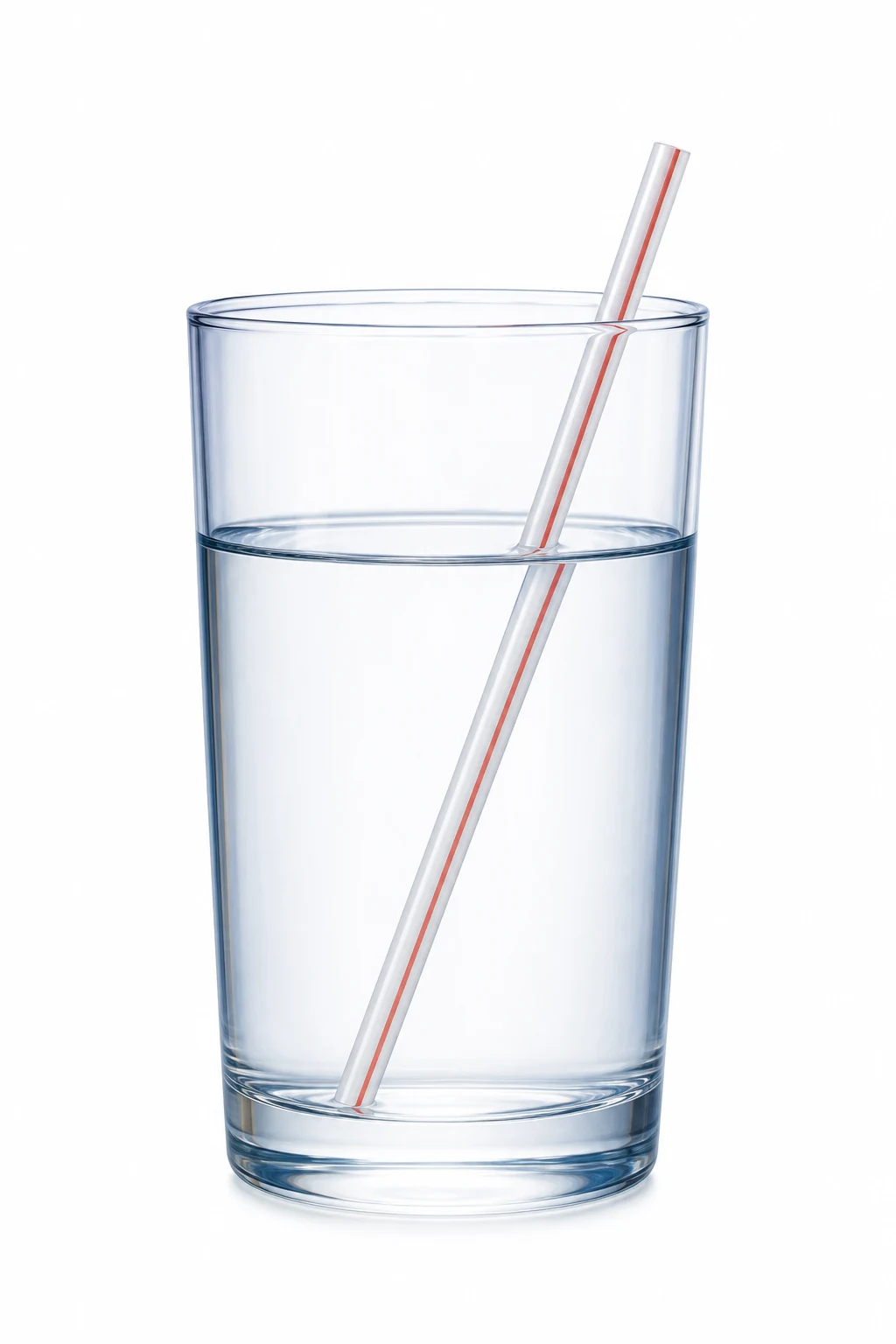
A glass of lemonade performs a magic trick every single time, and almost nobody applauds. Drop a straw into a glass of water and something quietly absurd happens: the straw appears to snap in half at the surface, as if the laws of physics had briefly lost interest in their job. The straw, of course, is fine. It is your eyes that have been fooled, by a trick so old that light has been playing it since long before there were eyes around to be fooled by it. The answer involves the speed of light changing lanes, a 17th-century Dutchman, and the reason your eyes are surprisingly easy to lie to.
Quick answer
Light travels slower in water than in air, and bends as it crosses the boundary between the two - a phenomenon called refraction - which shifts the apparent position of everything below the waterline. The straw is not bending even slightly. Your brain is simply assuming light has traveled in a straight line, when in fact it took a small detour.
The mystery
The answer involves the speed of light changing lanes, a 17th-century Dutchman, and the reason your eyes are surprisingly easy to lie to.
The short answer
Light travels slower in water than in air, and bends as it crosses the boundary between the two - a phenomenon called refraction - which shifts the apparent position of everything below the waterline.
The twist
The straw is not bending even slightly. Your brain is simply assuming light has traveled in a straight line, when in fact it took a small detour.
Common mistake
Some people assume the straw is genuinely flexing under the water's surface tension.
Everyday Science
The same refraction that bends a straw also raises the apparent floor of a pool.
The man who measured the bend
A Dutch mathematician who formalized the relationship between angles of incidence and refraction.
Related questions
Turbulent air refracts starlight unpredictably as it passes through the atmosphere.
Refraction in daily life
Pools always look shallower than they are, a fact responsible for a great many stubbed toes.
Refraction in daily life
Corrective lenses deliberately bend light to compensate for irregularities in the eye.
Surely the straw is actually warping slightly?
The straw remains perfectly rigid and straight; only the light reaching your eyes has changed direction.
Continue learning

Everyday Science
Another familiar question explained by simple physics.
Everyday Science
Another familiar question explained by simple physics.
Everyday Science
Another familiar question explained by simple physics.