Everyday Science

Why Does a Prism Split Light?

The simple glass shape that revealed white light was never actually white at all. Pass a beam of ordinary white sunlight through a triangular piece of glass and something startling happens on the other side: a full rainbow spills out, neatly ordered from red to violet, as if the glass had been hiding it the whole time. In a sense, it had - or rather, the light had been hiding it all along, and the glass simply revealed the secret. The answer involves wavelengths bending by different amounts, a young Isaac Newton's quiet act of scientific rebellion, and the surprising fact that white light is not one color at all.

Quick answer

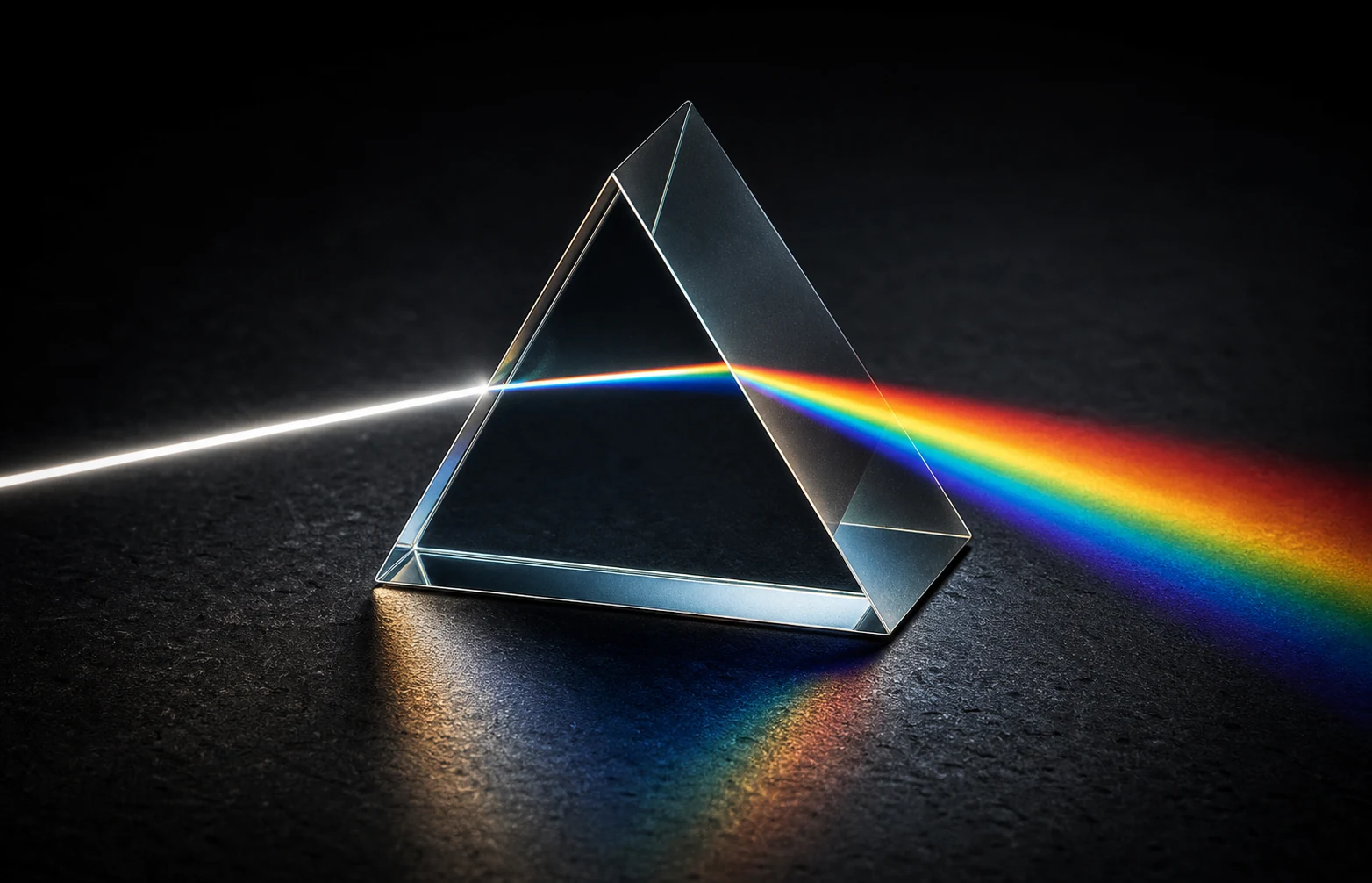
A prism splits light because different wavelengths of light, which we perceive as different colors, bend by slightly different amounts as they pass through glass, separating white light into its full spectrum of component colors through a process called dispersion. Before Isaac Newton's experiments in the 1660s, many scientists believed prisms somehow added color to light, rather than simply revealing colors that were already present within it.
Why Does a Prism Split Light? hero image

The mystery

The answer involves wavelengths bending by different amounts, a young Isaac Newton's quiet act of scientific rebellion, and the surprising fact that white light is not one color at all.

The short answer

A prism splits light because different wavelengths of light, which we perceive as different colors, bend by slightly different amounts as they pass through glass, separating white light into its full spectrum of component colors through a process called dispersion.

The twist

Before Isaac Newton's experiments in the 1660s, many scientists believed prisms somehow added color to light, rather than simply revealing colors that were already present within it.

Common mistake

A common historical and modern misconception is that the prism adds color to otherwise colorless white light.

White light was never just one color

A prism's rainbow reveals a truth about light that is invisible under ordinary conditions: white light is a mixture of every visible color combined.

Refraction bends every wavelength slightly differently

As light enters glass, it slows down and bends, a process called refraction - but the amount of bending depends slightly on wavelength, with shorter wavelengths like violet bending more than longer wavelengths like red.

This wavelength-dependent bending is called dispersion, and it is the entire mechanism behind a prism's rainbow.

Glass does not treat every color of light equally; violet light gets bent harder than red light, every single time.

The two refractions compound the separation

Light bends once entering the prism and again exiting it, with each surface adding a bit more separation between the different wavelengths.

By the time light exits the far side, the colors have spread apart enough to become individually visible as a spectrum.

A prism gives light two separate chances to argue about which way to bend, and the disagreement is what makes the rainbow.

Newton proved the colors were already there

Isaac Newton demonstrated that passing the resulting spectrum through a second prism recombined the colors back into white light, proving the rainbow was not created by the glass but merely separated by it.

This was a significant departure from the prevailing theories of his time, which assumed prisms somehow colored the light themselves.

Newton's real discovery was not the rainbow itself, but the proof that it had been hiding inside ordinary daylight the entire time.

How a prism separates white light

A short sequence explains the journey from plain sunlight to a visible spectrum.

1

01. White light enters the prism

Sunlight, containing a mixture of all visible wavelengths, strikes the angled glass surface.

2

02. Each wavelength refracts by a different amount

Shorter wavelengths bend more sharply than longer wavelengths as they slow down inside the glass.

3

03. The light exits and bends again

A second refraction at the exit surface further separates the wavelengths.

4

04. The colors spread into a visible spectrum

By the time the light reaches a surface or screen, each wavelength has spread into a distinct band of color.

What dispersion reveals about the nature of light

A prism's rainbow demonstrates that color is fundamentally tied to wavelength, a principle that underlies the entire modern understanding of light and the electromagnetic spectrum.

This same dispersion effect, in a different form, is responsible for natural rainbows, where raindrops act as countless tiny prisms scattered across the sky.

Surprising facts about prisms and light

Rainbows are giant natural prisms
Raindrops refract and disperse sunlight the same way a glass prism does, producing the rainbows seen after storms.
Different materials disperse light differently
Diamonds disperse light far more strongly than ordinary glass, which is part of why they sparkle with such intense color.
Newton named seven colors deliberately
Newton divided the spectrum into seven colors partly to align with the seven notes of a musical scale, a choice still reflected in the modern "ROYGBIV" mnemonic.

Doesn't the prism actually create the colors itself?

Myth

A common historical and modern misconception is that the prism adds color to otherwise colorless white light.

Since the colors only appear after passing through the glass, it is intuitive, though incorrect, to assume the prism itself is generating them.

Reality

The prism does not create any color; it merely separates colors that were already combined within white light, as Newton definitively demonstrated.

The prism does not create any color; it merely separates colors that were already combined within white light, as Newton definitively demonstrated.

Where dispersion shows up beyond prisms

Rainbows after rainfall
Sunlight refracting and dispersing through raindrops creates the same separation of colors seen in a glass prism.
Chromatic aberration in lenses
Camera and telescope lenses must be carefully designed to minimize unwanted color fringing caused by this same dispersion effect.

Why this 17th-century experiment still matters

Newton's prism experiments fundamentally reshaped the scientific understanding of light and laid groundwork for the later discovery of the full electromagnetic spectrum.

His work directly enabled the later invention of spectroscopy, a technique still used to analyze the chemical composition of distant stars.

Worth noting

A rainbow that was hiding in plain sight

A prism does not manufacture color; it simply unzips ordinary daylight into the rainbow that had been quietly traveling inside it the whole time. White light has been keeping a colorful secret since long before anyone thought to hold a piece of glass up to it.

Quick answers

Common questions

Can a prism work with artificial light, not just sunlight?

Yes, any light source containing a mix of wavelengths, including most household bulbs, can be dispersed by a prism.

Why does a prism need to be triangular?

The angled surfaces of a triangular prism maximize the separation of wavelengths through two successive refractions.

Everyday Science

Related questions

Each wavelength of light bends by a consistent, predictable amount, producing the same color sequence every time.

The scientist who proved white light's secret

Isaac Newton

In the 1660s, Newton used prisms to demonstrate that white light is composed of a mixture of all visible colors.

Related questions

Why do diamonds sparkle more than glass?

Diamonds have a much higher dispersion rate, separating light into more vivid, intense colors.

Where dispersion shows up beyond prisms

Rainbows after rainfall

Sunlight refracting and dispersing through raindrops creates the same separation of colors seen in a glass prism.

Where dispersion shows up beyond prisms

Chromatic aberration in lenses

Camera and telescope lenses must be carefully designed to minimize unwanted color fringing caused by this same dispersion effect.

Doesn't the prism actually create the colors itself?

The prism does not create any color; it merely separates colors that were already combined within white light, as Newton definitively demonstrated.

The prism does not create any color; it merely separates colors that were already combined within white light, as Newton definitively demonstrated.