Everyday Science

Why Does a CD Make a Rainbow?

A piece of plastic engineered to store music quietly moonlights as a prism. Tilt an old CD under a light and something unexpected happens: the dull silver surface erupts into shifting bands of color, as if a tiny rainbow had taken up residence on a disc meant only for storing songs. The CD was never designed to do this. It is simply too small, too precise, and too covered in tiny grooves to avoid it. The answer involves microscopic grooves, the separation of white light into colors, and a phenomenon that also explains butterfly wings and oil slicks.

Quick answer

A CD's surface is covered in thousands of microscopic, evenly spaced grooves that diffract white light, splitting it into its component colors the way a prism does, but through interference rather than refraction. The colors are not actually "on" the CD at all - they appear only because of how light waves interact with the disc's structure, and they change completely depending on the viewing angle.

Why Does a CD Make a Rainbow? hero image

The mystery

The answer involves microscopic grooves, the separation of white light into colors, and a phenomenon that also explains butterfly wings and oil slicks.

The short answer

A CD's surface is covered in thousands of microscopic, evenly spaced grooves that diffract white light, splitting it into its component colors the way a prism does, but through interference rather than refraction.

The twist

The colors are not actually "on" the CD at all - they appear only because of how light waves interact with the disc's structure, and they change completely depending on the viewing angle.

Common mistake

Some assume the rainbow is simply ordinary reflected light, similar to a mirror catching sunlight.

How a data storage disc becomes a rainbow machine

The same microscopic structure that lets a CD player read music is exactly what creates the rainbow effect.

The grooves are smaller than light itself, almost

A CD's surface contains a spiral track made of microscopic pits and lands, spaced only about 1.6 micrometers apart - close to the wavelength of visible light.

When spacing gets that fine, light does not just bounce off; it interferes with itself in complex ways.

A CD's grooves are so fine that light itself starts behaving strangely near them.

Diffraction, not simple reflection

When white light strikes these tightly spaced grooves, different wavelengths - different colors - bend at slightly different angles, a process called diffraction.

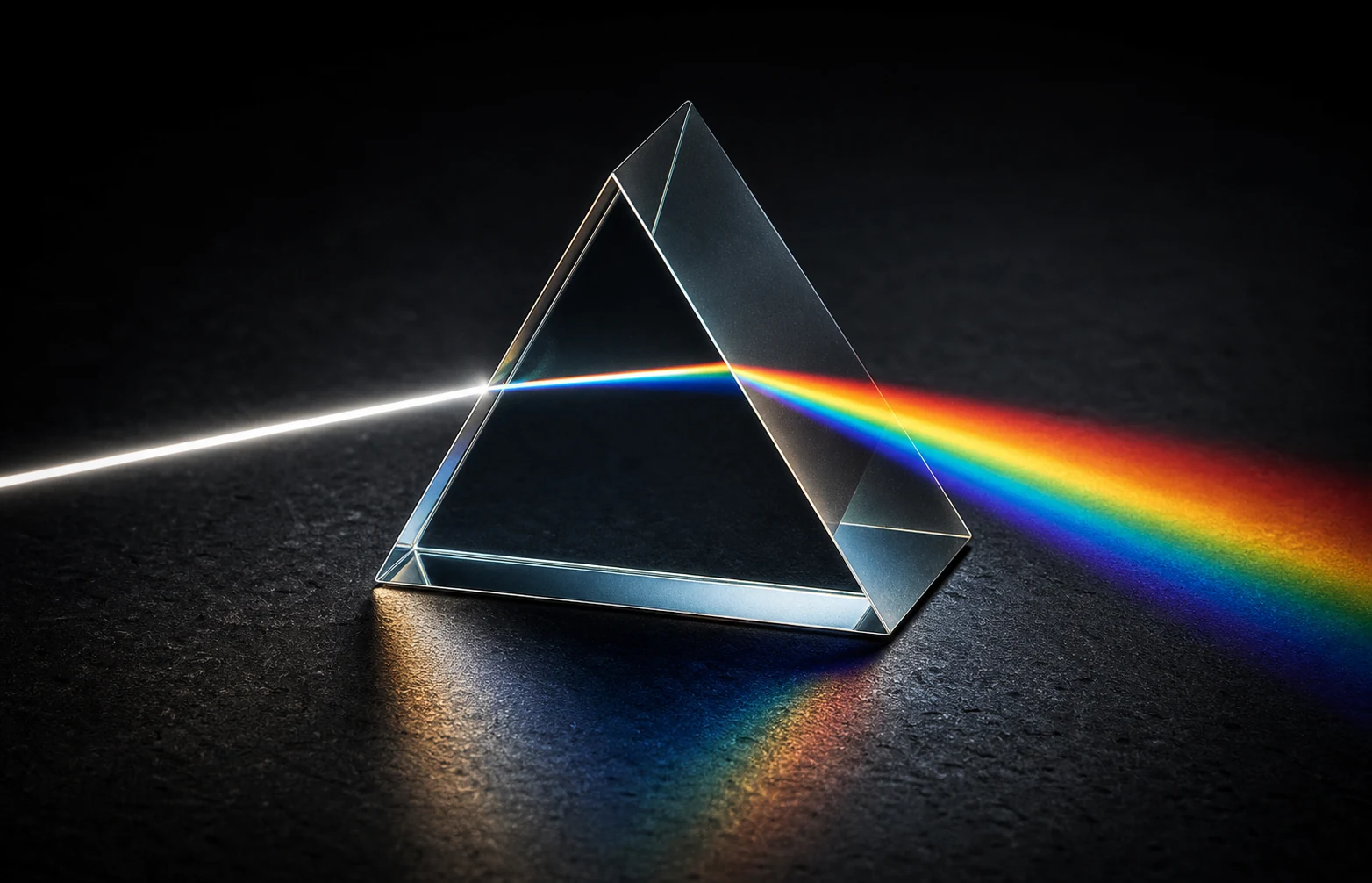
This spreads the white light into its full spectrum, the same separation a prism achieves through a completely different method.

A CD does the same trick as a prism, by an entirely different sleight of hand.

Why the colors shift as you tilt it

Because diffraction depends heavily on the angle between the light, the grooves, and your eye, tilting the disc continuously changes which wavelengths reach you.

This is why the rainbow seems to swim and shift rather than stay fixed in place.

The CD's rainbow is not painted on; it is recalculated, instant by instant, every time you move your wrist.

The science in four steps

Several precise conditions combine to produce the visible rainbow.

1

01. White light hits the disc

Ordinary light, containing all visible wavelengths, strikes the CD's reflective surface.

2

02. Microscopic grooves diffract it

The evenly spaced spiral track splits the light by wavelength as it reflects.

3

03. Different colors bend at different angles

Each wavelength of light is redirected slightly differently, separating the spectrum.

4

04. Your eye catches a shifting slice

Depending on the viewing angle, only certain wavelengths reach your eye at once, creating the rainbow pattern.

What diffraction reveals about light

The CD rainbow is one of the clearest everyday demonstrations that light behaves like a wave, not just a simple ray.

This same wave behavior, interference and diffraction, underlies everything from the colors of soap bubbles to the design of diffraction gratings used in scientific instruments.

Where else diffraction colors appear

Butterfly wings
Many butterflies get their iridescent colors from microscopic structures, not pigment, exactly like a CD.
Opal gemstones
Opals diffract light through tiny internal silica spheres, producing their famous shifting colors.
Soap bubbles and oil slicks
These produce color through a related but distinct phenomenon called thin-film interference.

Isn't the CD just reflecting normal light colors?

Myth

Some assume the rainbow is simply ordinary reflected light, similar to a mirror catching sunlight.

Both a mirror and a CD are shiny and reflective, making the underlying difference in surface structure easy to overlook.

Reality

A mirror reflects all colors together as white light; a CD specifically separates them through diffraction, which a flat mirror cannot do.

A mirror reflects all colors together as white light; a CD specifically separates them through diffraction, which a flat mirror cannot do.

Diffraction gratings in technology

Spectrometers
Scientific instruments use precisely etched diffraction gratings, working on the same principle as a CD, to analyze light from stars and chemicals.
Holograms
Many holographic images rely on microscopic diffraction patterns similar to those on a CD's surface.

Why a scratched-up old disc still has something to teach

The CD rainbow shows that everyday manufactured objects can accidentally demonstrate deep physical principles, if you know to look closely.

It offers a simple, accessible way to observe wave interference without any specialized equipment.

Worth noting

A rainbow with a day job

A CD's rainbow is a reminder that the structure of ordinary objects, examined closely enough, often turns out to be quietly extraordinary. Few household objects do double duty as both a jukebox and a physics demonstration.

Quick answers

Common questions

Does a DVD make the same effect?

Yes, and often more intensely, since DVDs have even finer groove spacing than CDs.

Why doesn't a brand-new mirror do this?

A mirror's surface is smooth at a much larger scale and lacks the regular microscopic grooves needed to diffract light.

Everyday Science

Related questions

Light reflecting off the bubble's thin film interferes with itself, separating colors in a related but different way.

The physicist behind the wave theory of light

Thomas Young

An English scientist whose double-slit experiment in 1801 demonstrated that light behaves as a wave.

Related questions

Why does a prism split light into a rainbow?

A prism bends different wavelengths by different amounts through refraction, not diffraction.

Diffraction gratings in technology

Spectrometers

Scientific instruments use precisely etched diffraction gratings, working on the same principle as a CD, to analyze light from stars and chemicals.

Diffraction gratings in technology

Holograms

Many holographic images rely on microscopic diffraction patterns similar to those on a CD's surface.

Isn't the CD just reflecting normal light colors?

A mirror reflects all colors together as white light; a CD specifically separates them through diffraction, which a flat mirror cannot do.

A mirror reflects all colors together as white light; a CD specifically separates them through diffraction, which a flat mirror cannot do.