Everyday Science

Why Does a Fan Make You Feel Cooler?

A machine that does not actually cool the air, and never has. Stand in front of a fan on a hot day and relief arrives almost instantly - which is strange, because the fan is not cooling the room at all. If anything, the motor is adding a tiny bit of heat to it. The fan's real trick has nothing to do with temperature and everything to do with your own skin. The answer involves sweat, evaporation, and the surprisingly large amount of energy it takes to turn liquid into vapor.

Quick answer

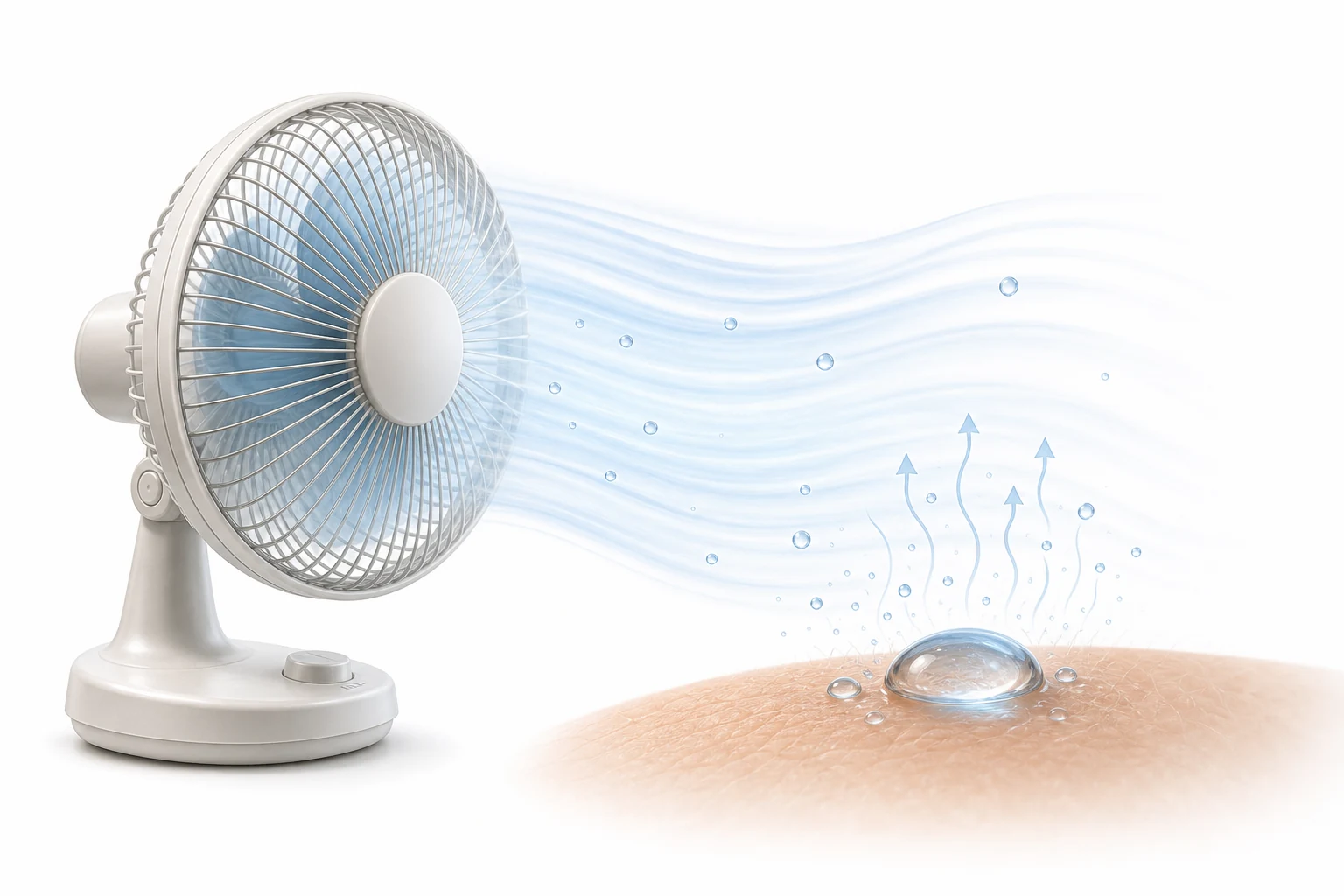
A fan makes you feel cooler by blowing away the thin layer of warm, humid air that builds up against your skin, speeding up the evaporation of sweat, which removes heat from your body far faster than still air would. A thermometer placed in front of a running fan shows no drop in air temperature at all - the cooling effect exists only for things, like skin, that can sweat or evaporate moisture.
Why Does a Fan Make You Feel Cooler? hero image

The mystery

The answer involves sweat, evaporation, and the surprisingly large amount of energy it takes to turn liquid into vapor.

The short answer

A fan makes you feel cooler by blowing away the thin layer of warm, humid air that builds up against your skin, speeding up the evaporation of sweat, which removes heat from your body far faster than still air would.

The twist

A thermometer placed in front of a running fan shows no drop in air temperature at all - the cooling effect exists only for things, like skin, that can sweat or evaporate moisture.

Common mistake

A common assumption is that a running fan measurably cools the air in a room.

The cooling trick is entirely about evaporation

A fan's apparent cooling power comes from accelerating a process your body is already doing on its own.

Sweat needs energy to evaporate

Turning liquid sweat into water vapor requires a substantial amount of energy, called latent heat of vaporization, and that energy is pulled directly from your skin.

The faster sweat evaporates, the faster heat is drawn away from your body.

Every drop of sweat that evaporates is quietly stealing a small amount of heat from you on its way out.

Still air slows evaporation down

Without airflow, the air immediately surrounding your skin becomes humid and saturated with moisture, slowing further evaporation almost to a stop.

This is why a hot, humid, windless day feels so unbearably sticky - your sweat has nowhere to go.

Still, humid air traps your sweat in a kind of polite standoff, evaporating just slowly enough to be useless.

Moving air clears the way

A fan continuously sweeps away that humid boundary layer, replacing it with drier air that can absorb more moisture, which speeds up evaporation and cooling.

This is purely a mechanical effect on your skin's microclimate - the room's actual air temperature never changes.

A fan does not cool the room; it simply refuses to let your sweat sit around being unproductive.

How a fan cools your skin

A short sequence explains exactly how moving air translates into a feeling of relief.

1

01. Your body produces sweat

Sweat glands release moisture onto the skin as part of your body's natural cooling response.

2

02. A humid layer forms around your skin

Without airflow, evaporated moisture accumulates close to your body, slowing further evaporation.

3

03. The fan disperses that layer

Moving air continuously replaces the humid boundary layer with drier air.

4

04. Evaporation speeds up and heat leaves your body

Faster evaporation pulls more thermal energy away from your skin, producing a cooling sensation.

Why this only works on living things

A fan's cooling effect depends entirely on the presence of moisture that can evaporate - which is why fans cool people effectively but do nothing meaningful to cool a dry object like a book or a wall.

This is also why fans become far less effective in extremely humid environments, where the surrounding air is already too saturated to absorb much more moisture.

Surprising facts about fans and cooling

Fans can be dangerous in extreme heat and humidity
In very high humidity and temperature, fans can blow hot air over the body without enough evaporation to compensate, increasing heat risk.
A fan technically adds a tiny bit of heat
The fan's motor generates a small amount of waste heat, very slightly warming the room overall.
Misting fans combine two cooling tricks at once
These add fine water droplets to the airflow, boosting evaporation well beyond what airflow alone provides.

Doesn't a fan actually lower the room's temperature?

Myth

A common assumption is that a running fan measurably cools the air in a room.

The strong, immediate feeling of relief makes it intuitive to assume the surrounding air itself has gotten cooler.

Reality

A thermometer in a fan's airflow shows essentially no temperature change; the cooling sensation exists only for skin and other moisture-releasing surfaces.

A thermometer in a fan's airflow shows essentially no temperature change; the cooling sensation exists only for skin and other moisture-releasing surfaces.

Where evaporative cooling shows up elsewhere

Wet clothing in the wind
A swimmer stepping out of water into a breeze feels a strong chill for exactly the same evaporative reason.
Evaporative "swamp" coolers
These appliances deliberately combine airflow and water evaporation to genuinely lower air temperature, unlike a standard fan.

Why this distinction actually matters

Understanding that fans cool people rather than rooms helps explain why fans become less effective, or even risky, in extremely hot and humid conditions.

This knowledge informs public health guidance during heat waves, where fans alone may not be sufficient protection against heat illness.

Worth noting

A cooling trick that lives entirely on your skin

A fan never touches the temperature of the room you're sitting in - it simply makes sure your own sweat finally gets to do its job. The fan gets all the credit, but the actual cooling was your sweat's idea all along.

Quick answers

Common questions

Do fans help if there's no sweat at all?

Minimally - some cooling still occurs from disrupting the warm air layer near skin, but the effect is much smaller without evaporation.

Is it true fans can be unsafe in extreme heat?

Yes, health agencies note that in very high heat and humidity, fans alone may not prevent heat-related illness.

Everyday Science

Related questions

Water evaporating rapidly off wet skin pulls heat away quickly, intensified by any breeze.

The physicist behind latent heat

Joseph Black

An 18th-century Scottish scientist who first identified and measured the concept of latent heat in changes of state.

Related questions

Why are fans less helpful in humid climates?

High humidity slows evaporation regardless of airflow, limiting a fan's cooling benefit.

Where evaporative cooling shows up elsewhere

Wet clothing in the wind

A swimmer stepping out of water into a breeze feels a strong chill for exactly the same evaporative reason.

Where evaporative cooling shows up elsewhere

Evaporative "swamp" coolers

These appliances deliberately combine airflow and water evaporation to genuinely lower air temperature, unlike a standard fan.

Doesn't a fan actually lower the room's temperature?

A thermometer in a fan's airflow shows essentially no temperature change; the cooling sensation exists only for skin and other moisture-releasing surfaces.

A thermometer in a fan's airflow shows essentially no temperature change; the cooling sensation exists only for skin and other moisture-releasing surfaces.