1
01. It is thrown nearly vertically
A near-upright throw keeps the curving flight path roughly level rather than diving into the ground.
Everyday Science
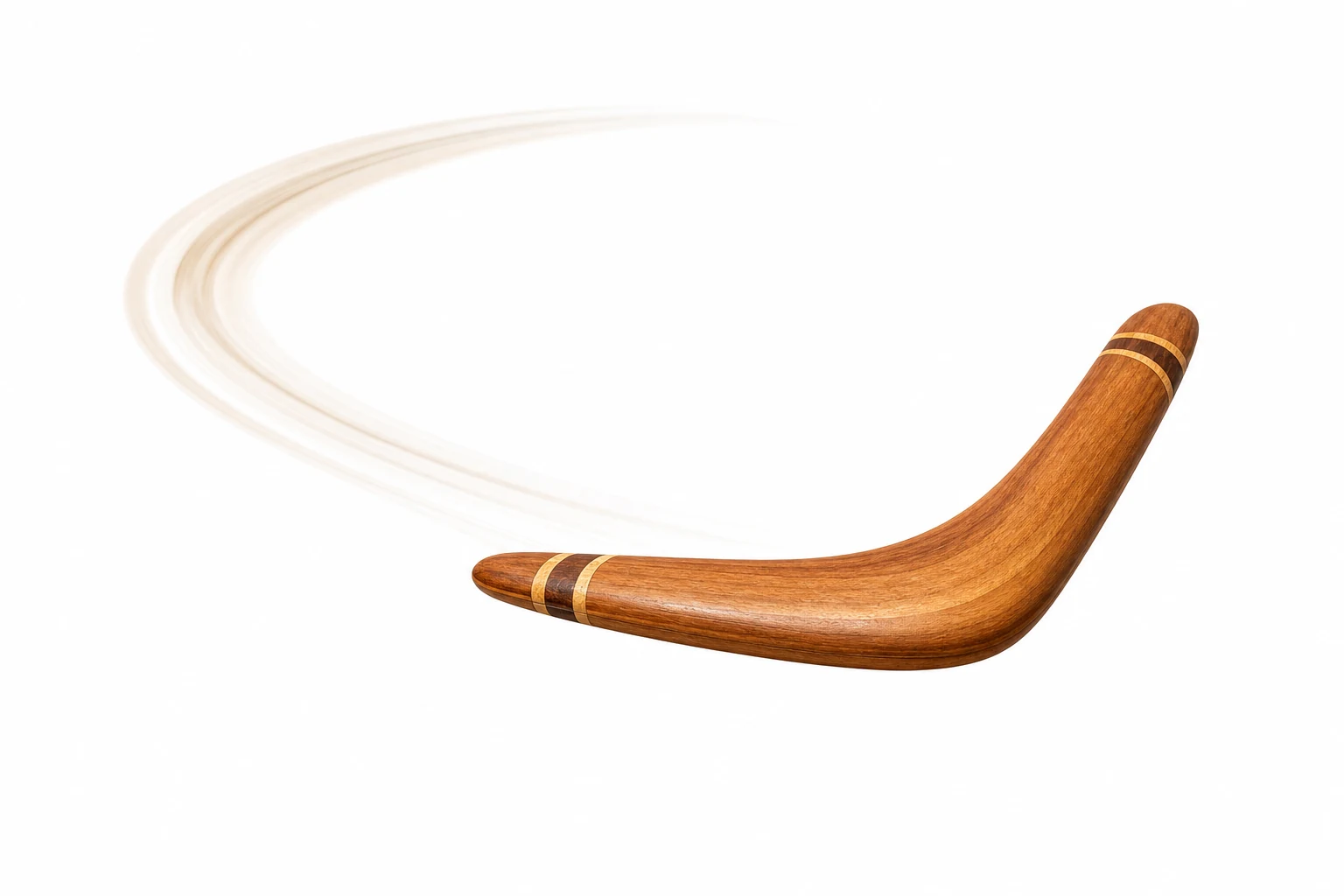
A piece of curved wood that quietly understood aerodynamics long before anyone wrote the equations. Throw most objects and they go where you threw them, then stop, embarrassed, somewhere in the grass. Throw a boomerang correctly and it sails away from you in a curve, loops gracefully through the air, and arrives back near your hand - as if it had simply gone out for a walk and remembered the way home. The answer involves the same principle that keeps airplanes in the sky, a spin that fights itself, and a wobble that is actually doing all the work.
Quick answer
A boomerang returns because its spinning, curved arms generate uneven lift on each side, causing the entire object to slowly curve through a circular flight path back toward the thrower. Most boomerangs used historically for hunting were not designed to return at all; the returning boomerang was likely a recreational refinement.
The mystery
The answer involves the same principle that keeps airplanes in the sky, a spin that fights itself, and a wobble that is actually doing all the work.
The short answer
A boomerang returns because its spinning, curved arms generate uneven lift on each side, causing the entire object to slowly curve through a circular flight path back toward the thrower.
The twist
Most boomerangs used historically for hunting were not designed to return at all; the returning boomerang was likely a recreational refinement.
Common mistake
Many people assume the return is purely about throwing technique, with no real role for the boomerang's shape.
Everyday Science
Frisbees are symmetrical and flat, producing balanced lift rather than the lopsided lift of a boomerang's arms.
An ancient aerodynamicist
Generations of careful design refined boomerangs for both hunting and, eventually, returning flight.
Related questions
Spinning objects resist changes to their orientation, a property called gyroscopic stability.
Where similar physics shows up
Frisbees use the same spin-generated lift, though without the extreme curve of a returning boomerang.
Where similar physics shows up
Rotor blades rely on similar spinning-wing aerodynamics to generate continuous lift.
Doesn't it just come back because of how it's thrown?
Technique matters, but the shape and spin of the boomerang are what physically generate the curving flight; throwing technique simply sets it in motion correctly.
Continue learning
Everyday Science
Another familiar question explained by simple physics.
Everyday Science
Another familiar question explained by simple physics.

Everyday Science
Another familiar question explained by simple physics.