1
01. Cold reduces electrolyte conductivity
Viscous electrolyte slows ion movement between electrodes.
Everyday Technology
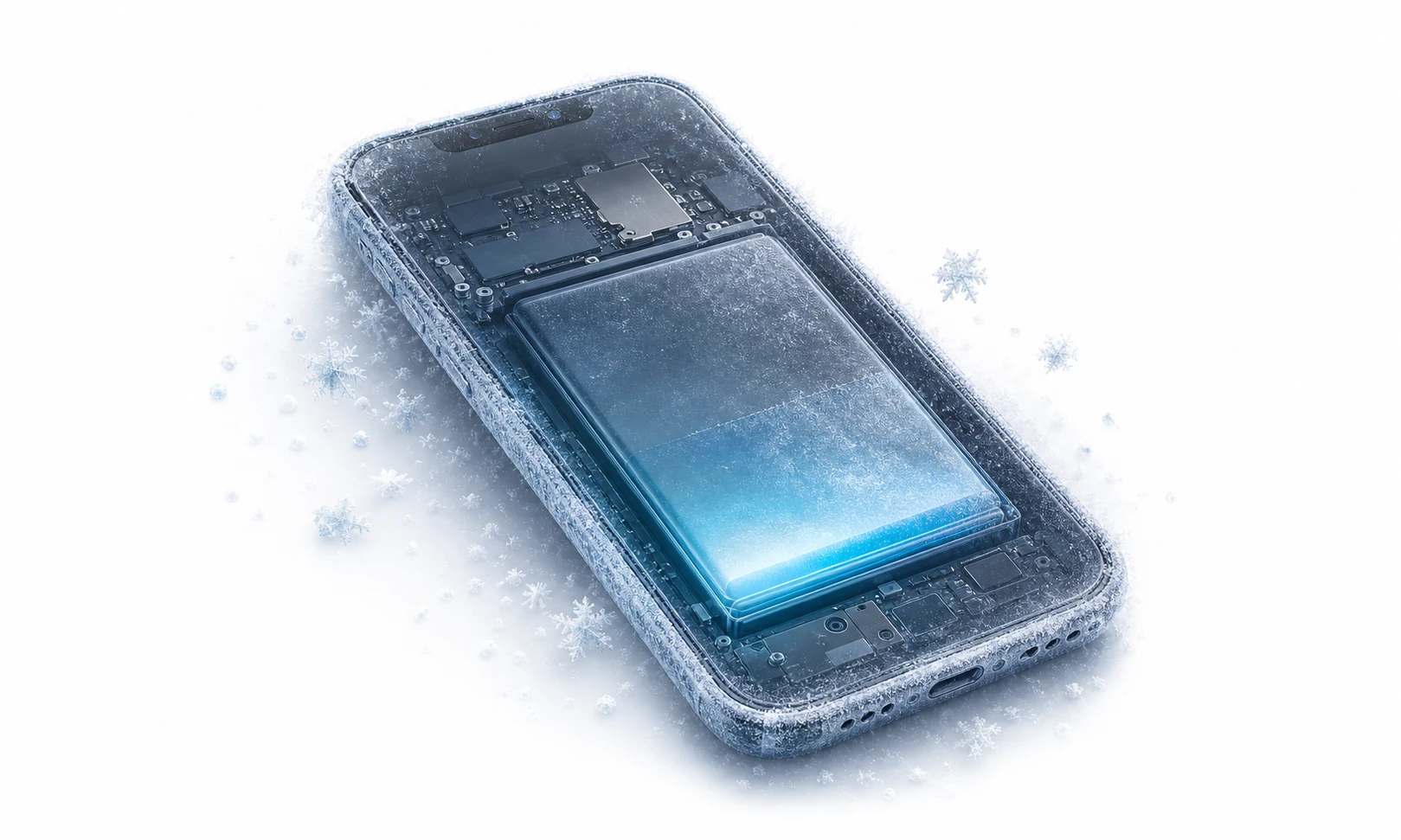
Your phone is not poorly made. It is simply cold, and cold batteries have a specific problem. Step outside on a cold morning and your phone battery, which showed 40 percent charge moments ago, suddenly reads 15 percent, then dies completely, then revives miraculously the moment you bring the phone back inside. The battery did not actually drain. It panicked, briefly, and then recovered. The cold was the cause of all of it. The answer involves lithium ions moving sluggishly through a gel electrolyte, a battery chemistry that is profoundly temperature-sensitive, and why your phone's battery percentage reading is sometimes entirely fictional in cold weather.
Quick answer
Phone batteries die faster in cold weather because lithium-ion batteries rely on ions moving through a liquid electrolyte to generate current, and cold temperatures slow that ion movement significantly, reducing the battery's ability to deliver power and causing the phone to underestimate or suddenly exhaust its charge. The charge reading on your phone in cold weather is sometimes simply wrong. The battery may have much more charge stored than it can currently deliver, and the percentage drops reflect delivery capacity rather than actual stored energy.
The mystery
The answer involves lithium ions moving sluggishly through a gel electrolyte, a battery chemistry that is profoundly temperature-sensitive, and why your phone's battery percentage reading is sometimes entirely fictional in cold weather.
The short answer
Phone batteries die faster in cold weather because lithium-ion batteries rely on ions moving through a liquid electrolyte to generate current, and cold temperatures slow that ion movement significantly, reducing the battery's ability to deliver power and causing the phone to underestimate or suddenly exhaust its charge.
The twist
The charge reading on your phone in cold weather is sometimes simply wrong. The battery may have much more charge stored than it can currently deliver, and the percentage drops reflect delivery capacity rather than actual stored energy.
Common mistake
Many people assume exposure to cold permanently reduces their phone's battery capacity.
Everyday Technology
Charging below freezing can cause lithium plating inside the battery, causing permanent damage - most phones disable fast charging in cold conditions automatically.
The chemist behind lithium-ion
An American physicist and Nobel laureate who developed key components of the lithium-ion battery in the 1980s at the University of Texas.
Related questions
Lithium-ion batteries perform best between about 15 and 25 degrees Celsius, with performance declining meaningfully below 0.
Where temperature-sensitive chemistry shows up elsewhere
Lead-acid car batteries experience similar cold-weather current delivery problems, which is why cars are harder to start on cold mornings.
Where temperature-sensitive chemistry shows up elsewhere
Photographers in cold climates routinely carry spare batteries and keep them warm inside jackets to maintain shooting capacity.
Does cold weather permanently damage phone batteries?
Brief exposure to cold affects performance temporarily but does not permanently damage lithium-ion batteries; only prolonged storage at very low temperatures or extreme cold can cause lasting harm.
Continue learning

Everyday Science
Another familiar question explained by simple physics.

Everyday Science
Another familiar question explained by simple physics.

Everyday Science
Another familiar question explained by simple physics.